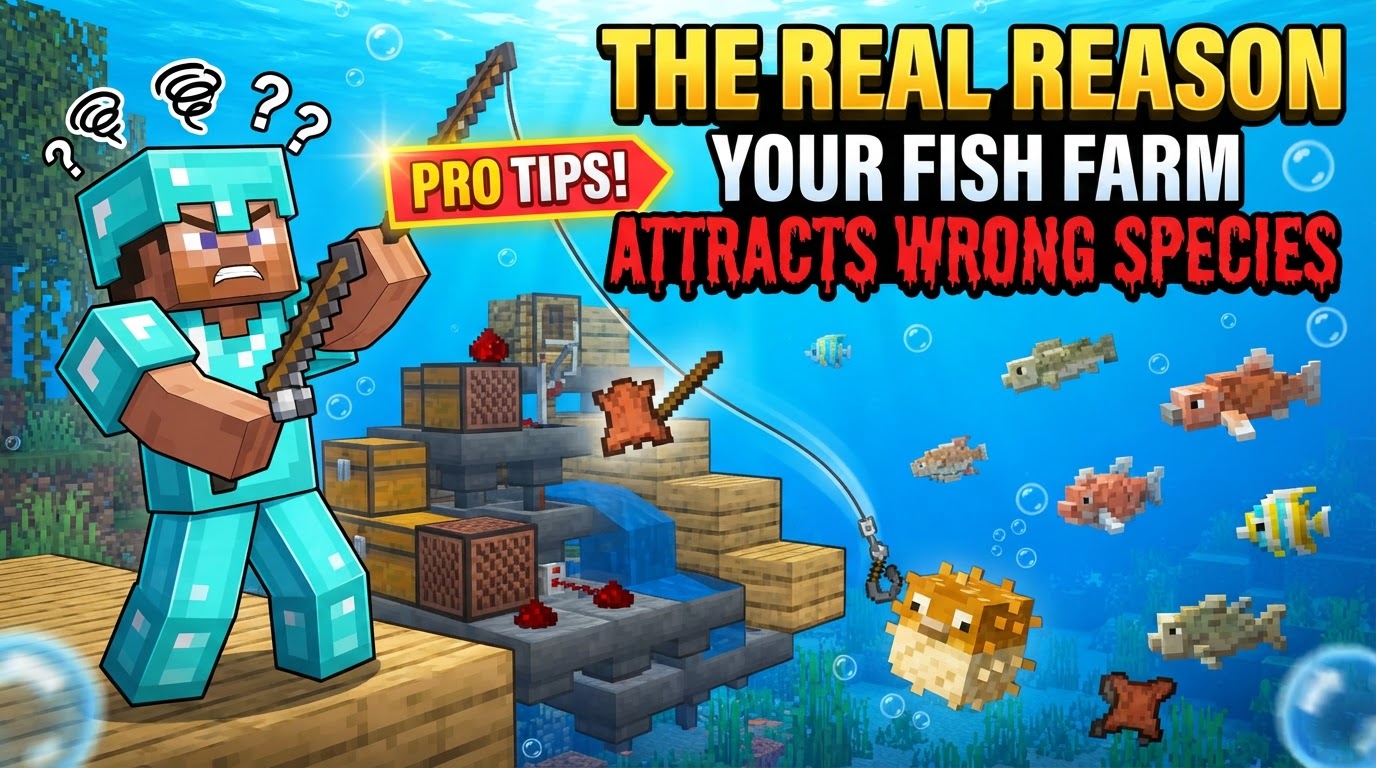
The Real Reason Your Fish Farm Attracts Wrong Species
The primary reason your Minecraft fish farm yields an abundance of unwanted items – what you might call “wrong species” – instead of valuable treasures, often boils down to one critical factor: you’re likely using an outdated farm design that doesn’t meet the specific water source requirements for treasure drops in Java Edition 1.16 and later versions. While older designs still catch fish and junk, the coveted enchanted books, nautilus shells, and name tags remain elusive without adhering to the updated mechanics.
Understanding Minecraft’s Fishing Loot Categories
To truly grasp why your farm might be underperforming, it’s essential to understand how Minecraft categorizes fishing loot. Every time you cast your line, the game rolls the dice across three distinct categories:
- Fish (85% Chance): This category includes your standard raw cod, salmon, pufferfish, and tropical fish. These are the most common catches and form the bulk of what most farms produce.
- Junk (10% Chance): As the name suggests, this category encompasses less desirable items like sticks, lily pads, water bottles, and bones. While some might have niche uses, they aren’t typically the target of an optimized farm.
- Treasure (5% Chance): This is where the magic happens. Treasure items include highly sought-after enchanted fishing rods, enchanted books, nautilus shells, saddles, and name tags. These rare drops are what make AFK fishing worthwhile for many players, providing valuable resources for progression.
The inherent distribution means that even under ideal conditions, treasure items are statistically rarer. However, the “wrong species” problem often arises when players inadvertently prevent the game from even considering the treasure category due to improper farm design.
The Game-Changing Mechanic: Open Water for Treasure (Java Edition 1.16+)
Prior to Java Edition 1.16, a simple 1×1 water source block was sufficient for all types of fishing loot, including treasure. This led to the proliferation of compact, highly efficient AFK fish farm designs that relied on minimal water. However, with the 1.16 update, Mojang introduced a significant change that directly impacts treasure acquisition:
To obtain valuable treasure items from fishing in Java Edition 1.16 and later, the water source must be considered “open.” This means the block where your fishing bobber lands needs to be surrounded by at least two blocks of water on all sides (North, South, East, West, Up, Down), and crucially, must have open sky directly above it.
This single change is the most common reason why modern Java Edition players find their old AFK fish farms only yielding fish and junk. The compact designs, often featuring a single water block enclosed by solid blocks on most sides, simply do not meet the “open water” criteria for treasure. Without this condition met, the game’s loot table effectively excludes the treasure category, leaving you with only the 85% fish and 10% junk chances.
How AFK Fish Farms Generally Operate
Regardless of version, AFK (Away From Keyboard) fish farms automate the tedious process of casting and reeling in a fishing rod. Most designs work by creating a mechanism that:
- Detects a fishing bobber’s splash (indicating a bite).
- Triggers a redstone pulse to “use” the fishing rod, reeling in the catch.
- Automatically recasts the line.
This automation allows players to gather resources, experience points (XP), and potentially valuable items while focusing on other tasks or even being away from their computer. Every successful catch grants a small amount of XP, making these farms a slow but steady source of experience. Rod durability is also consumed with each catch, emphasizing the need for enchanted rods.
A Look at a Common AFK Fish Farm Design (Pre-1.16 Java / Bedrock Style)
While often unsuitable for treasure in modern Java Edition, understanding a basic AFK farm design helps illustrate the mechanics that lead to the “wrong species” issue. This design is still effective for treasure in Bedrock Edition or for simply gathering fish and junk in Java Edition 1.16+:
- Dig a Trench: Start by digging a small trench, typically 3×1 or 4 blocks wide, to house your collection system.
- Place Collection System: Place two chests side-by-side to form a large chest. Connect a hopper to the chest, ensuring it funnels items into it.
- Water Source and Fence: Place a fence block directly on top of the hopper. Pour a bucket of water onto the fence. The water will log the fence and flow into the adjacent block, creating your fishing spot.
- Pressure Plate and Note Block: Place an iron pressure plate on the fence. Position a note block on the ground next to the water-filled trench, in line with your fishing area.
- Trapdoor Setup: Place a temporary block on top of the note block. Then, position an iron trapdoor above the water-filled trench, attached to the temporary block. Remove the temporary block.
- Usage: Stand on the chests, aim your fishing rod at the trapdoor, and hold down the right-click button. The trapdoor will open, and your character will automatically fish. Caught items will drop into the hopper and then into the chests.
This classic design, while clever, typically encloses the water block on multiple sides, failing the “open water” and “open sky” requirements for treasure in Java Edition 1.16+.
Optimizing Your Catch: Essential Tips for Better Results
To maximize your chances of getting valuable items and to ensure your farm runs smoothly, consider these tips:
- Enchantments are King:
- Luck of the Sea: This enchantment significantly increases your chances of catching treasure items and decreases the chances of catching junk. It’s crucial for treasure hunting.
- Lure: Reduces the wait time for a bite, making your farm more efficient.
- Unbreaking: Extends the durability of your fishing rod, allowing it to last much longer.
- Mending: Repairs your rod using collected experience points, making it virtually indestructible if you’re gaining XP.
- Strategic Location: Building your farm near a large body of open water in a biome where it rains frequently (like a river in a jungle or forest) can be beneficial, as rain increases fishing speed.
- Adequate Lighting: Ensure the area around your farm is well-lit with torches or other light sources to prevent hostile mob spawns, both in the water and on the surrounding ground.
- True AFK Methods: For PC users, holding down right-click and unplugging your mouse or using an auto-clicker works. Console users might need specific controller setups or auto-fire features to maintain the action.
- Regular Chest Maintenance: Monitor and empty your collection chests periodically. If they fill up, items will despawn or be lost, halting your collection efforts.
Common Mistakes Leading to “Wrong Species” and Farm Failure
Beyond the primary Java 1.16+ treasure mechanic, several other issues can cause your fish farm to underperform or fail entirely:
- Outdated Designs for Treasure (Java Edition): This cannot be stressed enough. If you’re playing Java Edition 1.16 or newer and using an old, compact AFK farm design, you will primarily yield only fish and junk. These designs simply don’t meet the “open water” and “open sky” requirements for treasure loot. You need a design that provides a 5×5 (or larger) open water area with sky access above the bobber.
- Incorrect Block Placement: Even a slight misplacement of a hopper, pressure plate, or water block can disrupt the farm’s functionality. Double-check all block orientations and connections.
- Forgetting to “Turn On” the Farm: Ensure any redstone mechanisms are powered, pressure plates are correctly activated, or your right-click input is consistently registered to automate the fishing process.
- Not Enough AFK Time: Accumulating significant loot, especially rare treasure items, requires patience. You often need to AFK for several hours to see substantial results.
- Tick Lag (Multiplayer Servers): On servers, tick lag can sometimes interfere with redstone timing, causing automated farms to malfunction. Adjusting repeater delays can sometimes help mitigate this.
- Not Using Source Blocks: For a consistent water source within the farm’s design (especially for complex builds), ensure all water blocks are source blocks (created from an infinite water source) rather than flowing water.
In essence, if your Minecraft fish farm isn’t delivering the treasure you expect, the real reason is likely a mismatch between your farm’s design and the game’s evolving mechanics, particularly the “open water” requirement introduced in Java Edition 1.16. Adapt your build, enchant your rod, and you’ll soon be reeling in those coveted treasures.
Tags:
YOU MAY ALSO LIKE...