

The Science of Piston Extension Order Calculation
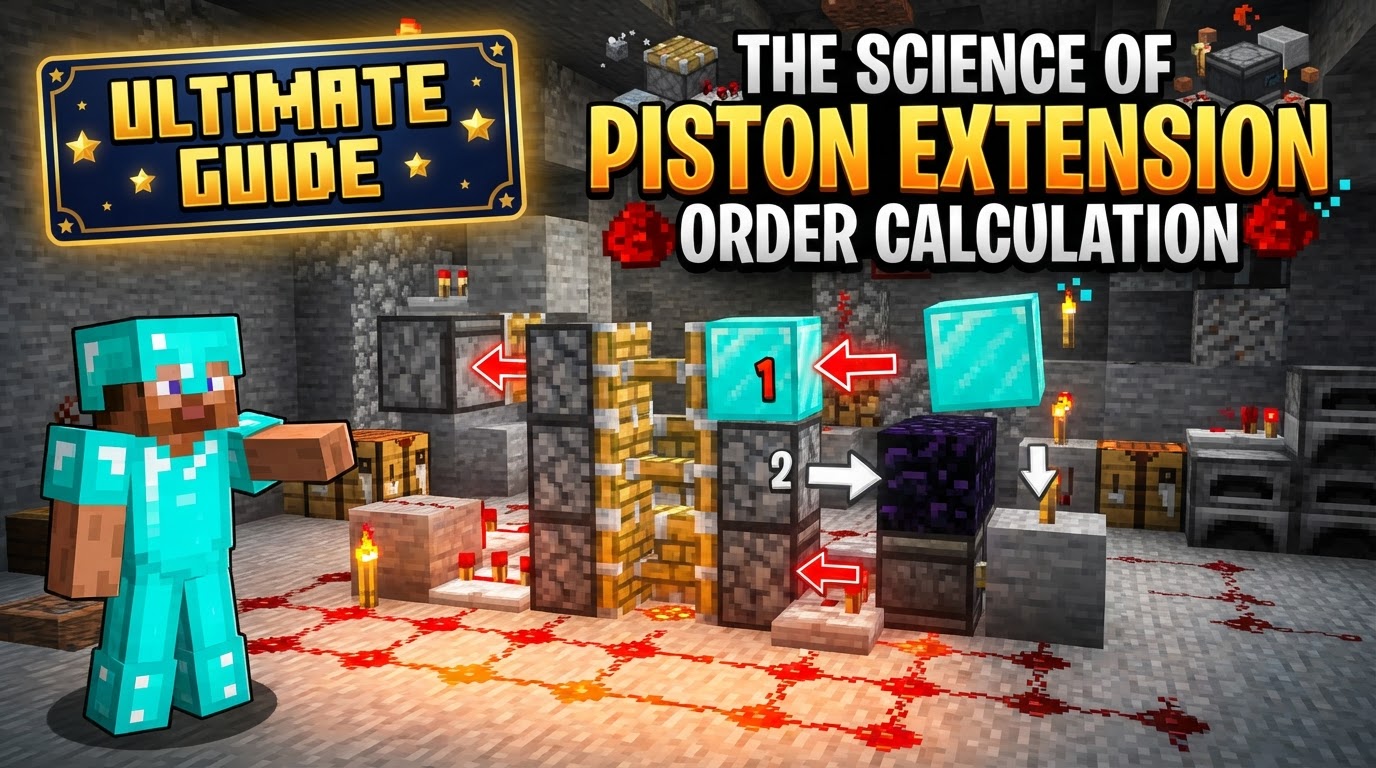
Many veteran Minecraft players, even those with intricate Redstone contraptions, often overlook a fundamental truth: pistons don’t always extend in the order you expect them to. The seemingly simple act of a piston pushing a block is, in fact, governed by a complex, internal set of rules and an often-misunderstood update order. Understanding this “science” is paramount for crafting reliable and efficient Redstone machinery, especially when dealing with complex contraptions like flying machines or multi-stage doors. Without this knowledge, even the most meticulously planned builds can fail unpredictably, leaving builders frustrated.
Fundamental Principles of Piston Operation
At its core, a piston’s function is straightforward: extend when powered, retract when unpowered. However, several critical mechanics dictate its capabilities and limitations:
- Extension and Retraction Logic: Pistons extend when they receive a Redstone signal and retract when that signal is removed. Sticky pistons add a layer of complexity by pulling back the block they just pushed upon retraction, making them indispensable for many mechanisms.
- The Push Limit: A crucial constraint in Java Edition is that a piston can push a maximum of 12 blocks. Exceeding this limit will cause the piston to fail its extension, remaining in its retracted state and effectively doing nothing. This is a common pitfall for new and experienced builders alike.
- Immovable Obstacles: Certain blocks are inherently unpushable. Blocks like obsidian, bedrock, command blocks, and even other extended pistons cannot be moved. If a piston attempts to push one of these blocks, it will simply fail to extend, regardless of the push limit.
- Movement of Pistons by Pistons: For a piston to be successfully moved by another piston (a common technique in flying machines), it absolutely must be in its retracted state. An extended piston acts as an immovable block and will be left behind if another piston attempts to push it. This distinction is vital for designing any moving Redstone contraption.
The Game’s Internal Clock: How Pistons Get Their Orders
The true “science” of piston extension order lies in Minecraft’s internal update mechanisms. When a piston is powered, it doesn’t instantly extend. Instead, it schedules a “block event” to perform this action. These block events are not all executed simultaneously; they follow a specific processing order:
- Block Updates and Event Scheduling: When a block changes state (e.g., a Redstone wire turns on), it can trigger updates in neighboring blocks. When a piston receives power, it creates a “block event” to extend. These events are queued and executed in the order they were generated within a game tick.
- Update Order Priority: Minecraft processes various types of updates in a defined hierarchy during each game tick. Block updates, which include piston extension events, are handled first. These are followed by shape updates (for things like Redstone dust connectivity) and then tile tick updates (for blocks like furnaces or dispensers). Understanding this hierarchy helps clarify why some actions appear to happen “before” others.
- Quasi-Connectivity (Java Edition Specific): A unique feature of Java Edition, quasi-connectivity allows pistons (and dispensers/droppers) to be “quasi-powered” by a powered block located two spaces directly above them. The piston won’t extend immediately upon quasi-powering; it requires a subsequent “block update” in its immediate vicinity to trigger the extension. This allows for compact and clever Redstone designs but also introduces an additional layer of complexity to update order.
- General Block Update Order: Outside of specific slime block mechanics, general block updates often follow a coordinate-based order. Typically, the game processes blocks from negative X to positive X, then negative Z to positive Z, and finally negative Y to positive Y. While not always strictly followed for all block events, this general directionality can influence the order in which adjacent pistons are updated and extend.
Slime Block Dynamics: Order in Motion
Slime blocks introduce their own set of rules, particularly when they form large, connected structures that pistons need to push. The game employs a specific logic to determine the order in which these structures are moved:
- Structure Segmentation: When a piston pushes a slime block structure, the game first separates the entire connected structure into conceptual “lines” that run perpendicular to the direction of movement.
- Distance-Based Processing: Generally, the lines of the slime block structure that are further away from the piston attempting to push them are processed and moved first. This counter-intuitive behavior is critical for designing complex moving contraptions.
- Directional Nuances: If multiple lines of a slime block structure are at the same distance from the pushing piston, their exact processing order can become more complex. This order can be subtly influenced by the specific direction of movement (e.g., North, South, East, West) and the precise shape of the slime block configuration.
- Internal Line Order: Within each of these segmented lines, the blocks that are further ahead in the direction of the piston’s movement are processed earlier. This ensures the entire “line” moves coherently.
- Retraction Reversal: When a piston retracts a slime block structure, the update order is typically reversed. Blocks closest to the piston are processed first, gradually pulling the structure back towards the piston. This ensures that the structure collapses correctly.
Precision and Practice: Controlling Piston Sequences
Given the complexities of update order, achieving predictable piston behavior often requires deliberate design choices and careful testing:
- Precise Timing with Repeaters: Redstone repeaters are your best friend for controlling the sequence of piston activations. By introducing specific delays, you can ensure that pistons extend or retract in the exact order required for your contraption to function. This is indispensable for mechanisms like double piston extenders, where one piston must push, then another, then retract in a specific sequence.
- Empirical Testing: The Ultimate Arbiter: For highly intricate slime block contraptions or situations where the update order is ambiguous, there is no substitute for empirical testing. Build a small-scale replica of the problematic section in a creative world. Replace critical Redstone components or blocks with Redstone blocks to visually observe the activation order. This hands-on approach often reveals subtle interactions that theoretical understanding alone might miss.
- Understanding Powering Mechanisms: Pistons can be powered in several ways: directly by a Redstone component, by a Redstone component adjacent to the block they are attached to, or indirectly by a powered block adjacent to them. In Java Edition, quasi-connectivity adds another layer. Knowing how each method transmits power and triggers block updates is fundamental to predicting their behavior.
Navigating the Redstone Minefield: Common Piston Missteps
Even experienced builders can fall prey to common errors related to piston mechanics:
- Ignoring Update Order: A frequent mistake is assuming that all pistons powered in the same game tick will extend simultaneously or in an intuitively predictable order. As detailed above, the game’s internal update mechanisms dictate a precise, often non-obvious, sequence.
- Bedrock Edition Inconsistencies: Builders often port Java Edition designs to Bedrock Edition without realizing the differences. Bedrock Edition generally has a less predictable or even “random” update order compared to Java. This means many Java-specific timing-dependent designs will fail or behave erratically in Bedrock and require different approaches.
- Overcomplicating Designs: Especially when it comes to flying machines or other dynamic Redstone, overly complex builds can introduce instability. More moving parts mean more opportunities for update order conflicts, leading to lag and unreliability. Simpler designs are often more robust.
- Exceeding the Push Limit: Attempting to push more than 12 blocks with a single piston is a guaranteed failure. Always count the blocks in your pushable structure to avoid this basic but critical error.
- Moving Extended Pistons: Trying to push an extended piston with another piston will result in the extended piston being left behind, acting as an immovable block. Ensure all pistons intended for movement are in their retracted state.
Mastering the science of piston extension order is not about memorizing every single update permutation, but rather understanding the underlying principles and knowing when to apply specific techniques like repeaters or empirical testing. With this knowledge, you can transform unpredictable Redstone contraptions into reliably functioning marvels.
Tags:
YOU MAY ALSO LIKE...


