How to Build Bases Invisible to Flying Players
One of the most persistent myths in Minecraft is that simply building a base at the very top of the world makes it invisible. While height certainly helps, a determined flying player with a basic understanding of the F3 debug screen can still pinpoint your “hidden” sky-high fortress. True invisibility to flying players requires a far more nuanced approach, blending clever game mechanics with strategic camouflage and location to make your sanctuary virtually undetectable from above.
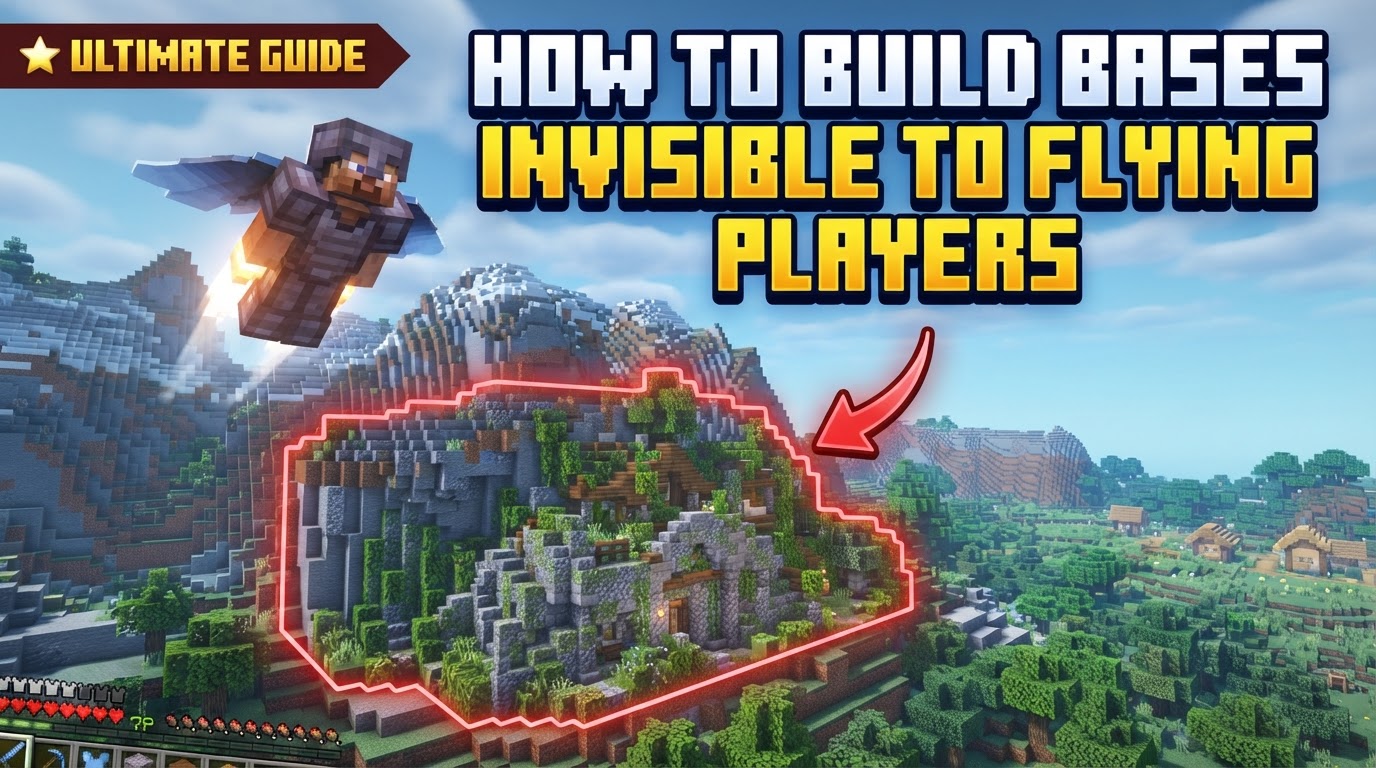
The Foundations of Concealment: Understanding Game Mechanics
Achieving true stealth in Minecraft isn’t about magic; it’s about exploiting the game’s core systems. A few key mechanics dictate what players can and cannot see, especially when flying:
- Render Distance Limitations: Minecraft optimizes performance by not rendering every block or entity at infinite distances. Crucially, smaller entities like chests and shulker boxes become invisible to a player at approximately 64 blocks away. Larger, moving entities disappear at around 100 blocks. This mechanic is paramount for high-altitude bases.
- The Build Limit (Y-320): The maximum build height provides a vast vertical canvas for construction. Building at extreme altitudes, such as above Y-250 and approaching the Y-320 limit, places your base far above common observation points and general flight paths.
- Natural Blending: The game’s world generation creates diverse terrains. Blocks that perfectly match the surrounding environment allow structures to merge seamlessly, making them visually indistinguishable from natural formations.
- The F3 Debug Screen’s Heightmap: This often-overlooked tool displays detailed information, including a heightmap that reveals the highest block at any given coordinate. This means a purely high-altitude sky base, even one made of shulker boxes, isn’t truly “unfindable” if an opponent actively uses this debug feature to scan for anomalies.
- Chunk Loading and Advanced Detection: While beyond vanilla gameplay, it’s important to acknowledge that advanced client-side modifications, such as Distant Horizons, can extend a player’s render distance beyond typical limits, potentially exposing bases built far away. Your goal is to deter the average, flying player, not necessarily a hyper-optimized hacker.
Strategic Placement: Where to Build Your Sanctuary
The first step to an invisible base is choosing the right location. Placement is as critical as the design itself.
- Remote Wilderness: Your base should be as far as possible from known player activity. Avoid areas near spawn points, major server roads, or prominent landmarks that players frequently visit or use for navigation. The further you are from common routes, the less likely you are to be accidentally stumbled upon.
- Unremarkable Biomes: Seek out biomes that offer little in terms of unique resources or visual appeal, as these are less likely to be extensively explored. Large, monotonous plains, deep oceans, or expansive deserts can be excellent choices for blending in.
- Vertical Extremes: Whether you go high or deep, extremes offer natural protection. High Y-levels for sky bases and deep underground for subterranean fortresses both minimize casual observation.
Mastering Concealment Techniques: Sky vs. Ground
Once you’ve chosen your location, the method of concealment depends on whether you opt for a sky-high haven or a grounded fortress.
The Sky-High Mirage: Leveraging Render Distance
Building high in the sky is a classic technique, but it can be significantly enhanced:
- Above the Clouds, Near the Limit: Construct your primary base structure at very high Y-levels, ideally above Y-250 and pushing towards the Y-320 build limit. This places it far above most player flight paths.
- The Shulker Box Advantage: This is a game-changer for sky bases. By constructing the exterior walls and non-essential interior elements of your base from shulker boxes, you leverage their unique render distance property. At distances greater than approximately 64 blocks, these boxes simply cease to render, making your entire structure effectively invisible to a flying player passing by. This creates a “ghost” base that only materializes when a player is very close.
- Elytra for Discreet Access: For sky bases, elytra are essential for entry and exit. They allow for rapid, vertical movement without leaving visible trails or requiring a large, obvious entrance structure.
- Acknowledging the F3 Heightmap: While shulker boxes make your base visually disappear, remember the F3 debug screen’s heightmap. A savvy player can still use this to detect the highest block in a chunk. To counteract this, consider building your shulker-box structure on top of a single, naturally generated peak that already reaches a high Y-level, or integrate it into a pre-existing cloud layer if possible, making the heightmap anomaly less suspicious.
The Earth-Bound Enigma: Seamless Blending
For those who prefer to stay grounded, camouflage is your best friend:
- Perfect Terrain Mimicry: Design the exterior of your base to precisely match the surrounding natural terrain. This means using the exact same block types, colors, and even natural erosion patterns.
- Mountain Integration: Carve your base into a mountain, making the entrance a natural-looking cave or a subtle rock face.
- Giant Tree Disguise: Hollow out a massive tree or construct a base within its canopy, using leaves and wood to blend in.
- Ocean Floor Concealment: Build deep underwater, using sand, gravel, and sea lanterns to match the ocean floor. Kelp can provide excellent visual obstruction for entrances.
- Nether Lava Oceans: The Nether offers unique opportunities. Building underneath large lava oceans provides natural concealment, as the glowing liquid obscures vision and deters easy access.
- Deep Underground Fortresses: Bury your base far beneath the surface. The deeper you go, the less likely you are to be detected by surface scanners or random digging.
- Natural Integration: The key here is to make your base appear as if it’s always been a part of the landscape, rather than an addition to it. Any unnatural block placement or visible patterns will draw attention.
The Art of Hidden Entrances
Even the most camouflaged base is compromised by an obvious entrance. Redstone ingenuity is paramount here.
- Redstone Piston Doors: Master simple redstone circuits to create piston doors that blend seamlessly with the environment when closed. These can be activated by hidden levers, pressure plates disguised as natural blocks, or even specific item frames.
- Disguised Entry Points:
- Tree Trunks: A specific log in a forest could be a button or a pressure plate that reveals a hidden staircase.
- Underwater Passages: Conceal entrances with kelp, sea grass, or carefully placed blocks that require specific breaking or manipulation to reveal.
- Subtle Rock Formations: A seemingly ordinary rock face might hide a switch or a block that retracts into a passageway.
- Multiple Escape Routes: For underground bases, incorporating several concealed exits is crucial. These shouldn’t just be for escape; they can also be used as alternative entry points, making your base harder to track.
Common Pitfalls to Avoid
Even experienced players can make mistakes that compromise their hidden bases.
- Building in Obvious Locations: Placing your base near common travel routes, major resource veins, or prominent landmarks is an open invitation for discovery.
- Ignoring the F3 Heightmap: Relying solely on building high for sky bases is insufficient. A player actively using the F3 debug screen can still detect the highest block in a chunk, revealing your presence. True sky invisibility requires the shulker box trick or extreme blending with existing high terrain.
- Poor Camouflage Execution: Any unnatural block placement, visible patterns that don’t match the surrounding environment, or visible light sources from within an otherwise dark exterior will immediately draw attention from a flying player.
- Predictable Entrances: Using simple, easily identifiable entrances like a visible button or a clearly distinct block in a wall negates all the effort put into hiding the base.
- Underestimating Opponents: Always assume that other players might employ advanced detection methods. This includes knowledge of game mechanics, diligent use of F3 data, or even specific client-side modifications that extend visual range. Build with the assumption that someone is actively looking for you.
Building a base truly invisible to flying players in Minecraft is a challenging but rewarding endeavor. It requires a combination of strategic location, a deep understanding of game mechanics, and meticulous attention to detail in camouflage and access. While no base is 100% immune to discovery by the most determined and technologically equipped opponents, these techniques will significantly increase the difficulty of detection, allowing you to enjoy your hidden sanctuary in peace.
Tags:
YOU MAY ALSO LIKE...