

How Armor Durability Repair Works at Scale
Many experienced Minecraft players have faced the frustration of a powerful, enchanted diamond chestplate becoming “Too Expensive!” to repair, effectively rendering a prized item useless. This common mistake highlights a crucial aspect of long-term survival and efficiency in Minecraft: understanding how armor durability repair works, especially at scale. While basic methods exist, truly mastering armor maintenance for an entire arsenal of gear, across countless hours of gameplay, hinges on a few core mechanics and strategic planning.
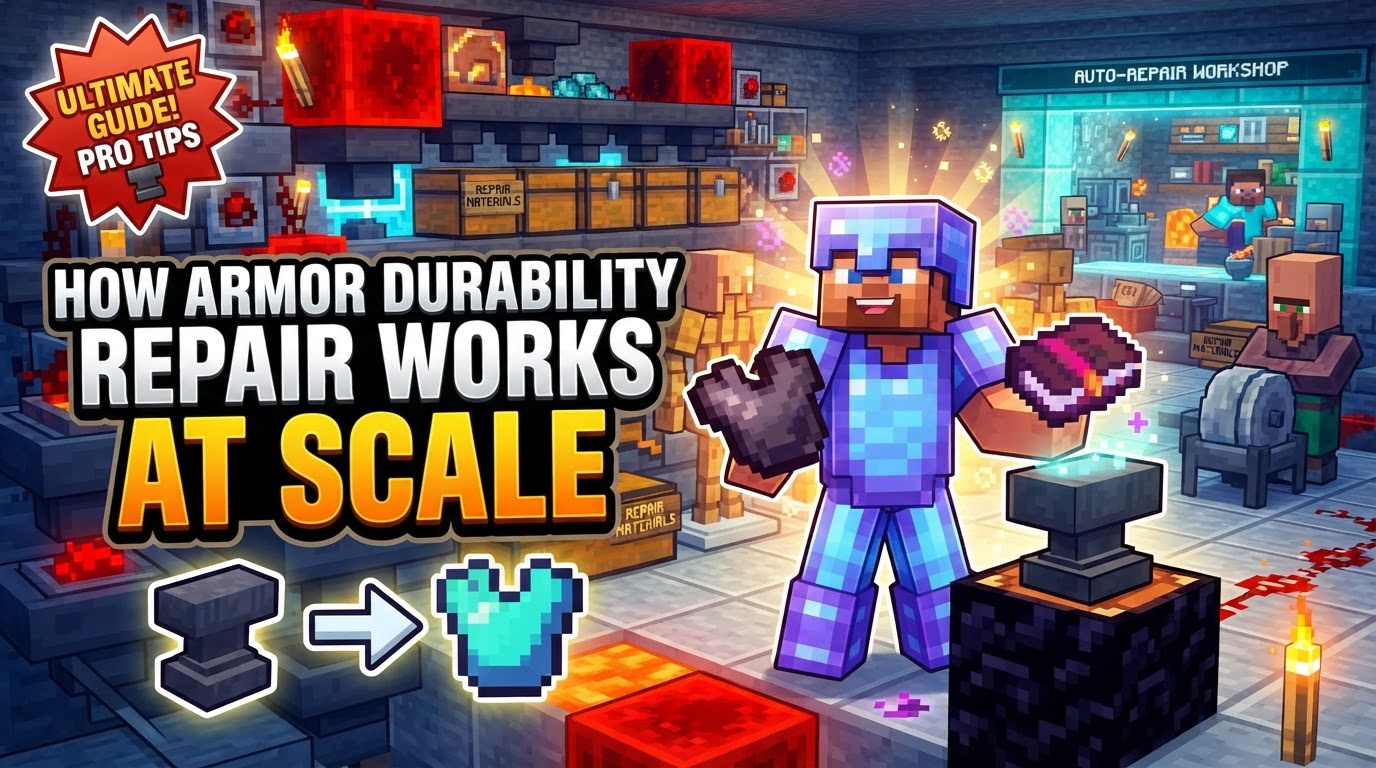
The durability of your armor is a finite resource, dwindling with every hit taken and every block mined while equipped. Maintaining this durability efficiently is not just about keeping your gear intact; it’s about preserving valuable enchantments and avoiding the constant grind of crafting new high-tier items. This guide delves into the various repair mechanisms available in Minecraft, emphasizing the methods that allow for sustainable, large-scale armor upkeep.
Understanding Core Durability Mechanics
Before diving into repair, it’s essential to grasp the fundamental concept of durability. Every piece of armor possesses a durability bar, which visually transitions from green to red as the item takes damage and wears down. When this bar empties, the item breaks and is lost. Preventing this requires proactive repair, and Minecraft offers several distinct methods, each with its own advantages and limitations.
- Durability Basics: Armor durability decreases with use. When it reaches zero, the item is destroyed. The goal of repair is to restore this durability before that happens.
- Mending Enchantment: The Unrivaled Solution for Scale
The Mending enchantment stands out as the most efficient and scalable method for long-term armor maintenance. Instead of contributing to the player’s experience bar, experience orbs collected by the player are automatically consumed to repair Mending-enchanted items. This happens at a rate of one experience point restoring two durability points. If you have multiple damaged Mending items equipped or in your main hand/off-hand, the game randomly selects one item per XP orb to repair. Crucially, Mending stops repairing an item once it reaches full durability, allowing any remaining experience to then go towards the player’s experience bar. This mechanism makes Mending an infinitely sustainable repair method without increasing costs. - Anvil Repair: Strategic, Not Sustainable
Anvils allow players to repair enchanted items without removing their enchantments. This process involves combining two identical armor pieces or using raw materials (e.g., diamonds for diamond armor). While useful for preserving enchantments, anvil repairs incur an experience cost that increases with each subsequent repair of the same item, known as the “Prior Work Penalty.” Eventually, an item becomes “Too Expensive!” to repair on an anvil, rendering this method impractical for frequent, large-scale maintenance. - Grindstone Repair: Salvage and Simplicity
Grindstones are primarily used for repairing non-enchanted items by combining two identical pieces. A significant feature of the grindstone is its ability to remove all enchantments (except curses) from an item, providing a small amount of experience in return. When repairing, the grindstone combines the durability of the two items and adds a 5% bonus of the item’s maximum durability. This makes it useful for cleaning up looted armor or combining basic damaged pieces. - Crafting Grid Repair: Basic and Destructive
Similar to the grindstone for non-enchanted items, combining two identical items in a crafting grid will repair them. However, this method does not offer the experience bonus of a grindstone, and critically, it removes all enchantments from the repaired item. Consequently, it’s generally only useful for basic, non-enchanted gear.
The Scalable Solution: Mending in Practice
For any serious Minecraft player aiming for long-term survival and efficiency, Mending is not just an option; it’s a necessity. Here’s the step-by-step process for implementing Mending on a large scale:
- Obtain the Mending Enchantment: The most reliable way to acquire Mending books is through trading with Librarian villagers. By repeatedly breaking and replacing a lectern, you can reset a Librarian’s trades until Mending appears as an option. Mending books can also be found in treasure chests or acquired through fishing, though these methods are less consistent.
- Apply Mending to Your Armor: Once you have a Mending enchantment book, use an anvil to combine it with your desired armor piece. This will apply the enchantment, allowing the item to automatically repair itself.
- Generate Experience (XP): With Mending applied, the next step is to generate a consistent stream of experience orbs. Activities like mining, fighting mobs (especially in mob farms), smelting large quantities of items, and farming are all excellent sources of XP.
- Automatic Repair: As you collect these experience orbs while wearing or holding your damaged Mending-enchanted armor, the items will automatically consume the XP to repair themselves. This process is seamless and requires no further player intervention once set up.
Strategies for Large-Scale Armor Maintenance
Implementing Mending effectively for all your valuable gear requires strategic planning and infrastructure within your Minecraft world.
- Prioritize Mending on All Valuable Gear: Any armor piece you intend to keep long-term, especially those with powerful enchantments, should have Mending applied. This ensures indefinite repair without escalating costs, making your gear virtually indestructible in the long run.
- Establish Efficient XP Farms: To feed your Mending enchantments, a reliable and high-volume source of experience is crucial. This could be a mob grinder (e.g., zombie, skeleton, Enderman farm), a large-scale smelting array for items like cactus or kelp, or even a gold farm in the Nether. The more XP you generate, the faster and more effortlessly your armor will repair.
- Develop Villager Trading Halls: A dedicated villager trading hall with multiple Librarian villagers is invaluable for consistently obtaining Mending books for all your new gear or for replacing lost items. This also provides access to other powerful enchantments.
- Strategic Anvil Use: Reserve anvil repairs exclusively for initial enchanting, merging enchantments, or combining high-level enchantments onto a single piece of armor. Avoid using anvils for routine durability repair, as the “Prior Work Penalty” will quickly make items “Too Expensive!”
- Utilize Grindstones for Salvage: Grindstones are excellent for clearing unwanted enchantments from looted armor, making it ready for new enchantments via an anvil. They can also be used to combine damaged non-enchanted pieces for a quick, low-cost repair, particularly useful in the early game or for basic tools.
Common Pitfalls to Avoid
Even with a grasp of the mechanics, certain mistakes can lead to unnecessary resource expenditure or the loss of valuable items.
- Excessive Anvil Repairs: The most common mistake is repeatedly repairing the same item on an anvil. This will quickly accumulate the “Prior Work Penalty,” leading to the dreaded “Too Expensive!” message and making the item irreparable by this method.
- Repairing Enchanted Items in Crafting Grid/Grindstone (if keeping enchantments): Using a crafting grid or a grindstone to repair an enchanted item will result in the loss of all enchantments (except curses for grindstones). Always use an anvil or Mending for enchanted gear.
- Wasting Resources on Low Durability Items: When combining items for repair, especially on an anvil or grindstone, be mindful of the total durability. Combining two items whose combined durability (plus any bonuses) exceeds 100% of the maximum durability for that item is inefficient and wastes resources.
- Neglecting Mending: Failing to apply Mending to high-value armor pieces will force you into constant and costly anvil repairs or the even more expensive process of crafting entirely new enchanted gear. Mending is the cornerstone of sustainable armor maintenance.
Mastering armor repair at scale in Minecraft is fundamentally about embracing the Mending enchantment. By establishing robust XP farms and reliable sources of Mending books, you can transform armor maintenance from a tedious, resource-intensive chore into an automatic, background process, allowing you to focus on exploration, building, and combat without worrying about your gear breaking.
Tags:
YOU MAY ALSO LIKE...


