A Deep Dive Into Redstone Torch Burnout Prevention
Did you know a Minecraft redstone torch can only be toggled eight times within a mere three seconds (60 game ticks) before it rebels? This often-overlooked mechanic, known as redstone torch burnout, is a common source of frustration and circuit failure for even experienced builders. Understanding and actively preventing burnout is not just a best practice; it’s fundamental to constructing reliable and efficient redstone contraptions.
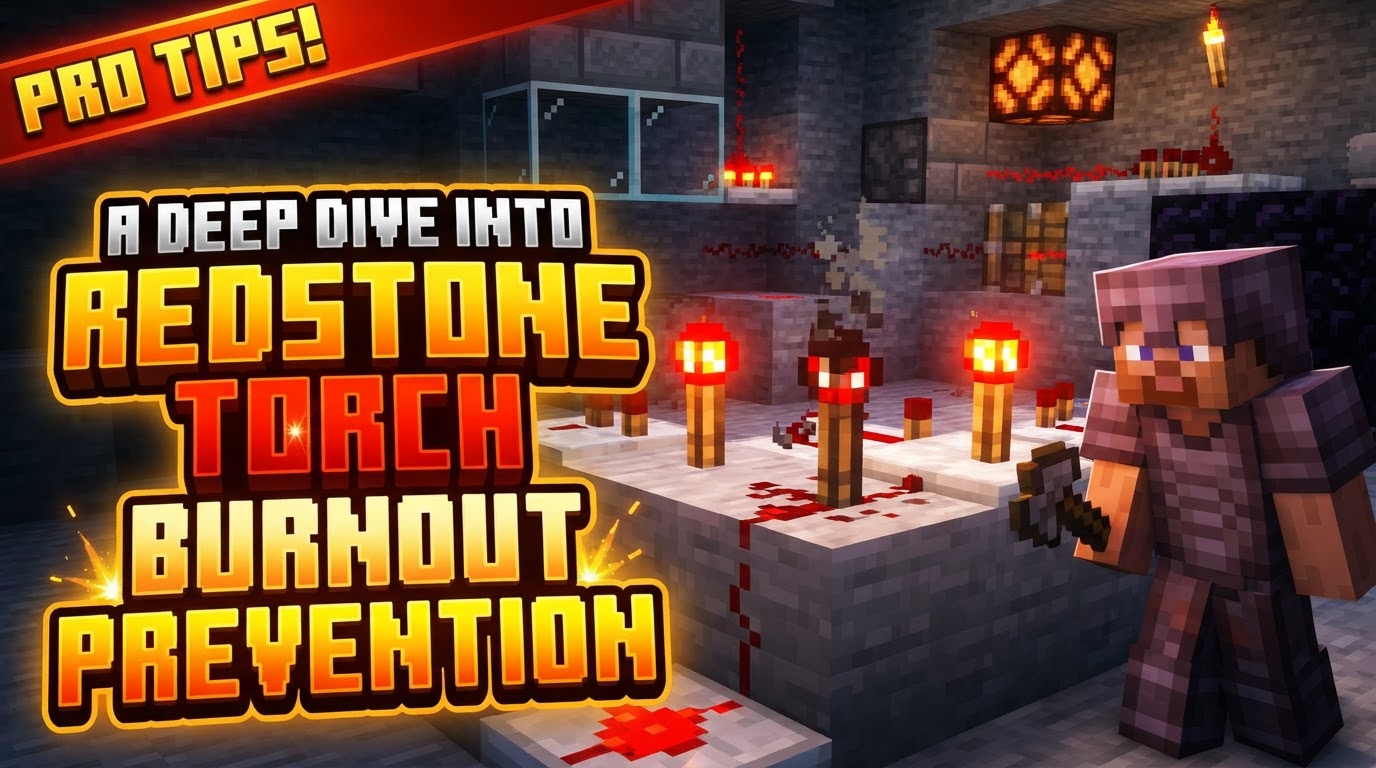
A redstone torch, while seemingly simple, is a dynamic component. It acts as a constant power source, but its state can be inverted by powering the block it’s attached to. When this on-off cycling occurs too rapidly, the torch enters a temporary state of “burnout,” ceasing to function until the conditions for its activation are met again. This guide will delve into the intricacies of redstone torch burnout, offering comprehensive strategies and insights to keep your circuits running smoothly and predictably.
Understanding the “Hiss”: The Core Mechanics of Redstone Torch Burnout
At its heart, a redstone torch is designed to be a reliable power source, outputting a redstone signal to adjacent components. However, its stability is contingent on the rate at which its power state is forced to change. Burnout is triggered when a redstone torch is compelled to alternate between powering and de-powering the block it is attached to more than eight times within a 60-game-tick window, which translates to exactly three seconds of real-time gameplay (assuming no server lag).
When a torch burns out, it provides clear visual and auditory cues: a puff of smoke particles will emanate from the torch, accompanied by a distinct “hissing” sound. Crucially, the torch then deactivates, turning off and temporarily becoming unresponsive to any further state changes. It will remain in this burnt-out state until two conditions are met: first, the rate of state changes must fall below the critical burnout threshold; and second, it must receive a block or redstone update that would typically cause it to turn on. This update effectively “resets” the torch, allowing it to function normally again. It’s important to note that there is no inherent limit to how many times a single redstone torch can burn out over its lifetime; the mechanic is purely a rate limiter. Furthermore, redstone torches can also detect block updates, much like an observer. Rapid or continuous block updates around a torch can contribute to its burnout, even if the updates aren’t directly toggling its power state.
Strategic Delay: The Cornerstone of Prevention
The most direct and effective method for preventing redstone torch burnout is to introduce sufficient delay into your circuits. By ensuring that the torch is not forced to toggle its state too frequently, you can keep it well below the critical 8-toggle-per-3-second threshold.
- Tailoring Delay for Edition: The required delay can vary significantly between Minecraft editions.
- For Bedrock Edition players, a relatively minimal delay is often sufficient. A single redstone repeater or comparator, even set to its lowest delay, can frequently provide enough breathing room to prevent burnout in many clock designs.
- In Java Edition, the requirements are typically more stringent. Clocks designed for Java often demand a significantly longer delay to avoid burnout. Even seemingly slow clocks can induce burnout if the cumulative delay is inadequate. This often necessitates more repeaters or higher delay settings.
- Optimizing Repeater Clocks: When constructing clocks using redstone repeaters, careful attention to delay settings is paramount. For instance, a common design is a 4-repeater clock. To prevent burnout in such a configuration, each of the four repeaters must be set to at least two ticks of delay. This ensures a total of eight ticks of delay between pulses (2 ticks/repeater * 4 repeaters = 8 ticks total), providing enough time for the torch to reset without burning out. Always calculate the total delay in your clock to ensure it exceeds the required minimum for stable operation.
Beyond Delay: Advanced Prevention Techniques and Best Practices
While introducing delay is the primary defense, a holistic approach to circuit design can further safeguard against burnout and enhance overall reliability.
- Thoughtful Circuit Redesign: If a redstone torch in your current design is consistently burning out, it’s a strong indicator that the circuit’s logic needs re-evaluation. Consider if there’s an alternative way to achieve the desired outcome that doesn’t rely on such rapid toggling of a single torch. Sometimes, distributing the load across multiple torches or using different components entirely can resolve the issue.
- Leveraging Repeaters for Precision: Redstone repeaters are invaluable tools for precisely controlling signal delays. They not only extend signal strength but also allow you to fine-tune the timing of your redstone pulses. By strategically placing repeaters and adjusting their delay settings, you can ensure that signals arrive at torches at a controlled pace, preventing the rapid cycling that leads to burnout.
- Harnessing Comparators for Stable Clocks: For certain applications, particularly stable and efficient clocks, redstone comparators can be a superior alternative to torch-based designs. Comparators can create reliable clock circuits without relying on the rapid toggling of torches, thereby eliminating the risk of burnout entirely. They often produce less redstone “noise” and can be more compact.
- Understanding Block Updates for Reactivation: A burnt-out torch will reactivate once its state changes fall below the threshold and it receives a block or redstone update. This knowledge can be useful in specific scenarios. For example, simply activating a piston near a burnt-out torch, even if it doesn’t move a block, can provide the necessary block update to reactivate it. Generally, any adjacent block update can serve this purpose, allowing for manual or automated resets if a burnout does occur.
- Meticulous Placement and Timing Verification: Many burnout issues stem from simple oversights. Always double-check the placement of your redstone components and meticulously verify the timing of your signals. An incorrectly placed redstone dust or a repeater set to the wrong delay can inadvertently create rapid toggling conditions for a torch. Taking the time for a thorough review can save hours of troubleshooting later.
Deconstructing Failure: Common Pitfalls Leading to Burnout
Understanding the causes of burnout is just as important as knowing the solutions. Many common redstone mistakes directly lead to torches burning out, often without the builder immediately realizing why.
- Unintended Infinite Feedback Loops: One of the most frequent culprits is the accidental creation of self-powering loops. These occur when a redstone signal, perhaps from a torch, inadvertently feeds back into itself or a nearby component in a way that causes the torch to rapidly turn itself on and off. These loops can be subtle and difficult to spot, but they invariably lead to immediate torch burnout.
- Excessive Toggling Speed: As established, the core reason for burnout is toggling a redstone torch more than eight times within a three-second (60 game ticks) window. Any circuit that demands this level of speed from a single torch is inherently unstable and will lead to burnout. This often happens in fast-pulsing clocks or rapid-fire mechanisms.
- Inadequate Delay Implementation: Directly related to excessive speed, the failure to incorporate sufficient delays in fast-cycling circuits is a primary cause of burnout. Whether it’s a lack of repeaters, repeaters set to too low a delay, or simply underestimating the speed of a signal loop, insufficient delay will inevitably result in torch burnout, particularly in clock designs.
- Incorrect Component Placement: The physical arrangement of redstone components can significantly impact torch behavior. Placing a torch in a location where it receives rapid, unintended updates from adjacent blocks or redstone dust, or where it powers itself in an unexpected loop, can induce burnout. Always consider the interaction of a torch with its immediate surroundings.
Building Reliable Redstone
Redstone torch burnout, while a potential headache, is a completely avoidable mechanic once its rules are understood. By prioritizing sufficient delay, carefully designing your circuits, and being mindful of common pitfalls, you can ensure your redstone contraptions operate with unwavering reliability. Embrace the power of repeaters, consider comparators for stable clocks, and always double-check your timing. With practice and a solid grasp of these principles, you’ll be building complex, burnout-free redstone machines in no time.
Tags:
YOU MAY ALSO LIKE...