

A Deep Dive Into Minecart Collision Box Interactions
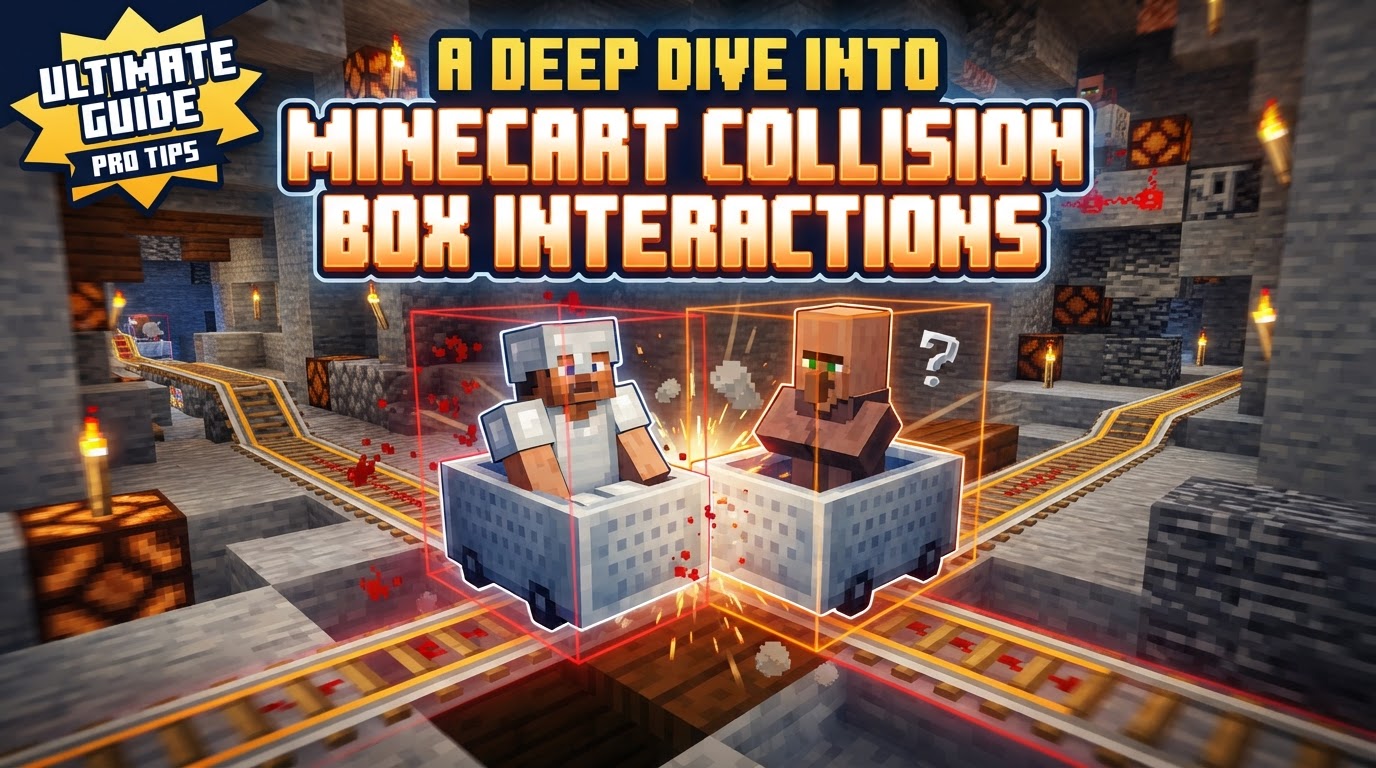
One of the most perplexing aspects of Minecraft’s rail systems often stems from a simple truth: minecart collision boxes don’t always align perfectly with their visual models. This subtle discrepancy is just one example of the deeper, often counter-intuitive mechanics governing how minecarts interact with their environment and each other. Understanding these invisible boundaries and the grid-based physics that dictate their behavior is crucial for building efficient, reliable, and even creative rail networks in your world.
The Invisible Mechanics of Collision
Every entity in Minecraft, from a humble block to a complex minecart, possesses an invisible collision box. This box defines its physical dimensions within the game world and is the primary determinant of how it interacts with other entities and blocks. Unlike real-world physics, Minecraft’s collision system operates on a simplistic, grid-based model. Collision checks are not simultaneous; instead, they occur in a specific sequence: first along the Y-axis (vertical), then the X-axis, and finally the Z-axis (horizontal). This sequential checking can lead to subtle but significant differences in how interactions play out, often diverging from real-world expectations.
Minecarts themselves are not monolithic in their physical properties. They possess varying “masses” depending on their contents. An empty minecart behaves differently from one carrying a player, a chest, a hopper, or a furnace. This difference in effective mass influences how they respond to collisions and propulsion. While a minecart’s default top speed on a straight track is 8 meters per second (m/s), this can increase to 11.314 m/s on diagonal tracks, or be significantly boosted by powered rails and downhill gradients. However, this momentum is not infinite; minecarts naturally lose energy and momentum as they travel over rails, eventually coming to a stop unless continuously propelled.
Key Collision Triggers and Reactions
The behavior of a minecart upon collision is highly dependent on what it hits. A minecart will immediately come to a complete stop upon encountering another minecart, unpowered powered rails, mobs, solid blocks, or even water. However, a particularly interesting and often utilized mechanic involves powered rails and the “south-west rule.” When a minecart traveling on a powered rail collides with a solid object – be it a wall, a single block, a player, or another cart – it will reverse its direction. Crucially, this reversal only occurs with solid objects; translucent blocks like glass or slabs will not trigger this effect, allowing for specific design choices in track layouts.
Unusual Behaviors and Common Pitfalls
Despite the underlying rules, minecart collision boxes can sometimes lead to behaviors that appear “wonky” or unexpected. As mentioned, the visual model of a minecart might not perfectly align with its collision box, resulting in instances where it seems to push or be pushed by objects it visually shouldn’t be touching. Head-on collisions between two minecarts, for example, often result in them bouncing off each other with less speed reduction than one might anticipate, sometimes even appearing to “glance” off rather than halt.
Perhaps one of the most unrealistic, yet exploitable, behaviors involves the furnace minecart. A moving furnace minecart has the peculiar ability to propel an empty minecart forward in an almost “flying off” manner, demonstrating an exaggerated transfer of momentum. Relatedly, due to the inherent collision mechanics, it’s possible to achieve “minecart merging.” This technique involves strategically aligning and pushing multiple minecarts together to accelerate them without the need for powered rails, leveraging their overlapping collision boxes to generate momentum.
Another common issue arises when minecarts are pushed into solid blocks. This can occur irrespective of intended collision settings, especially if a player is directly pushing the cart. The game’s physics can sometimes force the minecart into the block, leading to it becoming stuck or glitching. In complex setups, overlapping collision boxes between multiple minecarts can create a perpetual motion loop, where carts continuously push each other, unable to settle into a static state. This can be either a frustrating bug or an unintended feature for certain contraptions.
Strategic Management: Engineering Collision-Proof Systems
Understanding these intricate collision behaviors opens up possibilities for designing more robust and efficient minecart systems. Detector rails, for instance, are invaluable tools for managing cart flow and preventing collisions. By integrating them with redstone, they can activate powered rails precisely when needed, creating “fail-safes” that prevent carts from piling up or crashing. For creating “trains” of multiple minecarts, placing buffer blocks around powered rails can be effective. These buffer blocks cause carts to continuously travel back and forth, allowing multiple carts to chain together and maintain momentum.
For more complex scenarios, such as two-way tracks or multi-cart stations, sophisticated minecart collision prevention systems can be engineered. These often rely heavily on redstone logic, combining detector rails, powered rails, and various gates to manage multiple incoming carts, directing them to open tracks or holding them until a path is clear. This level of automation is essential to avoid bottlenecks and crashes in busy rail networks.
It’s also worth noting that some server modifications, like CraftBook Extra, introduce entirely custom collision behaviors. These can include “ghost” carts that pass through other carts without interaction, “plow” carts that destroy other carts on impact, or “phase” carts that exhibit complete non-collision with anything. While not part of vanilla Minecraft, these demonstrate the potential for altering fundamental collision mechanics for specialized gameplay.
Conclusion
The world of Minecraft minecart collision boxes is far richer and more nuanced than it initially appears. Beyond the simple act of placing rails and pushing a cart, lies a complex interplay of invisible boundaries, sequential checks, varying masses, and often counter-intuitive physics. From the precise “south-west rule” that dictates powered rail reversals to the peculiar propulsion of furnace carts and the potential for perpetual motion loops, mastering these interactions is key to becoming a true rail system architect. By understanding how collision boxes define interaction, you can move beyond basic tracks and design truly dynamic, efficient, and crash-resistant minecart networks.
Tags:
YOU MAY ALSO LIKE...


