

Annealed Copper Modern Industrialization
One of the most frequently encountered roadblocks for aspiring industrialists in Modern Industrialization isn’t a lack of resources, but a misunderstanding of specific machine requirements, particularly concerning the Electric Blast Furnace (EBF) and its crucial coil tiers. Many players find themselves scratching their heads when their meticulously set up EBF refuses to produce Annealed Copper, often overlooking the exact tier of the EBF’s coils or an elusive oxygen supply.
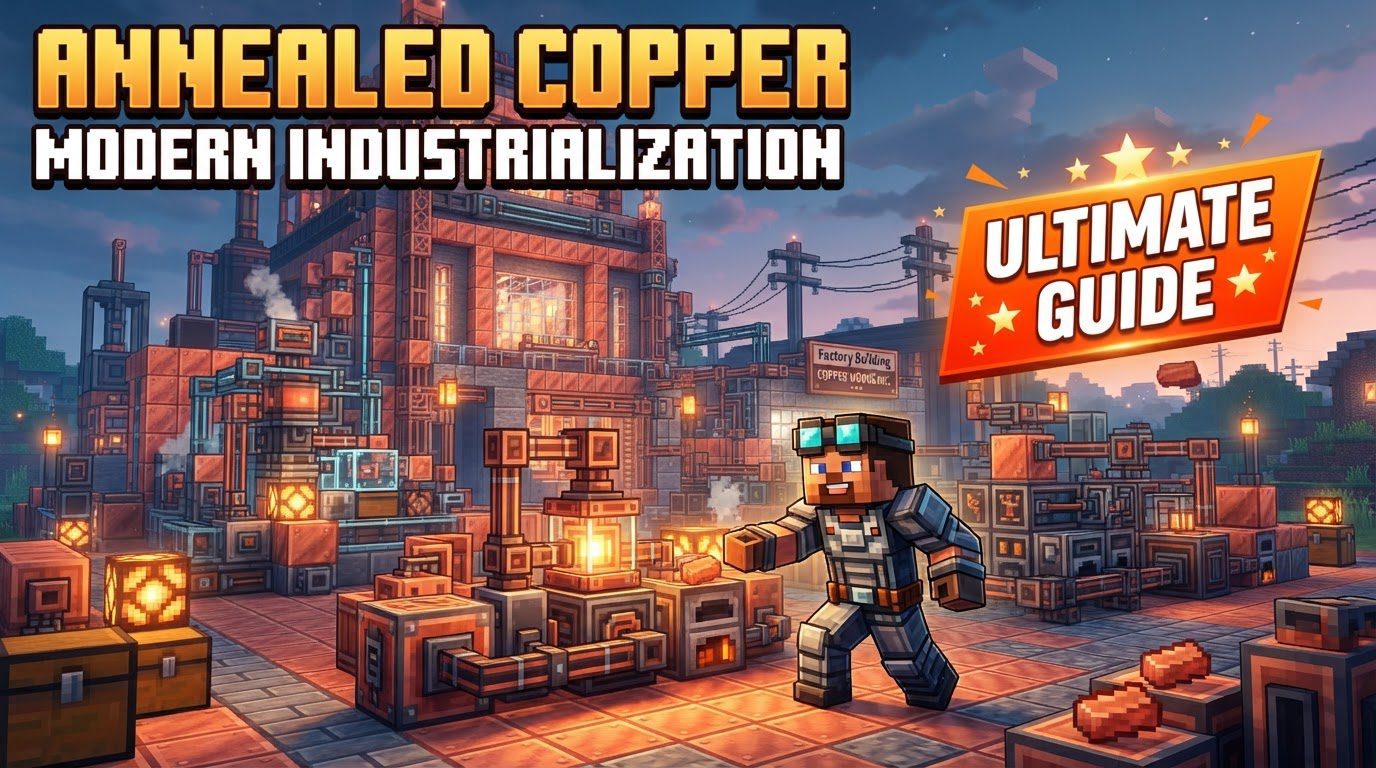
Annealed Copper stands as a cornerstone material within the Modern Industrialization mod, serving as a vital intermediate for a plethora of advanced components. Without it, progression into the higher echelons of industrial automation, including the construction of powerful machines like those requiring the Turbo Machine Hull, grinds to a halt. Mastering its production is not merely a step; it’s a gateway to true industrial might in your Minecraft world.
The Heart of the Process: The Electric Blast Furnace (EBF)
At the core of Annealed Copper production lies the Electric Blast Furnace (EBF). This multi-block structure is purpose-built for high-temperature reactions, and its capabilities are directly tied to the type of coils used in its construction. For Annealed Copper, you’re typically looking at a specific requirement: the Kanthal-tier EBF. This isn’t just a recommendation; it’s a hard requirement. Lower-tier EBFs simply cannot achieve the extreme temperatures and conditions necessary to anneal copper effectively, leaving you with unprocessed materials and a stalled production line.
Understanding the EBF’s role is paramount. It’s not just a furnace; it’s a sophisticated reactor demanding precise inputs, sufficient power, and the correct environmental conditions (temperature, achieved via coils) to function. Neglecting any of these aspects will result in failure, highlighting the mod’s emphasis on realistic industrial processes. Furthermore, oxygen is a common and necessary reactant in the production of Annealed Copper within Modern Industrialization, making proper fluid handling an integral part of the setup.
A Step-by-Step Guide to Annealed Copper Production
Producing Annealed Copper is a methodical process that, once understood, can be efficiently automated. Here’s a general breakdown of the steps involved:
Step 1: Acquiring Copper Dust
- Your journey begins with copper dust. This is typically obtained by processing raw copper ore through crushers, pulverizers, or similar early-game processing machines. Ensure you have a consistent and ample supply, as Annealed Copper is often needed in significant quantities for subsequent crafting recipes.
Step 2: Securing an Oxygen Supply
- Oxygen is a critical reactant in the annealing process. You will need to either generate a steady supply of oxygen or acquire it through other means within your modpack. This often involves specialized fluid production setups, which should be integrated into your overall industrial complex. The reliability of your oxygen supply directly impacts the consistency of your Annealed Copper output.
Step 3: Setting Up and Utilizing the Electric Blast Furnace
- With your copper dust and oxygen ready, the next step is to feed them into your EBF. This requires careful placement of input hatches for both items and fluids. The copper dust will go into item input slots, while the oxygen, being a fluid, will be directed into a designated fluid input hatch on the EBF structure.
Step 4: Powering and Temperature Management
- The EBF is an energy-hungry machine. Ensure it is supplied with a robust and consistent power source capable of sustaining its operation. Crucially, the EBF must reach and maintain the specific high temperature required for the annealing reaction. As mentioned, this temperature threshold is unlocked by using the correct coil tier, most commonly the Kanthal-tier coils for Annealed Copper. Without adequate power and the proper coil setup, the EBF will not initiate or complete the process.
Step 5: Processing and Yielding Annealed Copper
- Once all conditions are met – copper dust and oxygen supplied, EBF powered, and operating at the correct Kanthal-tier temperature – the EBF will begin processing. After a set duration, the machine will output the coveted Annealed Copper. This material can then be automatically collected from the EBF’s output inventory or connected storage system, ready for its next industrial application.
Crucial Considerations for Efficient Production
While the steps might seem straightforward, several nuanced aspects can significantly impact your success and efficiency:
Recipe Verification with JEI/REI
- Always consult your in-game recipe viewer! Tools like Just Enough Items (JEI) or Roughly Enough Items (REI) are indispensable. Modpack developers often tweak recipes, and what might be true for one version of Modern Industrialization could be different in another. JEI/REI will show you the exact inputs, outputs, required temperatures, and crucially, the specific EBF coil tier needed for your current setup. This is your primary source of truth.
The Importance of EBF Coil Tier
- Reiterating this point is vital: the coil tier dictates the EBF’s capabilities. If your JEI/REI recipe specifies a Kanthal-tier EBF, a Nichrome-tier or lower will simply not work. Invest the time and resources to build the correct EBF configuration from the outset to avoid frustration and wasted effort.
Precise Input Hatches for Fluids
- Fluid handling in Modern Industrialization is precise. Oxygen, as a fluid, must be directed into the correct fluid input hatches on your EBF. Attempting to pipe it into an item input slot or an incorrectly configured hatch will lead to a system stall. Double-check your pipe connections and EBF hatch configurations to ensure seamless fluid delivery.
Strategies for Automation
- Once you’ve mastered manual production, automation is the next logical step. This involves setting up robust item transportation (e.g., pipes, conveyors, logistics networks) for copper dust and output collection, alongside a reliable fluid network for oxygen. Plan your layout carefully, considering throughput and storage. Automation frees you to focus on other aspects of your industrial empire, but it demands meticulous planning and configuration.
Troubleshooting Common Pitfalls
Even with a solid understanding, issues can arise. Here’s how to address the most common problems:
Incorrect EBF Tier: The Silent Killer
- This is perhaps the most common mistake. If your EBF isn’t processing despite having all ingredients, power, and oxygen, immediately check your EBF’s coil tier against the recipe in JEI/REI. A mismatch here guarantees failure. Upgrading your EBF coils is often the solution.
Oxygen Supply and Input Discrepancies
- Problems with oxygen are frequent culprits. This could range from insufficient oxygen generation to blockages in your fluid pipes, or simply piping oxygen into the wrong EBF hatch. If your automation system isn’t outputting Annealed Copper, check your oxygen production rate, fluid buffer tanks, and ensure the EBF’s fluid input hatch is receiving oxygen without interruption. This can also manifest as the automation system failing to output copper dust, even if oxygen is the root cause.
Challenges with Advanced Autocrafting Systems
- Automating Annealed Copper production with complex systems like Applied Energistics 2 (AE2) can present unique challenges. It’s not uncommon for AE2 to “believe” it has all the necessary ingredients, including copper dust, but fail to output them to the EBF. This often stems from subtle misconfigurations in interface settings, storage priorities, or a misunderstanding of how AE2 interacts with multi-block machines. Thoroughly review your AE2 patterns, export bus settings, and ensure there are no bottlenecks in item movement to the EBF’s input.
Demystifying Recipe Loop Confusion
- New players sometimes find the recipe for Annealed Copper, and other intermediate materials, confusing due to perceived “loops” or interdependencies. This often happens when a material required for one machine is also an output of a related process, or when a material is needed to *make* the machine that *produces* it. The key is to break down these perceived loops by identifying initial manual steps or alternative early-game recipes that bootstrap the process. For Annealed Copper, focus on the direct inputs: raw copper dust and oxygen. Don’t get lost in overly complex dependencies until these fundamentals are solid.
Mastering Annealed Copper production is a true mark of progress in Modern Industrialization. It demands attention to detail, a methodical approach, and a willingness to troubleshoot. Once you have a reliable, automated pipeline for this vital material, the doors to truly advanced industrial automation will swing wide open, allowing you to build an empire of unparalleled efficiency and power.
Tags:
YOU MAY ALSO LIKE...


