

Best way to organize a shared storage system
Hundreds of hours are lost in shared Minecraft worlds, not to epic battles or complex redstone, but to players sifting through unorganized chests, desperately searching for a single diamond pickaxe. A well-structured storage system is the bedrock of any successful multiplayer base, transforming frustration into efficiency. While there’s no single “perfect” solution, understanding the strengths and weaknesses of various storage methods allows a shared community to build a system tailored to their specific needs and progression.
Chests (and Double Chests): The Ubiquitous Starting Point
The humble chest is the most fundamental and universally recognized storage unit in Minecraft. Crafted from just eight planks, it’s accessible from the very first moments in a new world. When two chests are placed side-by-side, they seamlessly merge into a double chest, effectively doubling their storage capacity. This makes them the go-to for early-game bulk storage of everything from cobblestone to raw materials.
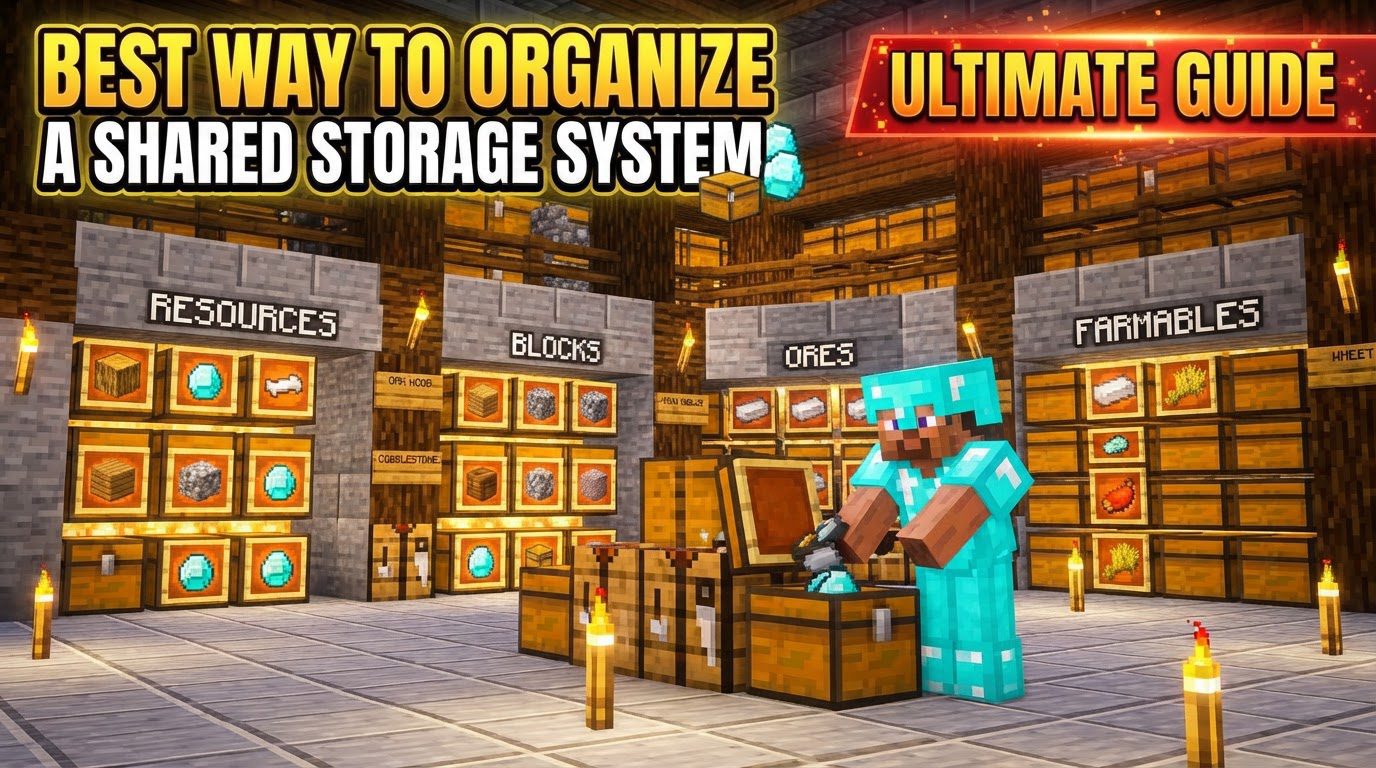
- Pros:
- Easy to Craft: Their minimal resource cost (just wood) means they can be mass-produced almost immediately, making them essential for new bases.
- High Capacity (Double Chests): A double chest provides a generous 54 inventory slots, making it efficient for storing large quantities of diverse items without needing many individual containers.
- Familiarity: Every Minecraft player understands how to use a chest, ensuring a low barrier to entry for new members of a shared world.
- Cons:
- Accessibility Issues: A significant drawback is their inability to be opened if a solid block is placed directly on top. This limitation dictates placement and can restrict compact base designs or integration into floors and walls.
- Lag Inducing: Chests are actively “ticked” by the server, meaning the server constantly checks their state. In large quantities, particularly in automated systems, this can contribute to server stress (TPS lag) and client-side frame rate drops (FPS lag).
- No Automatic Sorting: Manual sorting is the only option. As the variety of items in a shared base grows, manually organizing chests becomes a time-consuming and often neglected chore.
- Stats:
- Single Chest: 27 slots
- Double Chest: 54 slots
Barrels: The Compact and Performance-Friendly Alternative
Introduced in later versions of Minecraft, barrels offer a compelling alternative to chests, especially for large-scale storage projects or compact builds. Crafted from six planks and two slabs, they function similarly to single chests but come with key advantages that address some of the chest’s limitations.
- Pros:
- Accessible Anywhere: Unlike chests, barrels can be opened even when a solid block is placed directly on top. This freedom allows for incredibly compact and creative integration into base designs, such as being placed under floors, within walls, or in tight spaces where chests would be unusable.
- Lag Friendly: A major advantage for server performance, barrels are not “ticked” by the server in the same way chests are. This makes them a superior choice for large-scale storage arrays, as they contribute significantly less to server strain.
- Early Game Crafting: Like chests, they are easy to craft with readily available wood, making them a viable option from early in the game.
- Villager Job Site: As a bonus, barrels can be used as a job site block to convert unemployed villagers into fishermen, adding a layer of utility beyond storage.
- Cons:
- Limited Capacity: Each barrel holds only 27 slots, equivalent to a single chest. Crucially, they cannot be combined into a “double barrel,” meaning you’ll need more individual barrels to match the capacity of a double chest.
- More Hoppers in Automated Systems: In automated sorting systems, each barrel requires its own hopper to input items. This can lead to a higher number of hoppers overall compared to systems using double chests, potentially increasing the server stress caused by the hoppers themselves (though the barrels remain lag-friendly).
- Stats:
- Capacity: 27 slots
Shulker Boxes: The Portable Powerhouses of Logistics
Shulker boxes are an end-game item that revolutionizes inventory management and resource transport. Obtained by defeating shulkers in the End dimension and crafted with two shulker shells and a chest, these blocks act as portable chests, retaining their contents even when broken. They are indispensable for shared worlds that involve extensive exploration or large building projects.
- Pros:
- Portable Storage: Their most transformative feature. A shulker box can be filled with items, broken, and then carried in a player’s inventory or an Ender Chest. This makes moving vast quantities of resources between bases, to mining sites, or to a central storage system incredibly efficient.
- Inventory Expansion: They effectively multiply a player’s inventory space. A single inventory slot can hold a shulker box containing 27 stacks of items, allowing players to carry hundreds, even thousands, of items on expeditions.
- Efficient for Transport: Ideal for moving large hauls from mining trips back to base, or for supplying remote build sites with necessary materials.
- Automated Unloading: Shulker boxes can be integrated into automated systems for efficient loading and unloading of items, making them a cornerstone of advanced storage.
- Cons:
- End-Game Item: Obtaining shulker shells requires venturing into the dangerous End dimension, making shulker boxes a more expensive and late-game option that isn’t available from the start.
- Not Stackable (with contents): A shulker box containing items will not stack with other shulker boxes (empty ones do stack to 64). This means each filled shulker box occupies one inventory slot.
- Opening Restrictions: Similar to chests, a shulker box cannot be opened if a solid opaque block is placed directly on top of it, requiring careful placement or design.
- Slower for Manual Unloading: While automatic unloading into a hopper chain is efficient, manually emptying a full shulker box by repeatedly right-clicking into a chest can be slow.
- Stats:
- Capacity: 27 slots (same as a single chest)
Automated Sorting Systems: The Peak of Efficiency
For shared worlds with significant resource generation and multiple active players, automated sorting systems represent the pinnacle of storage efficiency. These complex contraptions utilize Redstone logic, hoppers, and storage units (chests or barrels) to automatically sort incoming items into designated locations. They can range from simple item sorters to elaborate multi-item and shulker box unloading systems.
- Pros:
- Effortless Organization: Once constructed, players can simply dump all their collected items into an input chest, and the system handles the rest, eliminating manual sorting entirely.
- Scalability: Most designs are modular, allowing them to be expanded to store hundreds or even thousands of different item types, accommodating vast inventories.
- Centralized Storage: Creates a single, convenient input point for all items, greatly streamlining post-expedition inventory management.
- High Capacity: Well-designed systems can theoretically hold millions of items, far surpassing what manual chest arrays can practically manage.
- Cons:
- Resource Intensive: Building an automated sorting system requires a significant investment in materials, especially iron for the numerous hoppers and Redstone components (dust, repeaters, comparators, torches).
- Time-Consuming to Build: The construction process is complex and demands a substantial time commitment, often requiring advanced Redstone knowledge.
- Potential for Lag: Large systems, particularly those with many active hoppers, can cause significant server-side lag (TPS issues) and client-side FPS drops if not optimized. Careful design and use of lag-friendly components (like barrels) are crucial.
- Chunk Loading Requirements: To function continuously, the area containing the sorting system often needs to be continuously chunk-loaded, which can be a challenge on servers or in single-player worlds without specific setups.
- Sorting Speed: While automatic, the sorting process for truly massive quantities of items (e.g., thousands of stacks) can still be slower than rapid manual unloading.
- Non-Stackable Item Challenges: Most common automatic sorters struggle with non-stackable items (tools, armor, potions, enchanted books), often requiring separate, manual storage solutions for them.
- Stats:
- Sorting Speed: Limited by single hopper speed, though parallel systems can increase throughput.
- Capacity: Can be designed to hold over 4.5 million items or more, depending on scale and design.
“Too Lazy” Chests / Buffer Zones: The Quick Dump Solution
Sometimes, after a long mining trip or an intense building session, the last thing anyone wants to do is meticulously sort through their inventory. This is where “too lazy” chests, or buffer zones, come into play. These are simply designated chests (or a small array of them) where players can quickly dump all their unsorted items upon returning to base.
- Pros:
- Quick Unloading: Allows players to empty their inventory almost instantly, freeing them to pursue other activities without the immediate burden of sorting.
- Reduces Immediate Sorting Burden: Delays the need for meticulous organization until a more convenient time, preventing burnout from constant sorting.
- Simple to Implement: Requires no complex builds or rare materials-just a few chests placed in an accessible location.
- Cons:
- Requires Subsequent Sorting: The items in these buffer chests will eventually need to be moved to their proper, organized locations. This task often falls to one or two diligent players, or it piles up.
- Can Lead to Clutter: If not managed regularly, these chests can quickly become disorganized, difficult to navigate, and effectively become another source of chaos.
- Not a Long-Term Solution: This method serves as a temporary buffer, not a primary or permanent organizational strategy. It complements a main system but cannot replace it.
- Stats:
- N/A (capacity depends on the number and type of chests used).
Linked Chests (Modded): The Interdimensional Inventory
For those playing on modded Minecraft servers, linked chests offer a level of convenience and integration far beyond vanilla capabilities. These are special blocks that, once linked, share the same inventory regardless of their physical location or even dimension. They are a staple of many tech-focused modpacks.
- Pros:
- Instant Access Anywhere: The ability to access the same inventory from any linked chest, across vast distances or even different dimensions (Overworld, Nether, End), is incredibly powerful for shared bases and large-scale projects.
- Automation Ready: Linked chests are typically designed to integrate seamlessly with hoppers and other automation systems for both importing and exporting items.
- High Capacity: Many modded linked chest systems offer substantial or even expandable inventory slots. Some allow for upgrades using valuable materials (like diamonds) to double their capacity.
- Cons:
- Requires Mods: This functionality is not available in vanilla Minecraft, making it exclusive to modded servers or single-player instances.
- Crafting Cost: Linked chests can often be expensive to craft, frequently requiring end-game materials such as End Stone, Eyes of Ender, or other mod-specific rare components.
- Balance Concerns: Due to their immense convenience, some players might find them “overpowered” as they trivialize many logistical challenges inherent to vanilla Minecraft.
- Stats:
- Varies by mod; some systems offer thousands of unique storage channels and capacities that can be doubled with upgrades.
The best way to organize a shared storage system in Minecraft is rarely about choosing one method over another, but rather intelligently combining them. Early game typically relies on chests and barrels for basic storage. As resources become more abundant, players can invest in automated sorting systems for bulk items, using shulker boxes for portable inventory management and “too lazy” chests as convenient buffer zones. Modded servers unlock even more powerful, interconnected solutions. The key is to communicate with your fellow players, establish clear guidelines, and adapt your system as your shared world evolves.
Tags:
YOU MAY ALSO LIKE...


