

Building Efficient Trading Hall Layouts for SMPs
One of the most disheartening experiences in a Minecraft Survival Multiplayer (SMP) world is returning to your carefully curated trading hall only to find your valuable villagers gone, victims of a stray zombie or a poorly designed enclosure. Crafting an efficient trading hall is not merely about accumulating villagers; it’s about strategic design, robust security, and forward-thinking expandability. For any serious SMP player, a well-constructed trading hub transforms resource acquisition, allowing for unparalleled access to enchanted gear, rare blocks, and vital supplies through sustainable villager economies.
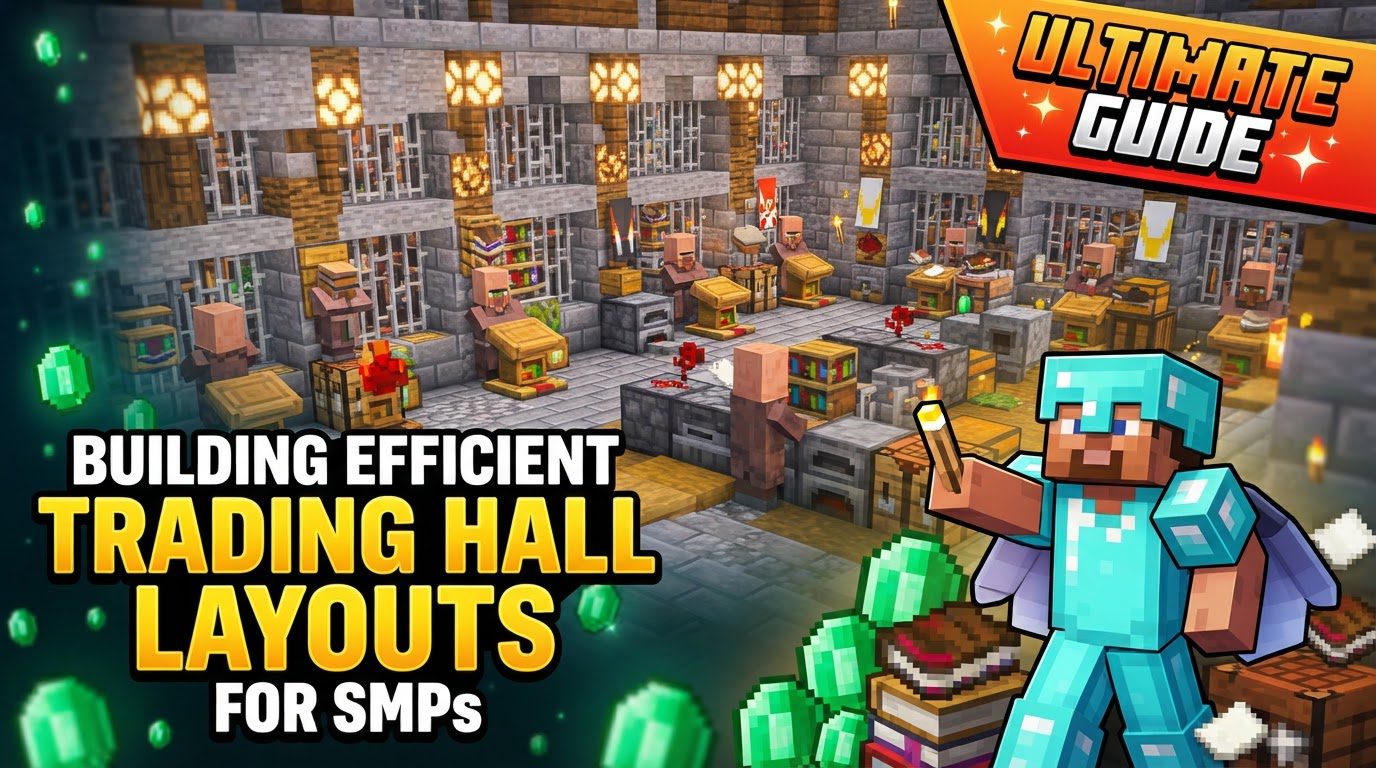
The Bedrock of Trade: Core Principles
Before laying the first block, understanding the fundamental mechanics governing villagers is paramount. These principles dictate every successful trading hall design:
- Individual Cells: Each villager must be housed in its own, inescapable cell. This prevents them from wandering, mixing professions, or becoming vulnerable to external threats. Containment is the cornerstone of a functional hall.
- Work Blocks: To enable trading and assign a specific profession, a job site block (such as a Lectern for a Librarian or a Blast Furnace for an Armorer) must be placed within each villager’s individual cell. This block needs to be accessible to the villager for them to refresh their trades.
- Adequate Lighting: Hostile mobs, particularly zombies, pose an existential threat to villagers. Comprehensive lighting throughout the entire trading hall, including pathways and inside cells, is crucial to prevent mob spawns and protect your valuable traders.
- Expandable Design: The needs of an SMP evolve. A truly efficient trading hall anticipates growth, allowing for the easy addition of more villager cells as new professions are desired or existing trades need duplication. Avoid fixed-size designs that bottleneck future expansion.
- Villager Farms: While not part of the trading hall itself, a robust villager farm is a foundational element. It provides a steady supply of new villagers, essential for populating and expanding your trading operations.
Building Your Trading Nexus: A Step-by-Step Approach
Constructing an efficient trading hall follows a logical progression, ensuring stability and functionality from the outset.
- Establish the Foundation: Begin by clearly defining the footprint and establishing a solid, level foundation for your entire trading hall structure. This initial step sets the stage for everything else.
- Structure Layering: Build the main structure in layers. This modular approach allows for outlining sections for villager cells, pathways, and any integrated features. Working in layers helps visualize the layout and ensures consistent spacing.
- Villager Containment: Design individual cells that effectively trap villagers. This means constructing walls that are at least two blocks high, and using solid blocks or specific mechanisms to prevent escape. Villagers cannot open gates or trapdoors, making these excellent choices for controlling access within villager farms and the trading hall itself.
- Workstation Placement: Once cells are ready and villagers are contained, place the appropriate job site blocks within each villager’s cell. This action assigns their profession and enables their trades. Strategic placement ensures the villager can interact with the block to refresh their offerings.
Maximizing Value: The Art of the Discount
Beyond basic trading, incorporating a mechanism for zombifying and then curing villagers can lead to significant trading discounts. This process, often referred to as “zombie curing,” permanently reduces the cost of trades, making resources incredibly cheap. Designing your trading hall with a dedicated zombification chamber or a system to bring cured villagers to their cells can dramatically enhance efficiency and resource accumulation on an SMP.
Refining Efficiency: Beyond the Basics
While the core mechanics lay the groundwork, several considerations can elevate your trading hall from functional to truly exceptional.
- Villager Movement: While complex rail networks can automate villager movement from a farm to their cells, simpler designs are often just as effective for getting villagers into position. Water streams, pistons, or even simply pushing them can achieve the main goal of efficient placement without over-complicating the build. Remember, the goal is efficient trading, not necessarily complex automation for its own sake.
- Simplicity in Design: Trading hall designs do not need to be overly complicated to be effective. Often, the most robust and maintainable halls are those that prioritize straightforward mechanics and clear pathways over intricate, fragile systems.
- Storage Integration: Consider incorporating storage solutions directly into the trading hall design. Chests or shulker box loaders positioned near frequently traded items reduce travel time and streamline the trading process, providing immediate access to traded goods.
Avoiding Common Pitfalls
Even experienced players can fall prey to design oversights that compromise a trading hall’s integrity. Being aware of these common mistakes can save countless hours of frustration:
- Lack of Villager Containment: This is perhaps the most critical error. Failing to adequately trap villagers in their cells, allowing them to escape or wander into danger, can quickly decimate your trading economy. Ensure every cell is secure.
- Insufficient Lighting: A dimly lit trading hall is an open invitation for hostile mobs. Zombies are particularly dangerous to villagers, and a single spawn can trigger a chain reaction, leading to widespread villager loss. Light up every corner.
- Non-Expandable Designs: Building a fixed-size trading hall that cannot be easily expanded to accommodate more villagers or professions limits your long-term potential. Always design with future growth in mind, even if it means initially building more space than immediately needed.
The Heart of Your SMP Economy
An efficient trading hall is more than just a collection of villagers; it’s a strategic investment that pays dividends in resource wealth and convenience for an entire Minecraft SMP. By adhering to principles of robust containment, intelligent layout, proactive security, and forward-thinking expandability, you can construct a trading hub that reliably serves your world’s needs, transforming mundane resource gathering into a seamless, automated process. Invest the time in a well-designed hall, and watch your SMP thrive.
Tags:
YOU MAY ALSO LIKE...


