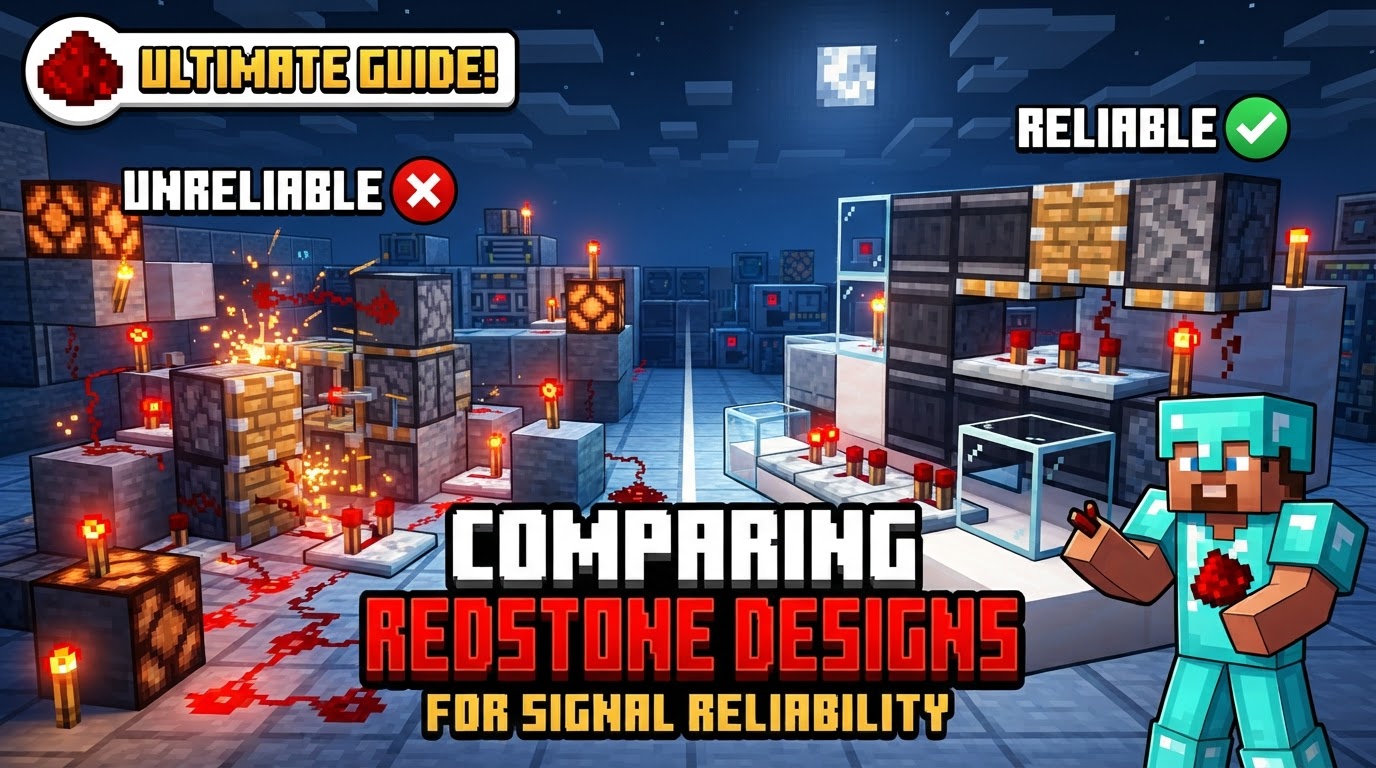
Comparing Redstone Designs for Signal Reliability
Did you know that a single redstone signal can only travel 15 blocks before it dies out completely? This fundamental limitation is just one of many challenges Redstone engineers face when striving for reliable and consistent contraptions in Minecraft. Building robust Redstone circuits requires a deep understanding of core mechanics, a systematic approach to design, and a keen awareness of common pitfalls. Without ensuring signal reliability, even the most ingenious designs can fail intermittently, leading to frustrating and unpredictable outcomes.
This guide delves into the essential principles and best practices for achieving rock-solid Redstone performance, ensuring your creations function flawlessly every time.
Essential Redstone Mechanics for Dependable Circuits
At the heart of every reliable Redstone design lies a solid grasp of how signals behave and how components interact. Mastering these foundational mechanics is the first step toward preventing common errors.
- Signal Strength: A Redstone signal begins with a maximum power level of 15. Crucially, this strength diminishes by one for each block of Redstone dust it traverses. Over distances greater than 15 blocks, the signal will completely dissipate without intervention.
- Redstone Repeaters: These are indispensable tools for maintaining signal integrity. Their multifaceted capabilities include:
- Amplification: Repeaters can take any incoming signal and boost it back to its full strength of 15, effectively extending its range beyond the natural 15-block limit.
- One-Way Flow: They enforce a strict one-way signal direction, moving from the back to the front (indicated by an arrow). This is vital for preventing unwanted signal feedback loops and isolating different parts of a circuit.
- Delay: Repeaters introduce a customizable delay to the signal, adjustable from 0.1 to 0.4 seconds per repeater by right-clicking. This allows for precise timing control within complex contraptions.
- Locking: A repeater’s current output state can be locked by powering it from the side with another repeater or a comparator, holding its signal indefinitely until the locking power is removed.
- Redstone Comparators: Comparators are used for advanced signal manipulation. They can compare the strength of two Redstone signals or detect specific data from certain blocks, such as the fullness of a container or the page number of a lectern. Unlike Redstone dust, comparators preserve the signal strength they are transmitting, making them useful for maintaining signal integrity over short distances when specific data is needed.
- Power Sources: Different power sources offer varied functionalities:
- Levers: Provide a persistent on/off signal, ideal for constant power.
- Buttons: Deliver a momentary pulse, typically lasting around 2 seconds, suitable for temporary activations.
- Redstone Torches: Offer constant power but possess a unique property: they turn off if the block they are attached to is powered, effectively acting as a NOT gate (an inverter).
- Block Powering: Understanding how blocks transmit power is critical. “Hard powering” a block (with a signal strength of 15) allows Redstone components to directly receive power from it. Conversely, “soft powering” a block (with a signal strength less than 15) requires a repeater to extract the signal effectively.
- Incompatible Blocks: Not all blocks can interact with Redstone signals directly. Transparent blocks like glass and non-solid blocks such as stairs cannot transmit or receive a Redstone signal, which can lead to unexpected signal breaks if not accounted for.
Building Reliable Circuits: A Step-by-Step Approach
Implementing Redstone effectively involves a systematic approach to design, focusing on predictable signal flow and precise timing.
- Extend Signal Range Strategically: To prevent signal decay over long distances, place Redstone repeaters at regular intervals. A good rule of thumb is to place a repeater every 15 blocks (or on the 16th block) to ensure the signal is consistently refreshed to full strength.
- Control Signal Direction with Precision: Always use repeaters to establish a clear, one-way signal path. This is paramount for preventing unwanted backfeeds that can interfere with other parts of your circuit or create unpredictable loops.
- Manage Timing Accurately: Fine-tune the delays of Redstone repeaters to synchronize various components within your contraption. Each repeater can add between 1 and 4 game ticks of delay, allowing for intricate timing sequences crucial for complex mechanisms.
- Strategic Component Placement: Ensure that all Redstone dust and components are placed on solid, opaque blocks. For vertical signal transmission, power can be routed into the base of blocks or across their tops, utilizing clever block arrangements.
- Utilize Logic Gates Effectively: Incorporate Redstone torches as inverters (NOT gates) to flip signal states. Understand the comparison and subtraction modes of comparators to build advanced logic for signal manipulation and data processing.
Advanced Tips for Robust Redstone
Beyond the basics, several practices can significantly enhance the reliability and longevity of your Redstone designs, especially for complex builds.
- Prototype in Creative Mode: Before committing to a survival build, always construct and rigorously test complex Redstone contraptions in Creative mode. This allows for quick iteration, identification, and resolution of issues without resource constraints.
- Prioritize Functionality Over Compactness: For challenging circuits, focus initially on making them fully functional, even if they appear large or sprawling. Once reliability is established, you can then attempt to compact the design.
- Prevent Signal Interference: Utilize transparent blocks, such as glass, directly above Redstone lines. This prevents accidental signal cut-offs or cross-powering from other elements or blocks placed above your circuit.
- Understand Redstone Terminology: Familiarize yourself with the precise operation and interaction of different Redstone components. A clear understanding of terms like “quasi-connectivity,” “block updates,” and “tick” will lead to more informed design choices.
- Choose Appropriate Clocks: For slow, long-period timing mechanisms, hopper clocks are an excellent choice due to their compactness and inherent reliability. Comparator clocks also offer a space-efficient solution for experienced builders needing repetitive pulses.
- Mind Server Performance: On multiplayer servers, prioritize efficient Redstone designs that minimize block updates, particularly for clocks. This reduces server lag and helps maintain consistent timing for all players.
- Pulse Extenders: For situations where a momentary button press needs to activate a mechanism for a longer duration, employ pulse extender circuits using comparators and Redstone dust.
Common Pitfalls and How to Avoid Them
Even experienced builders can fall victim to common Redstone mistakes. Recognizing and avoiding these issues is key to building dependable systems.
- Signal Decay: The most frequent error is failing to use repeaters to refresh signals over distances greater than 15 blocks, inevitably leading to signal loss and circuit failure. Always plan for repeaters.
- Incorrect Block Powering: Placing Redstone dust or components on non-solid blocks will prevent signal transmission. Always ensure your Redstone is on stable, opaque surfaces.
- Accidental Cross-Powering: Signals can inadvertently power unintended parts of a circuit if components are too close or improperly isolated. Design with adequate spacing or use isolating blocks.
- Self-Powering Circuits (Infinite Loops): Creating a Redstone line or component that continuously powers itself can make the mechanism impossible to turn off. Carefully trace signal paths to avoid these feedback loops.
- Timing Errors: Incorrectly setting repeater delays or neglecting to account for signal propagation times can cause components to activate out of sync, leading to malfunctions. Test your timing meticulously.
- Redstone Torch Burnout: Rapidly toggling Redstone torches (more than eight times within three seconds) can cause them to burn out. Prioritize designs that primarily use repeaters and comparators to circumvent this issue.
- Ignoring Version Differences: Redstone mechanics can differ between Java and Bedrock editions of Minecraft (e.g., quasi-connectivity in Java). Always be aware of the specific version you are building for.
- Observer Glitches: Observers can sometimes trigger themselves or be triggered by adjacent block updates (like pistons moving) that are not intended. Design observer arrays with careful consideration of surrounding block interactions.
Building reliable Redstone contraptions in Minecraft is an art perfected through understanding, practice, and attention to detail. By mastering the core mechanics, following a structured design process, and diligently avoiding common pitfalls, you can ensure your Redstone creations function with unwavering precision and consistency, bringing your most ambitious in-game projects to life.
Tags:
YOU MAY ALSO LIKE...