Create Big Cannons Artillery Calculator
Many a Minecraft engineer has painstakingly attempted to manually dial in the perfect pitch and yaw for a long-range cannon shot, only to watch their carefully crafted shell harmlessly plink into the terrain far from its intended target. This frustrating trial-and-error approach is precisely what the “Create Big Cannons Artillery Calculator” mod aims to eliminate, transforming your explosive endeavors from guesswork into a science.
Mastering Long-Range Artillery with the Calculator
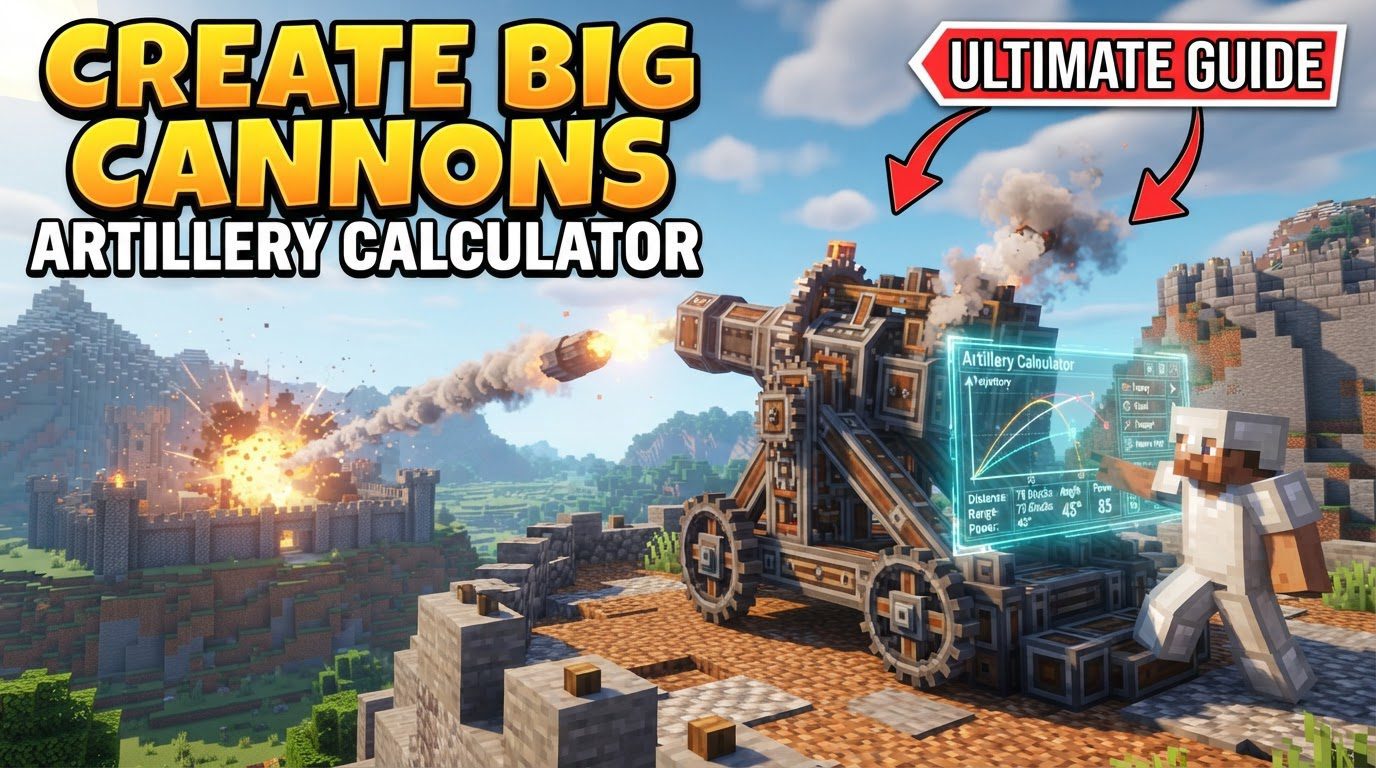
The Create Big Cannons Artillery Calculator, often referred to as the Ballistic Calculator or Director, is an indispensable tool for any serious Minecraft artillery enthusiast. It takes the complex physics of projectile motion – gravity, drag, and even minimal spread – and distills them into precise firing solutions for your cannons. Instead of relying on intuition or tedious manual adjustments, this system allows for automated, accurate targeting, ensuring your shells land exactly where you want them, every time. It’s the brain behind your brawny cannons, making long-range bombardment a reliable, repeatable process rather than a lucky shot.
The Science Behind the Blast: Core Mechanics
Understanding the underlying mechanics is key to effectively utilizing the calculator. The mod simulates several real-world physics principles that influence shell trajectory and cannon performance.
- Projectile Trajectory & Physics: The calculator precisely models shell trajectories, factoring in a constant gravitational pull of 0.05 blocks per tick. Additionally, drag, represented by a 0.99 per tick reduction in velocity, gradually slows down projectiles. Even minimal spread is accounted for, varying by cannon material: 0.1 for nether-steel, 0.5 for steel, 1.25 for cast iron, and 1.5 for wrought iron. These calculations ensure a highly realistic and predictable flight path.
- Cannon Construction & Material Impact: The very make-up of your cannon significantly affects its capabilities. Different materials possess varying strengths and properties. For instance, cast iron is generally robust enough for safe use with standard powder charges. Crucially, the material choice dictates the maximum effective length of the muzzle and the overall strength of the cannon, directly impacting how many powder charges it can safely handle without exploding.
- The Critical Role of Fuses: A powerful shell is useless if it doesn’t detonate. Shells can be equipped with various fuses, including impact fuses (exploding on contact), timed fuses (exploding after a set duration), and proximity fuses (exploding when near a target). For high explosive shells, a fuse is absolutely essential; without one, they will act like solid shot, merely impacting without an explosion.
- Big Cartridges: Efficiency in Reloading: For those seeking to optimize their cannon’s firing rate and power, Big Cartridges are a game-changer. These reusable charges can hold the equivalent power of multiple individual powder charges. This innovation allows for the construction of shorter cannons that still achieve the same projectile velocity and range as longer, multi-charge setups, while also speeding up the reloading process.
Automated Precision: A Step-by-Step Guide to Using the Calculator
Integrating the Artillery Calculator into your cannon setup transforms it into a highly precise, automated weapon system. Here’s how to do it:
- Assembling Your Artillery Piece: Begin by constructing your cannon using Create: Big Cannons components. Ensure it is properly assembled and activated, ready for firing.
- Establishing the Network: Place a Ballistic Calculator (Director) near your cannon. This block is responsible for computing firing solutions. Next, introduce an Artillery Coordinator, which acts as the central control unit for ballistic calculators and cannon controllers. Finally, use a Network Manager to link the Artillery Coordinator, the Ballistic Calculator, and your cannon’s controller (the gun/cannon block itself) to a single, shared network ID.
- Target Acquisition and Input: With your network established, grab a Rangefinder tool. Right-click on your desired target to obtain its precise X, Y, and Z coordinates. Immediately after, right-click the Ballistic Calculator. This action automatically inputs the acquired target coordinates into the calculator.
- Calculating the Firing Solution: On the Ballistic Calculator’s interface, you’ll need to specify the material your cannon is constructed from (e.g., steel, nether-steel, cast iron). Once confirmed, the calculator will process the target coordinates, cannon parameters, and shell type to determine the optimal pitch, yaw, and required number of charges for a successful hit.
- Automated Aiming and Firing: Once the calculation is complete, the Artillery Coordinator can be commanded to “Set” the cannon. This will automatically adjust the cannon’s pitch and yaw to align with the calculated solution. When the cannon has finished aiming and is “ready,” the Artillery Coordinator can then be used to “Fire” it, launching your projectile with calculated precision.
- Remote Command Capabilities: For controlling your artillery from a safe distance, a Radio Set can be connected to an Artillery Coordinator. This allows you to initiate calculations, aim, and fire your cannon remotely, adding another layer of strategic depth to your operations.
Advanced Artillery Strategies and Optimization
Beyond the basic setup, several strategies can enhance your artillery’s effectiveness and reliability.
- Beyond Manual Adjustments: The Ballistic Calculator’s primary advantage is precision. It eliminates the need for manual angle adjustments, which are inherently limited by the typically three-digit precision of cannon mounts. While community-developed “Direct Projectile Trajectory Formulas” (DPTCF) offer efficient calculation methods, the in-game calculator handles this for you, and future updates promise advanced cannon mounts for even greater automation.
- Barrel Length and Material Synergy: The length of your cannon’s barrel is not just aesthetic; it’s crucial for autocannons and overall projectile velocity. Always pay close attention to the maximum muzzle length and strength dictated by your chosen cannon material. An optimal ratio of muzzle length to powder charges prevents projectiles from getting stuck and maximizes their effectiveness.
- Streamlining Your Reloads: For rapid-fire cannons, efficient loading is paramount. A single hopper feeding ammunition often can’t keep up with the firing rate. Utilizing two hoppers or a chute system can significantly optimize reloading, ensuring a consistent and high rate of fire. Cannons can be loaded through either the muzzle or the breech, but always ensure safe loading practices to prevent accidental explosions.
- Powering the Precision: The intricate movements required for a cannon to aim horizontally and vertically demand power. This is typically supplied by large and small gears, which can be driven by handles for manual control or motors for automated, continuous adjustment, especially important for larger artillery pieces.
Common Blunders to Avoid in Cannonry
Even with the best tools, mistakes can happen. Being aware of common pitfalls will save you frustration and resources.
- The Fuse Fiasco: One of the most frequent errors is firing high explosive shells without an appropriate fuse. An unfused high explosive shell will simply act as a solid shot, impacting the ground without detonating, turning a potentially devastating blast into a mere thud. Always ensure your shells have the correct fuse type!
- Overloading Your Cannon: Every cannon material has a strength limit. Attempting to overload a cannon with too many powder charges beyond its material’s capacity is a recipe for disaster, almost guaranteed to result in a spectacular and destructive cannon explosion. Always respect the material’s limits.
- Trajectory Calculation Pitfalls: While the in-game calculator does its job, the underlying “brute force” method of trajectory calculation can be computationally intensive, particularly for very long distances or when targeting moving objects. While community-developed DPTCFs offer more efficient solutions, for most in-game automated setups, the Ballistic Calculator manages this complexity.
- Manual Aiming’s Limitations: Relying on manual adjustment for precise, long-range shots is incredibly difficult. The limited precision of cannon mount adjustments (typically three digits) makes fine-tuning for distant targets an exercise in futility. This is precisely why the Ballistic Calculator is invaluable.
- Reloading Bottlenecks: For cannons designed for rapid fire, using only a single hopper for ammunition loading will inevitably lead to a slower firing rate over time. The hopper simply cannot supply shells fast enough to keep the cannon fed, reducing its overall effectiveness.
The “Create Big Cannons Artillery Calculator” transforms the art of Minecraft cannonry from a hit-or-miss affair into a science of precision. By understanding its mechanics, following the setup process, and avoiding common mistakes, you can harness the true destructive potential of your creations, raining down calculated chaos upon your foes with unprecedented accuracy.
Tags:
YOU MAY ALSO LIKE...