Hidden Reasons Boats Flip Unexpectedly
The sudden, inexplicable capsizing or destruction of a Minecraft boat is rarely a random event. Instead, it’s often the culmination of specific game mechanics, environmental hazards, or even subtle player actions, many of which remain hidden until a boat inexplicably breaks into planks and sticks. Understanding these underlying causes is crucial for any seasoned adventurer or novice explorer looking to master aquatic travel and avoid the frustration of losing precious cargo or even their life.
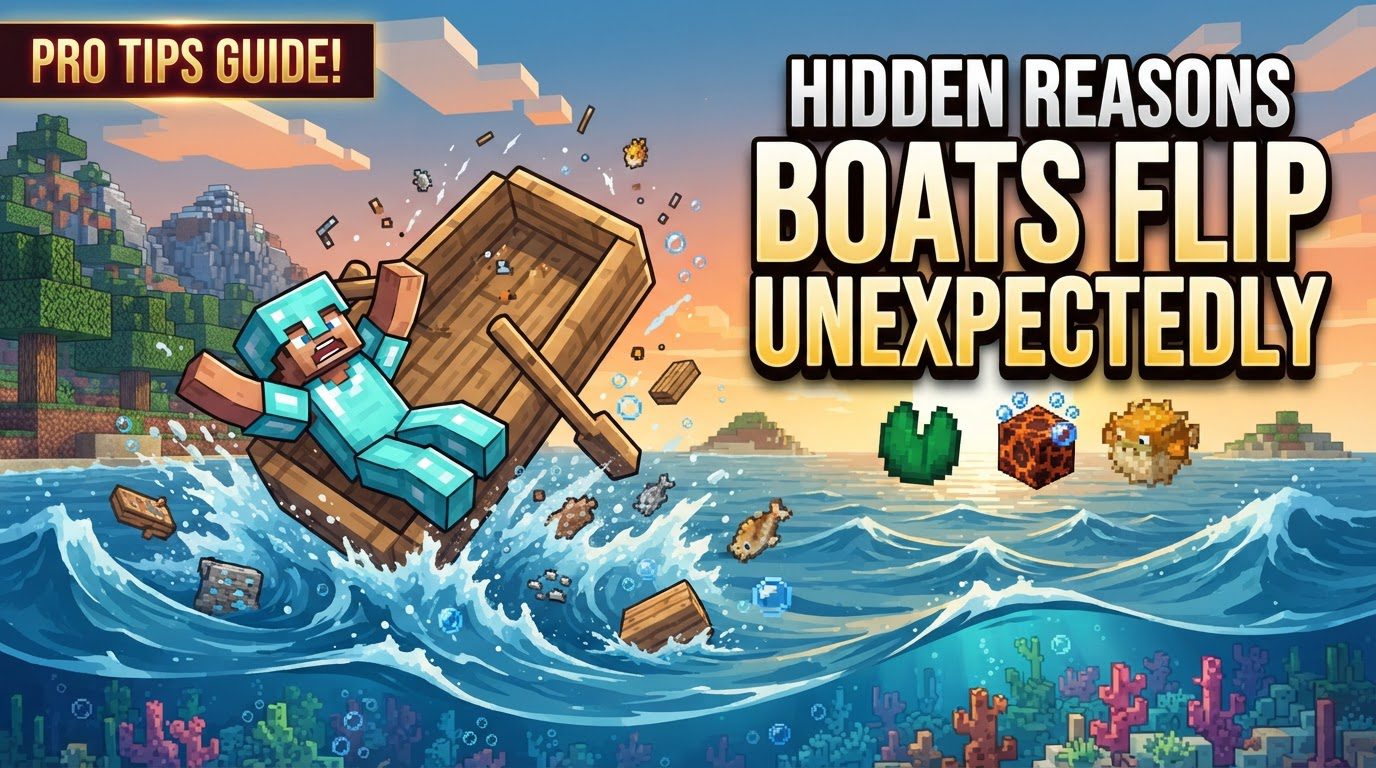
Far from being a simple block that floats, Minecraft boats interact with the world in complex ways. From the physics of water to the fragility of their construction, numerous factors contribute to their often-unpredictable behavior. This guide delves into the core mechanics, common player mistakes, and environmental quirks that lead to boats flipping, sinking, or outright breaking, offering insights to help you navigate the blocky seas with greater confidence and fewer mishaps.
The Unseen Forces: Core Game Mechanics at Play
At the heart of every boat mishap lies a specific interaction with Minecraft’s meticulously designed, yet sometimes counter-intuitive, game engine. These are the fundamental rules governing how boats behave, often leading to unexpected outcomes.
Turbulent Waters: Bubble Columns and Waterfalls
One of the most common culprits behind boat instability is turbulent water. Boats will almost certainly capsize or sink if they enter a natural waterfall. The game’s physics simply aren’t designed for graceful navigation down such powerful currents. Even more perilous are bubble columns. While an upward-flowing bubble column (created by a Soul Sand block) might seem like a convenient elevator, boats moving over them will typically become erratic. A downward-flowing bubble column, specifically one caused by a Magma Block, is far more dangerous. If a boat passes over a Magma Block bubble column, all passengers are immediately expelled, and the boat itself will sink, often breaking in the process. Always steer clear of these sub-aquatic hazards.
Fragility and High-Speed Collisions
Boats, despite their utility, are surprisingly fragile entities. They possess a damage threshold, and exceeding it will cause them to break. The most frequent cause of damage is crashing into solid blocks or land at high speeds. Even a minor bump can contribute to wear and tear, but a head-on collision with a wall while moving quickly will almost certainly result in the boat shattering. Beyond collisions, boats are also susceptible to environmental damage. Explosions, fire, and lava will instantly destroy a boat, often with fatal consequences for its occupants if they are caught in the blast or flames.
Gravity’s Grasp: Specific Fall Damage Thresholds
Like many entities in Minecraft, boats are subject to fall damage, but their thresholds are peculiar and precise. They can break when falling from certain heights, dropping planks and sticks instead of the boat item itself. These specific fall heights are known to include: 12, 13, 49, 51, 111, 114, 198, 202, 310, or 315 blocks. Understanding these specific numbers might seem esoteric, but it highlights that boat destruction from falls is not random; it’s based on very particular game logic. Any fall exceeding these specific values will result in the boat’s demise.
The Suffocation Trap: Ceiling Interactions
A lesser-known hazard is the boat’s interaction with low ceilings. If a boat moves through an area where there is only one block of air between the water’s surface and a solid ceiling, its occupants can take suffocation damage. This occurs because the game engine attempts to place the player’s head inside the solid block, leading to damage. This is particularly dangerous in cramped underwater tunnels or poorly designed boat paths.
Legacy Water Interactions: The 1.9 Change
For players who have experienced older versions of Minecraft, a significant change in version 1.9 altered how boats interacted with water levels. Prior to 1.9, boats had a tendency to float up when encountering multiple water levels or attempting to traverse small upward inclines in rivers or water elevators. Post-1.9, this behavior changed dramatically; boats would instead sink and eject the player in such scenarios. While less relevant for current gameplay, it illustrates how subtle mechanic changes can drastically alter boat behavior.
The Tick System’s Quirks: Unpredictable Physics
Minecraft operates on a tick-based system, meaning the game state updates at fixed intervals. This system can sometimes lead to inconsistent or seemingly unpredictable boat behavior. For instance, boats falling into water columns might not consistently be lifted as expected, or minor collisions can have disproportionate effects due to the precise moment of impact within a game tick. This underlying system can contribute to the feeling that boats are sometimes “buggy” when in fact, they are simply adhering to the game’s internal timing.
Platform-Specific Glitches: Bedrock/Marketplace Anomalies
It’s important to acknowledge that not all boat anomalies are universal. Specific versions of Minecraft, particularly those found in the Minecraft Marketplace or certain iterations of the Bedrock Edition, have been known to exhibit unique bugs. One such bug has seen boats not being affected by gravity, allowing them to float endlessly in mid-air or drift uncontrollably. While these are often patched, they serve as a reminder that platform-specific issues can also contribute to unexpected boat behavior.
Network Latency and Modded Environments
In multiplayer (SMP) environments, network lag can play a significant role in boat instability. The desynchronization between client and server can lead to ghost collisions or delayed damage registration, causing boats to break unexpectedly. Furthermore, modded physics, such as those introduced by complex technical mods like “Create,” can entirely redefine boat behavior. In such setups, boats or custom-built ships might flip if the center of lift (e.g., from propellers) is not directly aligned with or above the center of mass, leading to unbalanced forces and chaotic movement.
Pilot Error: Common Player Blunders
While game mechanics are crucial, many boat misfortunes stem directly from common mistakes players make, often unknowingly.
- Driving into Waterfalls or Magma Block Bubble Columns: As detailed above, these are instant boat destroyers or player ejectors. Misjudging a current or failing to spot a Magma Block can be costly.
- Crashing into Solid Blocks at High Speeds: Whether it’s the shore, a riverbank, or a poorly navigated tunnel, high-velocity impacts against any solid block will damage and eventually break your boat.
- Falling from Heights: Ignoring the specific fall damage thresholds can lead to your boat disintegrating upon impact with the ground or water after a significant drop.
- Attempting to Use Boats in Lava: This is a fatal mistake. Boats in lava are instantly destroyed, and any player inside will take immediate fire damage, often resulting in death.
- Attacking Mobs While Seated: A surprising cause of boat destruction. If you attempt to attack a mob with a sword while still inside your boat, the game can register the attack as hitting the boat itself, causing it to break.
- Multiplayer Logout Issues: Exiting the game while inside a boat in a multiplayer server can sometimes lead to your boat being far away and you falling into the water upon reloading, or even taking fall damage if the boat despawned or moved.
Navigational Strategies: Preventing Boat Blunders
Fortunately, many boat-related issues can be mitigated with careful planning and smart navigation. By adopting these strategies, you can significantly reduce the chances of your boat flipping or breaking.
Diligent Hazard Avoidance
The simplest and most effective tip is to be aware of your surroundings. Actively steer clear of waterfalls and any visible bubble columns, especially those caused by Magma Blocks. When traveling in new or unexplored areas, proceed with caution and scout ahead if possible.
The Sneak Tactic: Reducing Impact
Activating sneak mode (holding the Shift key) while in a boat may, in some versions or scenarios, reduce the chance of your boat breaking upon impact when traveling at high speed. While its reliability can vary across updates, it’s a habit worth developing for potentially softer landings.
Preparedness: Always Carry Spares
Given their fragility and the numerous ways they can be destroyed, always carry at least one, if not several, spare boats, especially for long journeys or expeditions into unknown territory. They are inexpensive to craft and can be a lifesaver.
Safe Docking Solutions: Wool Blocks
For high-traffic areas or important docks, consider constructing them with wool blocks. Wool has a unique property in Minecraft that can reduce the chance of boats breaking upon impact, offering a slightly softer landing zone compared to solid stone or wood blocks.
The Eject Maneuver: Mitigating Fall Damage
When descending a great distance in a boat, such as a drop-off into water, you can often prevent taking fall damage yourself by exiting the boat a split second before it hits the ground or water. While this won’t always save the boat from breaking (especially at critical fall heights), it will save your own health points.
Optimizing Travel Routes: Wider Passages
For high-speed travel, such as on ice boat tracks, ensure that your passages are sufficiently wide. A minimum of three blocks wide is often recommended to prevent accidental collisions with walls that can lead to boat destruction, especially when moving at maximum velocity.
Advanced Physics (Modded): The Balancing Act
If you’re delving into modded Minecraft with complex physics, such as building custom ships in mods like “Create,” pay close attention to the vessel’s design. Ensure that the forces generating lift or propulsion are symmetrically distributed and aligned with the ship’s center of mass. An unbalanced design will inevitably lead to your creation flipping or behaving erratically.
In conclusion, the seemingly random behavior of Minecraft boats is, in reality, a predictable outcome of specific game mechanics, environmental interactions, and player actions. By understanding these ‘hidden reasons,’ you can transform frustrating incidents into manageable challenges, navigating the game’s diverse landscapes and waterways with skill and confidence. Your trusty boat doesn’t just float; it interacts, reacts, and sometimes, it breaks – but armed with this knowledge, you’ll be far better prepared for whatever the blocky seas throw your way.
Tags:
YOU MAY ALSO LIKE...