How Armor Durability Loss Calculation Works Exactly
For every eight points of damage you take that your armor successfully mitigates in Minecraft, each equipped piece of armor loses one point of durability. This seemingly simple rule underpins the entire wear-and-tear system for your protective gear, dictating how long your precious diamond chestplate or netherite leggings will last against the myriad threats of the Overworld, Nether, and End. Understanding this mechanism is crucial for any seasoned adventurer, allowing for efficient resource management, strategic enchantment choices, and ultimately, a more durable and secure gameplay experience.
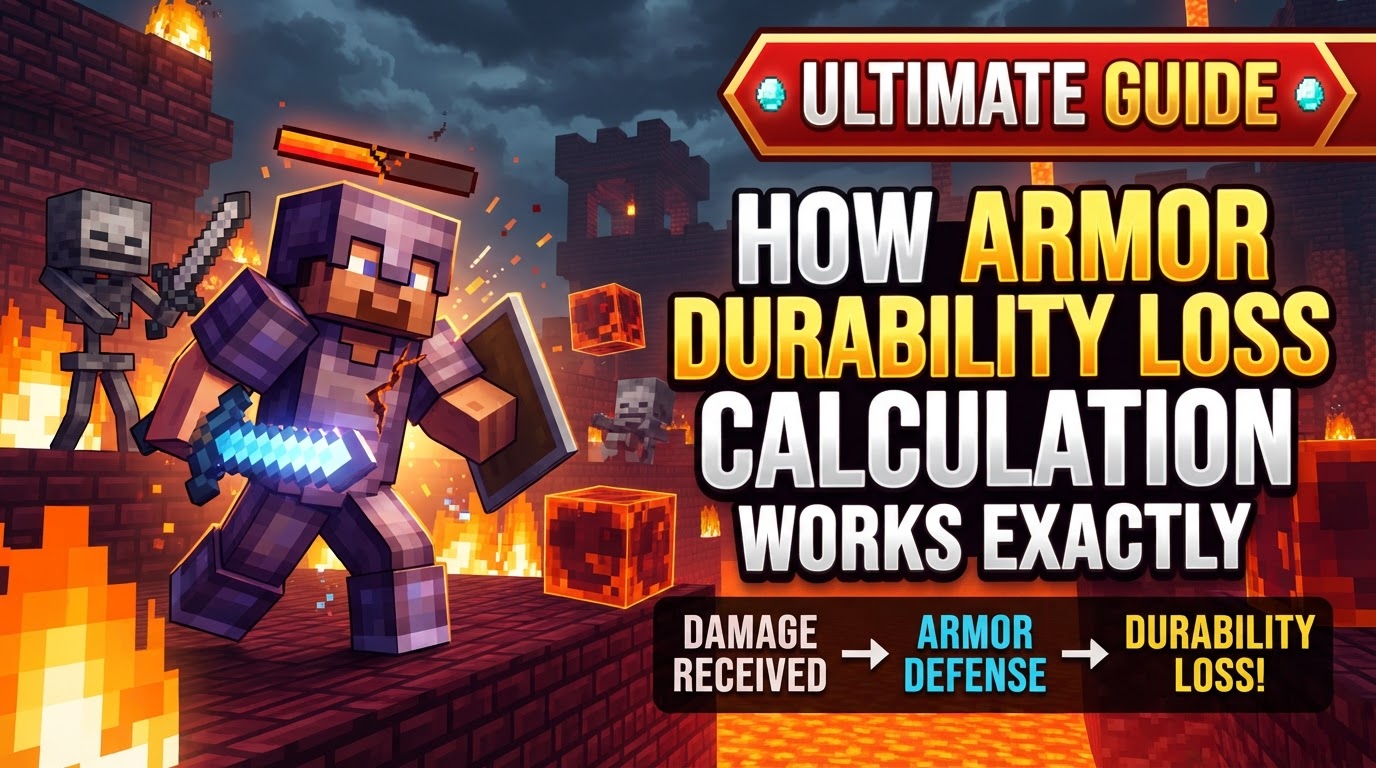
Far from a mere aesthetic detail, armor durability directly impacts your survivability. When a piece of armor breaks, it ceases to offer any protection, leaving you vulnerable to attacks. This comprehensive guide will delve into the precise calculations and scenarios that govern armor durability loss, helping you master this fundamental aspect of Minecraft survival.
The Core Mechanism: What Triggers Durability Loss?
The fundamental trigger for armor durability loss is surprisingly specific: it only occurs when a player takes damage that is successfully reduced by the armor. This means if you take damage that bypasses armor protection entirely, or if the armor’s protection value is zero against a certain damage type, your armor’s durability remains untouched. The game processes incoming damage, applies your armor’s protection values, and only then considers durability reduction for the damage that was effectively absorbed or mitigated.
The Damage-to-Durability Ratio Explained
The calculation for durability loss follows a consistent ratio: for every four hearts (equivalent to eight damage points) of incoming damage the player receives after armor reduction, each equipped piece of armor loses one point of durability. This calculation is always rounded down. For example, if you take 15 points of damage that your armor reduces, the game will calculate durability loss based on 8 damage points (15 divided by 8, rounded down to 1). This means if you take less than eight points of armor-reducible damage in a single hit, your armor’s durability will not decrease from that specific hit, assuming no other factors are at play.
Damage Types That Affect Armor Durability
A wide array of damage sources can cause your armor to degrade. These are typically physical or elemental threats that your armor is designed to protect against:
- Direct Attacks: This includes melee attacks from mobs (Zombies, Skeletons, Creepers, etc.) and other players.
- Projectiles: Arrows, tridents, fireballs from Ghasts or Blazes, eggs, and snowballs all contribute to durability loss if they deal damage.
- Environmental Hazards:
- Lightning Strikes: Direct hits from lightning.
- Lava: Contact with lava.
- Fire: Direct contact with fire blocks.
- Magma Blocks: Standing on magma blocks.
- Cacti: Touching cacti.
- Sweet Berry Bushes: Moving through sweet berry bushes.
- Explosions: Damage from TNT, Creepers, Ghast fireballs, and other explosive sources will degrade your armor.
Damage Types That Do NOT Affect Armor Durability
Equally important are the damage types that your armor will ignore in terms of durability. These are often non-physical or environmental effects that armor doesn’t traditionally mitigate, or damage sources that the game designers have specifically excluded:
- Damage Over Time: Fire damage over time (e.g., being on fire after leaving lava) does not affect durability.
- Suffocation: Being stuck in a block.
- World Border: Hitting the world border.
- Drowning: Running out of air underwater.
- Fall Damage: Damage taken from falling from a height.
- Elytra Collision: Hitting a block while flying with elytra.
- Magic Damage: This category includes:
- Evoker fangs.
- Poison status effect.
- Wither status effect.
- Instant Damage status effects.
- Powder Snow: Being inside powder snow.
- Void Damage: Falling into the void.
/killCommand: Dying by command.- Starvation: Running out of hunger points.
- Warden’s Sonic Attacks: These unique attacks bypass most forms of protection, including armor durability.
Key Enchantments and Their Impact
Unbreaking: Extending Lifespan
The Unbreaking enchantment is arguably the most valuable enchantment for armor durability. It doesn’t prevent damage, but it grants a chance for the armor piece to not lose durability when it normally would. The chance of avoiding durability loss is calculated as 1 in (1 + enchantment level). So, Unbreaking I gives a 1 in 2 (50%) chance, Unbreaking II a 1 in 3 (33.3%) chance, and Unbreaking III a 1 in 4 (25%) chance of losing durability. This effectively means an Unbreaking III item will last, on average, four times longer than an unenchanted item, significantly reducing the need for repairs and replacements.
Thorns: A Double-Edged Sword
While useful for retaliatory damage, the Thorns enchantment can indirectly increase the durability loss on the armor it is applied to. When Thorns activates and deals damage back to an attacker, it incurs an additional durability cost on the armor piece it’s on. This means your Thorns-enchanted armor will degrade faster than identical armor without Thorns, even if it has Unbreaking. It’s a trade-off between offense and armor longevity.
Armor Toughness: Indirect Protection
Armor Toughness, found on higher-tier armor like Diamond and Netherite, doesn’t directly prevent durability loss in the same way Unbreaking does. Instead, it helps mitigate the penetration of strong attacks, making your armor more effective against high damage. By reducing the overall damage that gets through to you, Armor Toughness indirectly reduces the amount of damage that needs to be “processed” for durability loss. Less effective damage taken means less durability lost over time, preserving your gear in intense combat situations.
The Step-by-Step Durability Loss Process
When you take damage from an armor-affecting source, here’s the sequence of events the game follows to determine durability loss:
- Damage Reception: The player is hit by a source of damage that armor can protect against.
- Damage Calculation: The game calculates the total damage dealt and how much of it is absorbed or mitigated by the player’s armor points and armor toughness.
- Base Durability Check: For every eight points of damage (four hearts) that was successfully reduced by the armor, a potential durability point loss is triggered for each worn armor piece. This is rounded down.
- Unbreaking Application: If any piece of armor has the Unbreaking enchantment, a random check is performed for each potential durability loss. Based on the Unbreaking level, there’s a chance that the durability loss for that specific hit will be nullified for that piece.
- Thorns Impact: If an armor piece with the Thorns enchantment successfully retaliates against an attacker, it will incur an additional durability cost, separate from the damage absorption calculation. This happens regardless of Unbreaking’s effect on the initial damage absorption.
Maintaining Your Armor: Essential Tips
- Monitor Durability Visually: Always keep an eye on the colored bar beneath your item icons in your inventory. It starts green when full, gradually turning yellow, orange, and finally red as durability depletes. This is your primary visual cue.
- Display Numerical Durability (Java Edition): For precise information, Java Edition players can press
F3 + Hto toggle advanced tooltips, which will display the exact numerical durability (e.g.,Durability: 500/1000) of items in their inventory. - Prioritize Unbreaking: When enchanting your armor, Unbreaking should be a top priority. It dramatically extends the lifespan of your gear, reducing the frequency and cost of repairs.
- Utilize Mending for Long-Term Repairs: The Mending enchantment is a game-changer. It automatically repairs your armor using experience orbs you collect from mining, killing mobs, or smelting. This makes it the most efficient and cost-effective way to maintain highly enchanted gear indefinitely, as long as you’re actively gaining XP.
- Repair with Anvils for Enchanted Gear: To repair enchanted armor while preserving its enchantments, use an anvil. You’ll need the base crafting materials (e.g., diamonds for diamond armor) or another identical armor piece. Be aware that anvil repairs cost experience levels, and this cost increases with each subsequent repair.
Common Pitfalls to Avoid
- Repairing Enchanted Armor in a Crafting Grid or Grindstone: While you can combine two damaged armor pieces in a crafting grid or use a grindstone, doing so will strip away all enchantments. The crafting grid method will merge durability (with a slight bonus), but the loss of enchantments makes it almost never worth it for valuable gear.
- Ignoring Low Durability: Allowing your armor to break completely in combat is a critical mistake. It leaves you exposed and vulnerable, and you’ll have to craft entirely new pieces or undertake costly repairs from scratch, which is far less efficient than proactive maintenance.
- Repeated Anvil Repairs: While anvils preserve enchantments, they are not infinite. Each repair on the same item increases the experience cost. Eventually, the item will become “too expensive” to repair, meaning the required experience levels exceed the cap (usually 39 levels). At this point, the item can no longer be repaired via an anvil, emphasizing the importance of Mending for truly long-lasting gear.
Mastering the intricacies of armor durability in Minecraft transforms you from a casual block-builder into a strategic survivor. By understanding how damage translates into wear, leveraging the right enchantments, and employing smart repair strategies, you can significantly extend the life of your gear and face the dangers of your world with confidence.
Tags:
YOU MAY ALSO LIKE...