How Minecart Physics Differ Between Java and Bedrock
Expecting Java Edition’s high-speed minecart commands to function identically in Bedrock Edition is a common pitfall for many Minecraft engineers. While minecarts may appear to be simple, universal transport mechanisms across Minecraft’s two primary versions, their underlying physics contain crucial differences that can profoundly impact the design, efficiency, and reliability of your rail systems. Understanding these distinctions is not merely academic; it’s essential for avoiding frustration and building truly effective transportation networks, whether you’re laying tracks in a single-player world or designing complex redstone contraptions on a server.
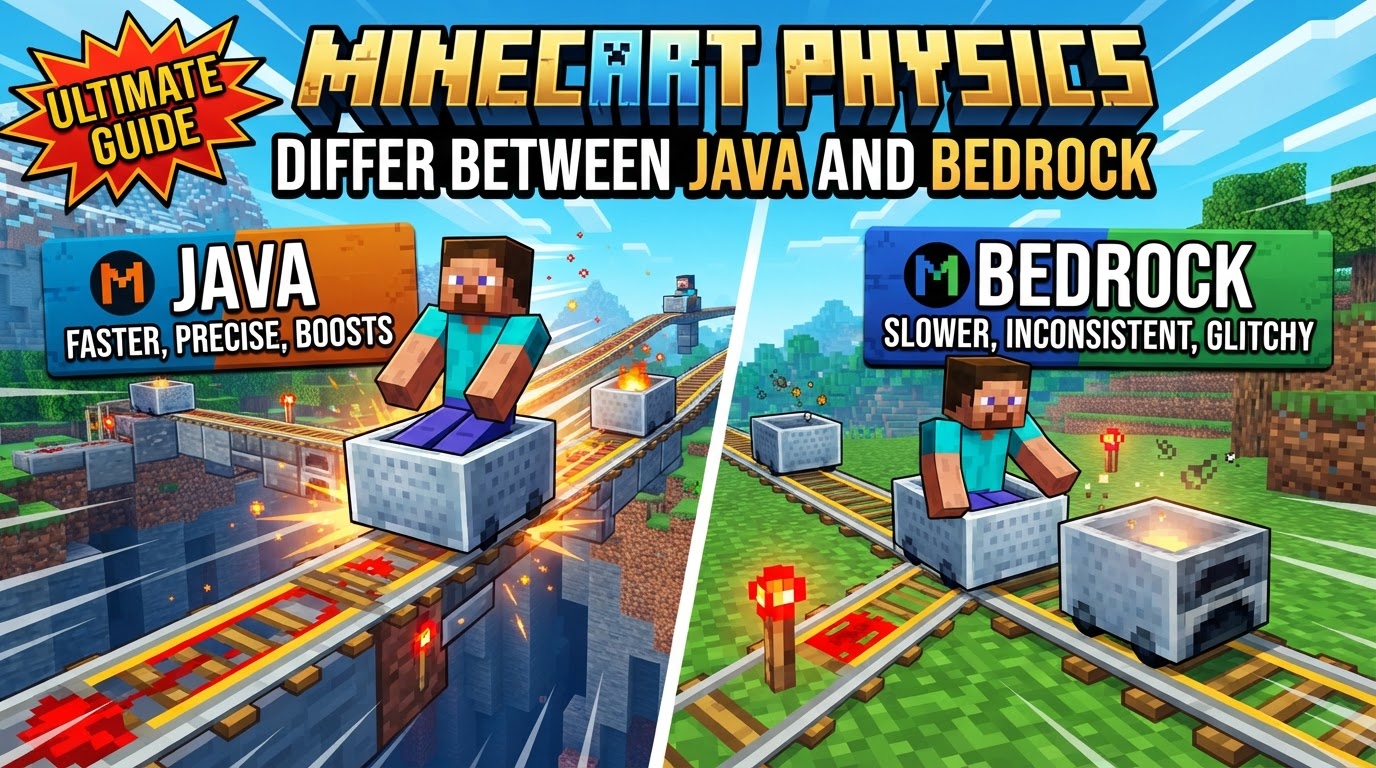
The subtle yet significant variations between Java and Bedrock Edition minecart physics dictate everything from maximum achievable speeds to how easily a cart can ascend a slope, and even how redstone signals interact with the rails. Ignoring these nuances can lead to stalled carts, derailing nightmares, or redstone circuits that simply refuse to function as expected when porting designs between editions. This guide will illuminate these critical differences, providing a comprehensive overview for builders looking to master minecart mechanics in either version.
The Quest for Velocity: Minecart Speed Dynamics
One of the most striking divergences between Java and Bedrock Edition minecarts lies in their maximum achievable speed and the methods available to manipulate it. This difference alone can reshape an entire transportation infrastructure.
Java Edition: Uncapped Potential
In Java Edition, the sky’s the limit – or rather, 1,000 blocks per second is. Minecart speed is not inherently capped at the default 8 blocks per second. Through the strategic use of commands, particularly /minecartMaxSpeed, players can significantly boost a minecart’s velocity far beyond what passive powered rails can offer. This command, when combined with experimental features like “Allow Commands” and “Minecart Improvements,” unlocks a realm of ultra-fast travel, allowing for incredibly rapid transit across vast distances in your world. This capability opens doors for sophisticated, high-speed rail networks, enabling players to traverse thousands of blocks in mere seconds. The emphasis here is on command-line control, offering a level of customization and speed not found natively in the other edition.
Bedrock Edition: The Hard Cap
Conversely, Bedrock Edition operates under a much stricter speed limitation. Minecart speed in Bedrock is hard-capped at 8 blocks per second. There are no built-in commands or game settings that allow players to natively bypass or increase this speed limit. Builders in Bedrock must therefore rely on traditional methods to maximize momentum, primarily utilizing powered rails for acceleration and maintaining speed, and incorporating gravity drops to gain additional velocity. While third-party add-ons or modifications might exist to alter this cap, these are external solutions and not part of the core game mechanics. Furthermore, pushing minecarts to excessively high speeds, even with add-ons or specific track designs, can lead to instability and frequent derailing on corners, a direct consequence of the hardcoded physics that weren’t designed for such extreme velocities.
The implications for track design are significant: Java players can envision warp-speed transit lines, while Bedrock builders must meticulously plan their routes, factoring in the consistent spacing of powered rails and the strategic use of elevation changes to achieve the fastest possible, yet stable, journey.
Ascending the Heights: Uphill Travel Mechanics
Traveling uphill presents another key area where minecart physics diverge, directly influencing the resource cost and complexity of elevated rail lines.
Java Edition: Resource-Intensive Inclines
In Java Edition, minecarts demand considerable assistance to conquer inclines. To travel uphill efficiently and without stalling, minecarts absolutely require a continuous supply of powered rails. Alternatively, a furnace minecart, with its self-propelling capabilities, can be used to push other carts up slopes. Building extensive uphill sections in Java therefore necessitates a substantial investment in gold ingots for powered rails, or a more complex system involving furnace minecarts. Without these aids, a minecart will quickly lose momentum and come to a halt on an ascending slope, making long, unpowered uphill segments impractical.
Bedrock Edition: Easier Ascents
Bedrock Edition offers a more forgiving experience when it comes to uphill travel. Minecarts in Bedrock have an inherently easier time ascending inclines. They can travel uphill with regular rails without the stringent, consistent need for powered rails or the specialized use of a furnace minecart to maintain momentum. While powered rails will certainly accelerate a minecart uphill faster, they are not always a strict requirement for simply *making it* up the slope. This characteristic can significantly reduce the gold cost for extensive rail networks in Bedrock, allowing for more expansive and less resource-intensive elevated tracks.
The Circuitry Conundrum: Redstone Integration Differences
Redstone, Minecraft’s intricate electrical system, often forms the backbone of advanced minecart contraptions. Given that redstone mechanics themselves vary between editions, it’s inevitable that minecart-related redstone interactions will also exhibit differences.
While the core principles of redstone remain, specific behaviors and properties can change. For instance, a notable difference is how redstone signals propagate through certain blocks. In Bedrock Edition, redstone signals can travel downwards through glass blocks, a behavior not observed in Java Edition. This seemingly minor distinction can have ripple effects on complex minecart loading/unloading stations, automated sorting systems, or detector rail circuits that rely on precise signal routing. Designs perfected in one edition may require significant modification or complete re-engineering to function correctly in the other, due to these underlying redstone disparities. Builders must be keenly aware of these differences when designing automated minecart systems to ensure reliable operation.
The Force of Impact: Minecart Collision Behavior
Though less explicitly documented in game mechanics, community observations frequently highlight differences in how minecarts interact upon collision, particularly in multi-cart systems.
In Java Edition, collision physics, especially when involving furnace minecarts or multiple carts in close proximity, can be quite volatile. Players have noted instances where collisions can cause minecarts to “yeet apart at light speed” if not properly managed. This can lead to carts derailing, flying off tracks, or systems breaking down. Designing robust multi-minecart systems in Java often requires careful spacing, precise timing, and mechanisms to prevent uncontrolled collisions, particularly at high speeds or when carts are carrying heavy loads. This unpredictable collision behavior can be a significant challenge for complex sorting or storage systems that rely on multiple minecarts moving in close quarters.
While Bedrock Edition’s collision physics may not elicit the same dramatic “yeeting” effect, the underlying code for object interaction is distinct. This means that even if the visual outcome isn’t as extreme, the precise timing and behavior of carts impacting each other or other entities will likely differ. Builders accustomed to specific collision outcomes in one edition should anticipate variations when designing similar systems in the other, ensuring their designs account for these subtle physical interactions.
Navigating the Pitfalls: Common Builder Mistakes
Understanding these differences is paramount to avoiding common mistakes that can derail your building projects and lead to considerable frustration:
- Expecting Java’s Speed Commands in Bedrock: This is perhaps the most frequent error. Players accustomed to using
/minecartMaxSpeedor similar commands in Java will find this functionality entirely absent in Bedrock Edition. Attempting to build ultra-high-speed tracks in Bedrock based on Java’s capabilities will result in disappointment, as carts will simply cap out at 8 blocks per second. - Designing Bedrock-Style Uphill Tracks in Java: Another common misstep involves building long, unpowered uphill segments in Java, assuming minecarts will ascend as easily as they do in Bedrock. In Java, this design will inevitably lead to stalled minecarts, requiring a costly retrofitting of powered rails or the integration of furnace minecarts.
- Assuming Identical Redstone Mechanics: Porting complex minecart-related redstone contraptions directly from one edition to the other without modification is a recipe for failure. Due to underlying redstone differences, such as signal propagation through glass, circuits designed for Java may not function in Bedrock, and vice-versa. Always test and be prepared to redesign redstone logic when transitioning between editions.
In conclusion, while minecarts serve the same fundamental purpose across both Minecraft editions, their physics are far from identical. From the speed at which they travel to their ability to climb hills and their interaction with redstone, these distinctions are critical. A true Minecraft expert understands that optimizing rail systems requires a deep appreciation for these version-specific mechanics, allowing for the construction of efficient, reliable, and frustration-free transportation networks tailored to the edition being played.
Tags:
YOU MAY ALSO LIKE...