Building a Custom Tree Design That Looks Natural
Building a custom tree in Minecraft that truly looks natural requires an understanding of organic forms, a diverse selection of blocks, and careful attention to the placement of its various components. Unlike the rigid, symmetrical trees that naturally generate in the game, a custom-built natural tree possesses an inherent organic feel, mimicking the imperfections and growth patterns found in real-world flora. The process is best approached by dissecting the tree into its fundamental elements: the sturdy trunk, the sprawling branches, and the vibrant canopy.
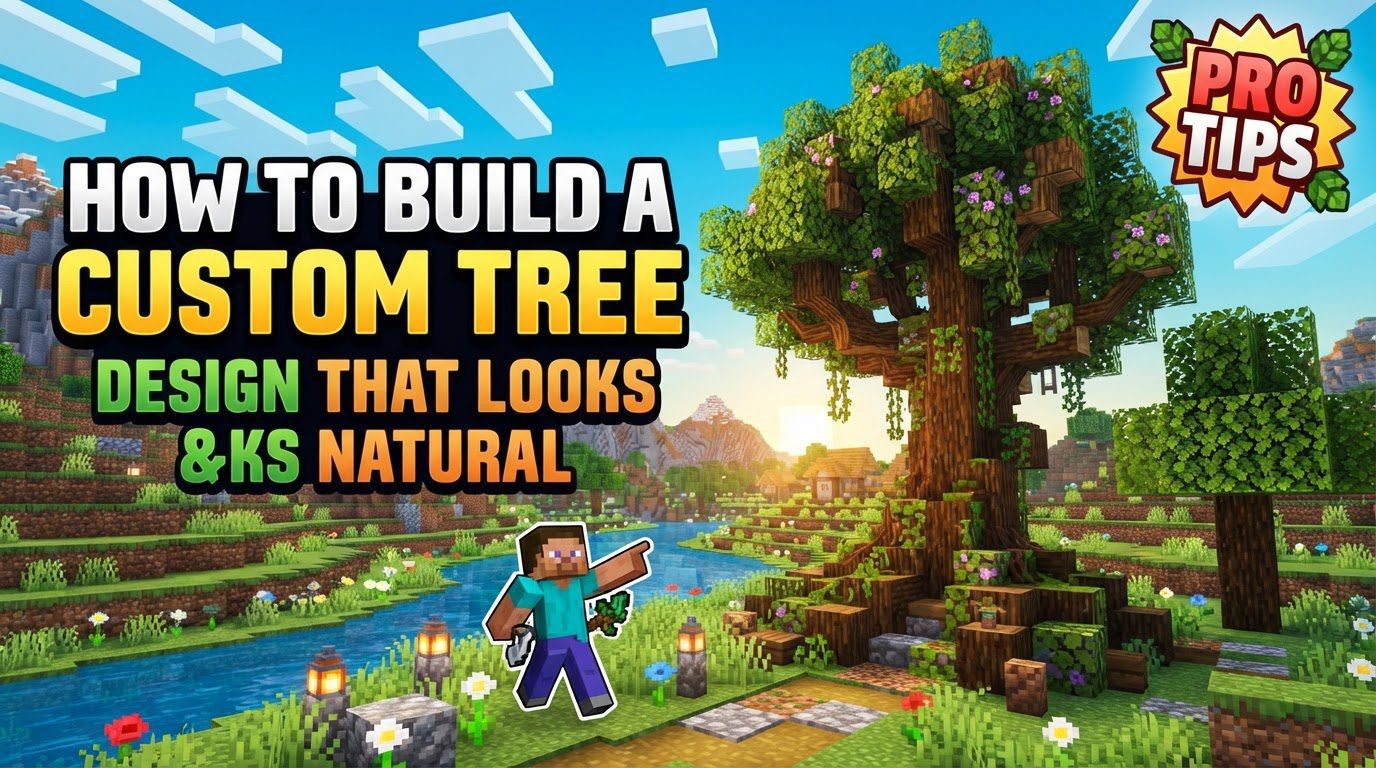
A builder’s palette for creating such structures extends far beyond simple log and leaf blocks. To add intricate detail, smooth transitions, and create the illusion of thinning parts, various utility blocks like stairs, slabs, fences, fence gates, walls, and trapdoors become invaluable. It is also crucial to remember the mechanics of leaf blocks; they are designed to decay if not connected to a log block within a certain proximity. This means careful planning is needed to ensure all leaf blocks remain attached, especially in complex custom designs. Ultimately, embracing imperfections and asymmetry is key to replicating the natural, often irregular, beauty of real trees.
Key Mechanics for Natural Tree Design
- Organic Feel: The cornerstone of a natural-looking tree is its organic form. This means avoiding straight lines, perfect symmetry, and uniform shapes. Instead, focus on curves, bends, and variations that suggest growth and adaptation to an environment, contrasting sharply with the blocky, often unnatural aesthetic of many default Minecraft structures.
- Three Main Components: Every tree, regardless of its size or species, can be broken down into a trunk, branches, and a canopy. Understanding these distinct components and how they interact is fundamental to constructing a cohesive and realistic tree. Each part plays a crucial role in the overall aesthetic and structural integrity of the design.
- Detailing Blocks: Beyond the primary log and leaf blocks, a variety of other blocks are essential for adding finesse. Stairs and slabs can create smooth curves and roots at the base of the trunk or thin out branches. Fences, fence gates, and walls are excellent for representing thinner, more delicate branches, while trapdoors can be used for small details, textures, or even to add a sense of depth and shadow.
- Leaf Decay Mechanics: Minecraft’s leaf blocks are programmed to decay if they are too far from a log block. When building custom trees, this means builders must strategically place log blocks within the canopy or ensure that leaf blocks are always within the required proximity to prevent them from despawning. This is particularly important for large, sprawling canopies where connectivity might otherwise be an issue.
- Embrace Imperfections and Asymmetry: Real trees are rarely perfectly symmetrical or uniformly shaped. They grow in response to light, wind, and obstacles, leading to unique and often irregular forms. Incorporating slight leans, uneven branching, and varied canopy shapes will significantly enhance the natural appearance of your custom tree, moving it away from a manufactured look.
Step-by-Step Process for Building a Custom Tree
Creating a truly natural custom tree is a methodical process that benefits from planning and careful execution. Follow these steps to bring your arboreal visions to life:
- 1. Gather Reference: Before placing a single block, take time to observe. Study real trees in your environment or meticulously examine reference images. Pay close attention to their unique shapes, how their branches emerge and spread, and the overall flow of their structure. Notice how trunks thicken at the base, how branches taper, and how canopies form their distinct silhouettes. This initial research is invaluable for developing an eye for organic detail.
- 2. Construct the Trunk: Begin with the foundation of your tree – the trunk. Avoid building a perfectly straight, uniform pillar. Instead, strive for an organic shape, allowing it to subtly lean, bend, or vary in thickness as it ascends. A natural trunk is typically wider at its base, gradually thinning as it reaches upwards. At the very bottom, utilize stairs, slabs, and even trapdoors to artfully form roots that seamlessly blend into the ground, creating smooth, natural-looking curves that ground the tree firmly.
- 3. Develop Branches: Once the trunk has a solid, natural form, it’s time to extend its limbs. Branches should emerge from the trunk at various heights and spread out in different directions, avoiding any sense of perfect symmetry. A common natural pattern is for branches to grow diagonally upwards, reaching towards the light. To achieve a realistic tapering effect, begin with full log blocks closer to the trunk, then transition to thinner blocks like fence gates, fences, and walls as the branches extend further outwards. Trapdoors can also be used at the very ends for the most delicate, twig-like details, creating an intricate and believable network of limbs.
- 4. Form the Canopy: The canopy is where your tree truly comes alive. Place leaf blocks carefully around the branches, ensuring a natural, rather than uniform, distribution. To add texture and color depth, mix two or more types of leaf blocks; for example, combining oak leaves with birch or jungle leaves can create a rich, varied appearance. A critical aspect of a natural canopy is the incorporation of air gaps. Instead of creating a solid, dense “blob” of leaves, strategically leave empty spaces within the canopy. These gaps allow light to filter through and prevent the tree from looking artificially dense, mimicking the way real foliage allows glimpses of sky or underlying branches. Furthermore, remember to cover the underside of leaf clusters. Neglecting this can make the canopy appear hollow and unfinished from below, detracting from the overall realism.
Important Tips for Realistic Tree Building
- Study Real Trees: This cannot be overstated. The more you observe how real trees grow, how their branches fork and spread, and how their canopies form intricate shapes, the better equipped you will be to replicate these organic forms in Minecraft. Pay attention to species-specific characteristics.
- Diverse Block Palette: Do not restrict yourself to just basic wood logs and their corresponding leaf blocks. Experiment widely with different wood types – oak, spruce, birch, jungle, acacia, dark oak, crimson, and warped – and their stripped variants for trunks and branches. For added texture and color variation in trunks, consider incorporating blocks like diorite, calcite, deepslate, and various stone types. This layering of different textures adds immense depth.
- Prioritize Air Gaps: These are absolutely vital for a realistic and airy canopy. A solid mass of leaves looks artificial and heavy. Strategically placed empty spaces within the leaf clusters create a sense of lightness, allow for natural light filtration, and break up the monotonous texture of a uniform leaf mass.
- Frame Your Builds: Custom trees are not just standalone creations; they can be powerful tools for landscaping. Position your custom trees thoughtfully to naturally complement and frame other structures or points of interest in your Minecraft world. They can draw the eye, provide shade, or define an area.
- Start Small: Especially when you’re beginning, or if you’re building in survival mode where resources are limited, it’s wise to start with smaller custom trees. This allows you to practice proportions, experiment with different shapes, and refine your techniques without committing to a massive, resource-intensive project immediately.
- Embrace Imperfection: Real trees are products of their environment, rarely achieving perfect symmetry. Allow for slight irregularities, uneven branch lengths, and varied canopy shapes. These “imperfections” are what give a tree its unique character and significantly enhance its natural appearance, making it feel less like a manufactured object.
- Consider Purpose: Not every tree needs the same level of detail. Allocate more detailing time and resources for trees that will serve as focal points in your world, such as those in a town square or at the entrance to a grand build. For trees in a dense forest where they might be less visible, a slightly simpler, yet still natural, approach might suffice.
Common Mistakes to Avoid
- Uniformity: A common pitfall is building trees with perfectly straight trunks, perfectly symmetrical branches, or perfectly spherical canopies. This results in an unnatural, stiff, and artificial appearance that instantly breaks immersion. Always aim for organic variation.
- “Blob” Canopies: Filling the entire leaf area densely without any air gaps creates what is often referred to as a “broccoli stick” look. This solid mass of leaves looks heavy, unnatural, and lacks the airy quality of real foliage. Remember to leave strategic openings.
- Neglecting the Trunk: Underestimating the importance of a detailed and organically shaped trunk is a significant mistake. A poorly constructed or overly simplistic trunk can undermine the realism of the entire tree, no matter how well the branches and canopy are done. The trunk is the tree’s backbone.
- Single Block Type: Relying solely on one type of wood block for the trunk and branches, or one type of leaf block for the canopy, leads to a flat, untextured, and uninteresting appearance. Introduce variety in your block palette to add depth and visual interest.
- Overdetailing: While detail is crucial for realism, there’s a fine line between intricate detail and clutter. Excessive detailing, especially with too many small, non-essential blocks, can sometimes make a build look messy and overwhelming rather than naturally complex. Strive for purposeful detail that enhances, not detracts.