How to build an automatic bamboo farm in Minecraft?
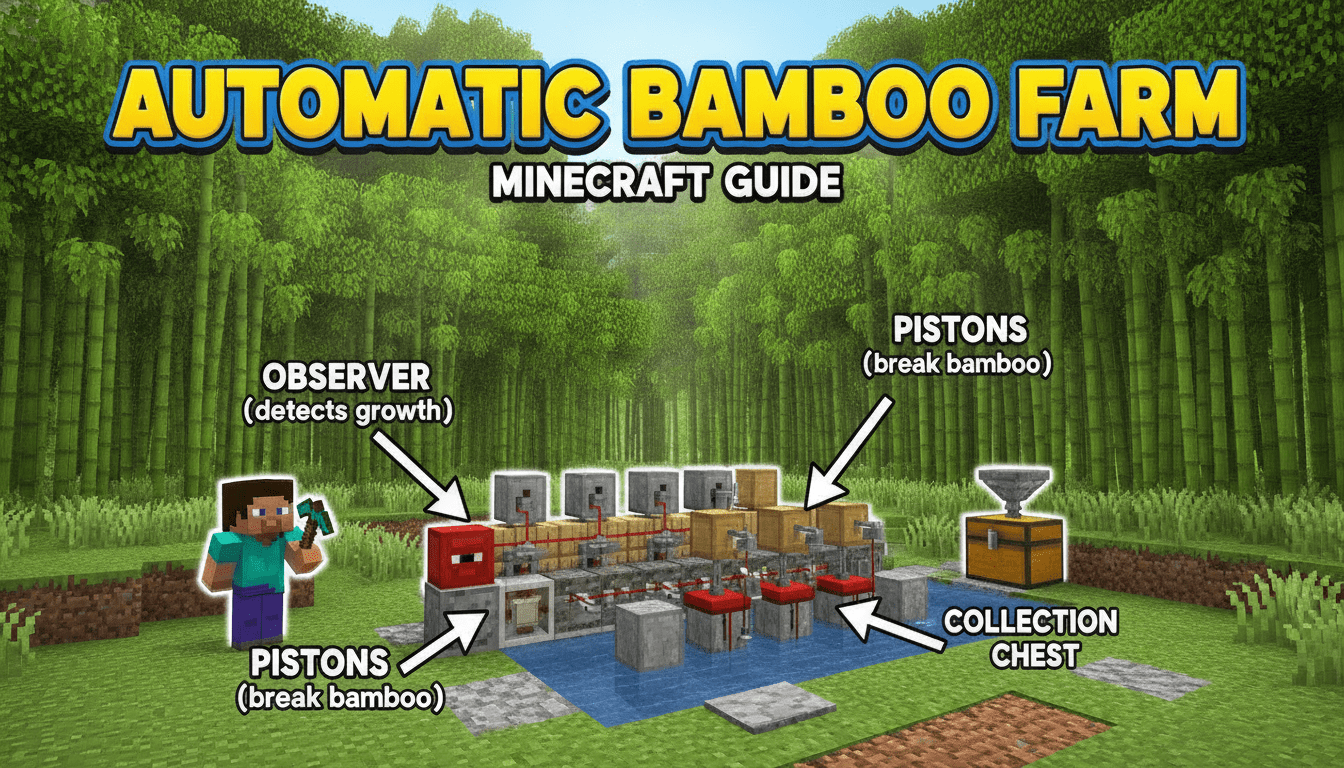
Learning how to build an automatic bamboo farm in Minecraft is a fantastic way to secure an endless supply of this versatile plant for fuel, scaffolding, or even crafting into blocks. This guide will walk you through constructing an efficient, automatic farm design that works reliably in both Java and Bedrock Editions.
What You’ll Need
Here’s a list of the essential items and materials required for a basic automatic bamboo farm, per plant you intend to grow:
- Building Blocks: Approximately 3-5 per bamboo plant. These can be any solid block like cobblestone, stone bricks, or glass for visibility.
- Where to get: Mine stone for cobblestone, then smelt it in a furnace for smooth stone, or craft it into stone bricks. Glass is obtained by smelting sand in a furnace.
- Bamboo: 1 piece per plant you wish to grow initially.
- Where to get: Found growing naturally in jungle and bamboo jungle biomes. You can also discover it in jungle temple chests, shipwrecks, or as junk loot from fishing in jungle biomes. Pandas may drop bamboo when killed (Java: 1, Bedrock: 0-2, increasing with the Looting enchantment).
- Dirt/Sand/Mud: 1 block per bamboo plant. This is the medium where the bamboo will be planted.
- Where to get:
- Dirt: Mined from grass blocks, or tilled from coarse/rooted dirt. Found in most Overworld biomes.
- Sand: Abundant in deserts, beaches, rivers, ponds, and ocean floors.
- Mud: Found exclusively in mangrove swamps.
- Where to get:
- Piston: 1 per bamboo plant.
- Where to get: Crafted at a crafting table using 3 Wooden Planks (any type), 4 Cobblestone, 1 Iron Ingot, and 1 Redstone Dust. Wooden Planks come from wood logs, Cobblestone from mining stone, Iron Ingots from smelting raw iron ore, and Redstone Dust from mining Redstone Ore.
- Observer: 1 per bamboo plant (or one observer can trigger multiple pistons if placed strategically in a row).
- Where to get: Crafted at a crafting table using 6 Cobblestone, 2 Redstone Dust, and 1 Nether Quartz. Cobblestone from mining stone, Redstone Dust from mining Redstone Ore, and Nether Quartz from mining Nether Quartz Ore in the Nether (most common around Y-level 114).
- Redstone Dust: 1 per piston.
- Where to get: Mined from Redstone Ore (requires an iron pickaxe or higher, commonly found between Y-levels -64 and -50). Can also be dropped by witches, traded from cleric villagers, or found in chests within some structures.
- Hopper: 1 per collection point (or more for a larger collection system).
- Where to get: Crafted at a crafting table using 1 Chest and 5 Iron Ingots. Chests are made from 8 Wooden Planks, and Iron Ingots from smelting raw iron ore.
- Chest: 1 or more for storage.
- Where to get: Crafted at a crafting table using 8 Wooden Planks (any type). Wooden Planks are obtained from wood logs.
Step-by-Step
Follow these precise steps to build your automatic bamboo farm. The basic design described here is scalable, meaning you can easily extend it to grow as much bamboo as you need.
1. Set Up the Collection System
The first crucial step is to create a system to collect the harvested bamboo automatically. This prevents items from despawning or scattering.
- Dig a Trench: Start by digging a 1-block deep trench where your bamboo will fall. The length of this trench will depend on how many bamboo plants you plan to have in a row. For example, for a 10-plant farm, dig a 10-block long trench.
- Place a Chest: At one end of your trench, place a chest. This will be your primary storage container. You can place a double chest for more storage capacity.
- Install Hoppers: Crouch (sneak) and right-click to place hoppers directly into the chest, filling the bottom of the trench. Each hopper should point towards the chest or another hopper that leads to the chest. This ensures all collected items are funneled into your storage. For a 10-plant farm, you’ll need 10 hoppers.
2. Create the Planting Area
This is where your bamboo will grow. It needs to be directly above your collection system.
- Place Growing Blocks: Place a layer of dirt, sand, or mud blocks directly on top of the hoppers. Each of these blocks will support one bamboo plant. Ensure they are aligned with your hoppers below.
3. Set Up Pistons and Observers
These are the core automation components that detect growth and harvest the bamboo.
- Back Wall for Pistons: Behind the row of planting blocks, place a row of solid building blocks. These will serve as a base for your pistons.
- Place Pistons: On top of these solid blocks, place pistons facing towards the planting area. Each piston should be aligned with a planting block where a bamboo plant will grow. The piston’s front face should be one block away from the planting block.
- Observer Support Blocks: Above the pistons, place another row of solid building blocks. These blocks will hold your observers.
- Install Observers: On top of these new support blocks, place observers. The “face” of each observer (the red dot) must be looking at the block where the bamboo will grow. The observer should be positioned 1-2 blocks above the planting level. For example, if your bamboo is planted on Y-level 64, the observer should be at Y-level 66 or 67, looking at Y-level 65 (the first growth stage of the bamboo). This allows the observer to detect when the bamboo grows tall enough to be harvested.
- Why this height? Bamboo can grow quite tall (up to 12-16 blocks). Placing the observer at a lower height ensures it detects the bamboo’s growth early, triggering the piston to break it before it gets too tall and potentially causes items to scatter or get stuck.
- Connect Redstone: Behind each piston, place a solid block with a piece of redstone dust on top. This redstone dust connects the observer’s signal to the piston. When the observer detects growth, it emits a brief redstone pulse, activating the piston.
4. Plant Your Bamboo
Now, it’s time to bring your farm to life!
- Plant Bamboo: Plant one piece of bamboo on each of the dirt/sand/mud blocks you prepared.
5. Build an Enclosure (Recommended)
An enclosure is vital to prevent harvested bamboo from flying out of the farm and being lost.
- Construct Walls: Build walls around your farm, at least 12-16 blocks high, using glass or any other solid blocks. Glass is excellent as it allows you to see your farm in action and lets light through.
- Ensure Adequate Lighting: Bamboo requires a light level of 9 or above at its top block to grow. If your farm is enclosed or underground, place torches, glowstone, sea lanterns, or other light sources to ensure sufficient light. Even if exposed to the sky, tall walls might cast shadows, so check the light levels with an F3 debug screen (Java Edition) or by observing growth rates.
Tips for Efficiency
To maximize the yield and longevity of your automatic bamboo farm, consider these tips:
- Scale Up: The modular design means you can easily extend your farm horizontally. Just repeat the piston, observer, and planting block setup for as many bamboo plants as you desire. Remember to extend your hopper-chest collection system accordingly.
- Lighting is Key: Always verify that the light level at the top of your bamboo plants is 9 or higher. Insufficient light will drastically slow down or even halt growth. If you build your farm underground or in a dark area, strategically place light sources.
- Prevent Item Loss: While the basic enclosure helps, sometimes items can still bounce strangely. For very large farms, you might consider adding a water stream above the hoppers to push items directly into them, although this adds complexity. For most designs, a simple enclosure is sufficient.
- Chunk Loading: For continuous production, ensure your farm is within a loaded chunk. If it’s in an unloaded chunk, it won’t produce bamboo. This might involve building it near your base or using a chunk loader (Java Edition only, and often requires advanced redstone or technical setups).
- Bamboo Uses: Remember bamboo’s versatility! It’s an excellent fuel source (smelts 0.25 items per bamboo, but can be crafted into bamboo blocks which smelt 1.5 items), useful for crafting scaffolding, and can be crafted into various decorative bamboo blocks for building.
FAQ
Q: How high can bamboo grow in Minecraft?
A: Bamboo can naturally grow up to 12 to 16 blocks tall. However, in an automatic farm, the observer will trigger pistons to break it at a much lower height (typically 2-3 blocks tall) to ensure efficient harvesting.
Q: Does bamboo need water to grow?
A: No, unlike sugarcane, bamboo does not require water to grow. It only needs a dirt, sand, or mud block to be planted on, and a light level of 9 or higher at its top block.
Q: Can I use sticky pistons instead of regular pistons?
A: While sticky pistons would work, regular pistons are sufficient and more resource-efficient for this farm design. Sticky pistons would retract the block they push, but for breaking bamboo, a simple push from a regular piston is all that’s needed.
Q: What if my farm is too big and causes lag?
A: Building excessively large farms can indeed cause performance issues, especially on servers or less powerful computers. If you notice lag, consider reducing the size of your farm or building multiple smaller farms in different areas. Ensure your collection system is efficient to prevent item buildup.
Q: Are there any differences in this farm design between Java and Bedrock Edition?
A: The basic observer-piston design described here works reliably in both Java and Bedrock Editions. While some complex redstone mechanisms can differ between versions, this simple growth detection and harvesting system is consistent. The main difference you might observe is in panda bamboo drops (Java: 1, Bedrock: 0-2).
Happy farming, and enjoy your endless supply of bamboo!
Tags:
YOU MAY ALSO LIKE...