How to build an automatic honey farm in Minecraft
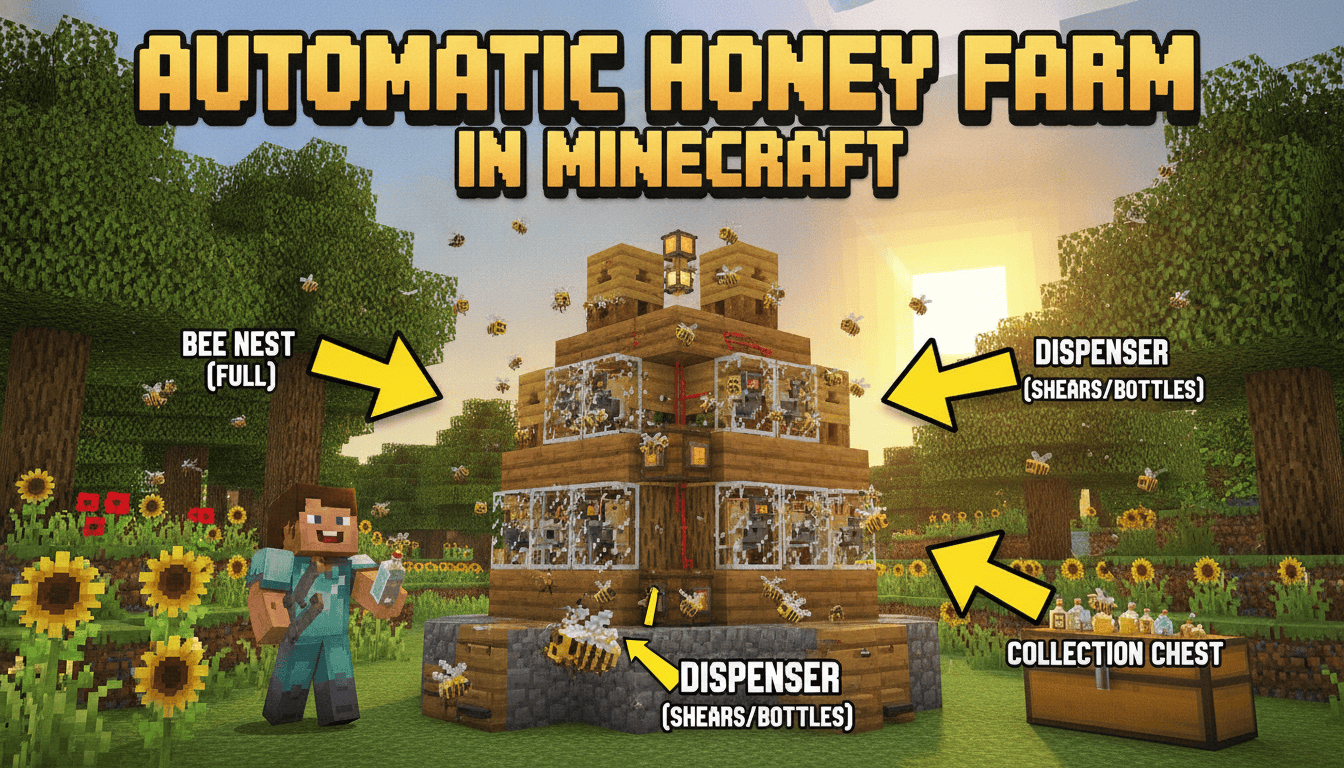
Learning how to build an automatic honey farm in Minecraft is a fantastic way to secure a steady supply of honey bottles and honeycombs without the tedious manual labor or the risk of angry bees. This guide will walk you through constructing an efficient, compact farm that works in both Java and Bedrock Editions.
What You’ll Need
Here’s a list of materials required for a single-hive automatic honey farm. Quantities will scale if you plan to build a larger farm with multiple hives.
- 1 Beehive or Bee Nest:
- Bee Nests: Found naturally on oak or birch trees in biomes like plains, forests, and flower forests. Use a Silk Touch tool to harvest it with any bees inside.
- Beehives: Crafted from 3 Honeycombs and 6 Any Wood Planks.
- 1 Dispenser: Crafted from 7 Cobblestone, 1 Bow, and 1 Redstone Dust.
- 2 Hoppers: Crafted from 5 Iron Ingots and 1 Chest.
- 2 Chests: Crafted from 8 Wood Planks. One for output, one to feed the dispenser.
- 2 Redstone Comparators: Crafted from 3 Stone, 3 Redstone Torch, and 1 Nether Quartz.
- 1 Redstone Repeater: Crafted from 3 Stone, 2 Redstone Torch, and 1 Redstone Dust.
- 7 Redstone Dust: Mined from Redstone Ore.
- 1 Redstone Torch: Crafted from 1 Stick and 1 Redstone Dust.
- ~18 Placeholder Blocks: Any solid, non-flammable block like cobblestone or stone. Used for redstone circuitry and Java item filtering.
- Plenty of Glass Bottles or Shears:
- Glass Bottles: Crafted from 3 Glass Blocks. Used to collect honey bottles.
- Shears: Crafted from 2 Iron Ingots. Used to collect honeycombs.
- Flowers: Any type of flower (except Wither Roses) to attract and encourage bees to collect pollen.
- Building Blocks: Such as glass, stone, or wood, to enclose the farm and prevent bees from escaping.
- Bees: At least 1-3 per hive for optimal efficiency. Found near bee nests, lured with flowers, or moved with leads. Breed them using any flower.
- 1 Honey Bottle (Java Edition only): For setting up an item filter in the dispenser.
Step-by-Step
This guide outlines a common, compact design for an automatic honey farm.
- Place the Collection Chest: Start by placing a double chest on the ground. This will be where your harvested honey bottles or honeycombs are collected.
- Add the First Hopper: Crouch (shift-click) and place a hopper on top of the double chest, ensuring its spout faces into the chest.
- Position the Beehive/Bee Nest:
- Place a temporary block on top of the first hopper.
- Crouch and place a second hopper on top of the temporary block, ensuring its spout faces into the temporary block.
- Remove the temporary block.
- Place your Beehive or Bee Nest directly on top of the second hopper. This hopper will collect items dropped by the dispenser.
- Place the Dispenser: Crouch and place a Dispenser directly in front of and facing into the Beehive/Bee Nest. The opening of the dispenser should be pointing at the hive.
- Build the Redstone Circuit (Honey Level Detection):
- Behind the Beehive/Bee Nest, place a Redstone Comparator directly against the hive. This comparator will detect the honey level.
- Place a solid building block directly behind the comparator.
- Place a line of Redstone Dust extending 5 blocks straight back from the block behind the comparator. This line will carry the signal to trigger the dispenser.
- Connect this redstone line to the back or side of the dispenser. The signal from the comparator will reach level 5 when the hive is full, activating the dispenser.
- Set Up the Dispenser Input Chest:
- Place a double chest on top of the dispenser. This chest will serve as the input for your glass bottles or shears.
- Crouch and place a hopper on top of this chest, facing down into the dispenser. This hopper will automatically feed bottles/shears into the dispenser.
- Optional (Java Edition) – Dispenser Item Filter:
- This step is for Java Edition to prevent harvested honey bottles from getting stuck in the dispenser and to ensure only empty glass bottles are used.
- Open the dispenser’s inventory.
- In the first slot, place 1 Honey Bottle.
- In the next 18 slots, place 18 Placeholder Blocks (e.g., cobblestone).
- Fill the remaining slots with Empty Glass Bottles. This setup ensures that when the dispenser harvests honey, the filled honey bottle is immediately pushed out into the collection system, and the dispenser prioritizes using empty bottles.
- Enclose the Farm: Build an enclosure around your Beehive/Bee Nest using glass or other solid blocks. This prevents bees from flying away and makes it easier for them to find the flowers. Leave an opening for yourself to access the input chest and for bees to fly to flowers.
- Plant Flowers: Plant several Flowers on grass blocks directly in front of or very close to the Beehive/Bee Nest. Bees need flowers to collect pollen and produce honey.
- Introduce Bees: Lure bees into your farm using flowers, or transport them using leads. You can also break a naturally occurring bee nest with Silk Touch and place it in your farm. Breed them with flowers to increase your bee population.
- Load the Dispenser: Fill the input chest (which feeds the dispenser via the hopper) with Glass Bottles (for honey) or Shears (for honeycomb). Ensure you have a plentiful supply.
Java vs. Bedrock Edition Considerations
While the core design works for both, there are important differences to note:
- Item Collection (Bedrock Edition): In Bedrock Edition, items dropped by dispensers (like honeycombs or honey bottles) can sometimes “bounce” and not be reliably collected by a hopper directly below. For more robust collection in Bedrock, consider using a minecart with hopper running on a rail beneath the collection point, or experimenting with water streams to guide items to a central hopper.
- Dispenser Behavior (Honey Bottles – Bedrock Edition): In Bedrock, it’s crucial to fill all available slots in the dispenser with empty glass bottles if you’re collecting honey bottles. If you don’t, the dispenser might try to store the filled honey bottle it just harvested, preventing it from dispensing into your collection system. The Java item filter (Step 7) is not typically used or as effective in Bedrock for this purpose.
- Redstone Mechanics: While the basic comparator-based detection works in both, subtle differences in redstone timings and block interactions can exist. Complex redstone circuits might require minor adjustments.
- Bee AI: Bees might exhibit slightly different pathfinding and wandering behaviors between versions. A secure enclosure is always recommended.
- Water Damage (Java Edition): Bees take damage from water in Java Edition. Avoid placing water sources directly where bees might fly or fall. In Bedrock, bees are not harmed by water, and a carpet over water can even allow them to pass over it safely.
Tips for Efficiency
- More Bees, More Honey: The more bees you have per hive (up to 3-4 per hive is optimal), the faster honey will be produced. Breed them often by feeding them flowers.
- Flower Density: Plant a dense patch of flowers directly in front of the hive. This minimizes the travel time for bees, increasing their pollen collection rate.
- Lighting: Ensure the area around your flowers is well-lit to prevent hostile mobs from spawning, which could harm your bees.
- Multiple Hives: Once you’ve mastered a single-hive setup, you can easily scale up by building multiple identical units side-by-side or in layers. Just ensure each hive has its own dispenser and collection system.
- Honey vs. Honeycomb: Decide whether you want honey bottles (for sugar, honey blocks, or food) or honeycombs (for beehives, honeycomb blocks, or candles). Load your dispenser with the appropriate tool (glass bottles for honey, shears for honeycomb).
- Storage: Plan for ample storage. Honey and honeycomb can stack, but you’ll accumulate a lot over time. Connect your collection chest to a larger storage system if needed.
FAQ
Q: Why are my bees getting angry when the dispenser harvests?
A: Dispensers harvest honey or honeycomb without angering bees. If your bees are becoming aggressive, it’s likely a player or another mob is manually harvesting or attacking them, or a different redstone component is interacting incorrectly. Double-check that only the dispenser is interacting with the hive.
Q: Do I need to light up the inside of the farm?
A: The inside of the farm where the hive is doesn’t necessarily need light for the bees, but lighting up the area where the flowers are planted is crucial to prevent hostile mobs from spawning and potentially harming your bees.
Q: Can I use different types of flowers?
A: Yes, any type of flower (except Wither Roses) will work to attract bees and allow them to collect pollen. Different flowers don’t impact honey production rates.
Q: How do I get more bees for my farm?
A: You can breed bees by feeding two bees any type of flower. They will then mate and produce a baby bee. You can also find naturally generated bee nests and use a Silk Touch tool to collect them with the bees inside.
Q: How often does the farm produce honey/honeycomb?
A: The production rate depends on the number of bees, the proximity of flowers, and the bees’ activity. With 3 bees per hive and ample flowers, a hive can fill up every 5-10 minutes of in-game time (assuming bees are actively working).
Enjoy your endless supply of sticky goodness!
Tags:
YOU MAY ALSO LIKE...