How to build an efficient gold farm in Minecraft?
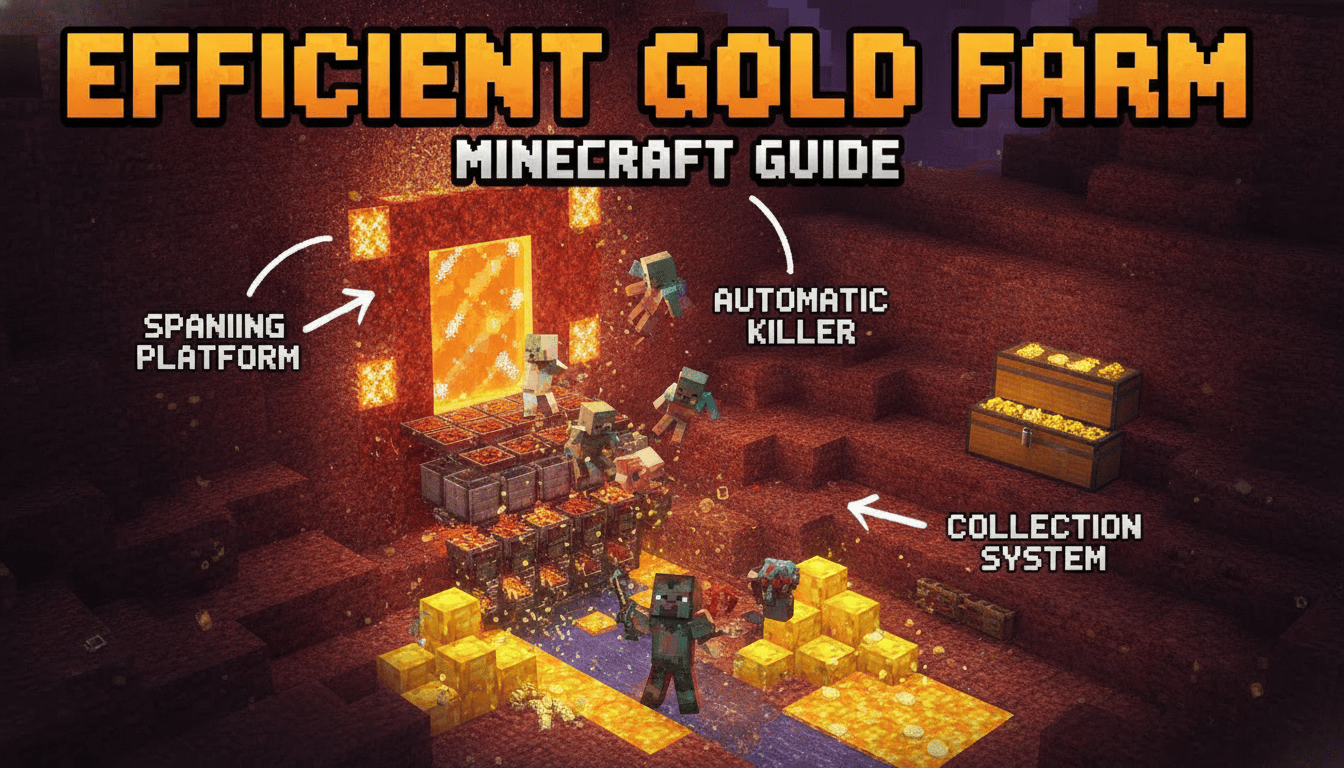
To build an efficient gold farm in Minecraft, you’ll need to harness the power of Zombified Piglin spawns in the Nether, creating a system that automatically collects their valuable drops. This guide will walk you through constructing a highly productive gold farm, detailing the necessary materials and step-by-step instructions for both Java and Bedrock Editions.
What You’ll Need
The exact quantities of materials can vary significantly based on the specific farm design you choose, but here’s a general list of common items and where to acquire them:
- Magma Blocks: Several stacks (e.g., 2880 for a large farm, or 6.5 stacks per layer).
- Obtain from the Nether, especially in Basalt Deltas biomes, or craft from magma cream (which drops from Magma Cubes).
- Glass: Several stacks (e.g., 541 or 492 for specific designs).
- Smelt sand in a furnace.
- Slabs: Several stacks (e.g., 1118 or 7 stacks).
- Craft with three stone blocks or three wood planks of the same type in a horizontal row.
- Scaffolding: 2-4 stacks (e.g., 128 or 2×64).
- Craft with 6 bamboo and 1 string.
- Trapdoors: 1-4 stacks (e.g., 60, 64, or 16).
- Craft with 6 wood planks of the same type in a 3×2 grid.
- Turtle Eggs: At least 1 per spawn platform (e.g., 4 for a multi-platform farm).
- Breed two turtles by feeding them seagrass. They will lay eggs on nearby sand. Mine the laid eggs with a Silk Touch tool to pick them up without breaking them. Be careful not to walk on them, as they can break easily.
- Hoppers: 1-2 stacks (e.g., 12, 6, or at least 4).
- Craft with 1 chest in the center and 5 iron ingots surrounding it (one above, one below, one left, one right, one in the bottom center).
- Chests: 2-12 (e.g., 12, 2, or at least 4).
- Craft with 8 wood planks of the same type surrounding a central empty space.
- Building Blocks: Several stacks of non-spawnable blocks (e.g., stone, cobblestone, glass, netherrack).
- Mine stone, cobblestone, etc. These are used for the main structure.
- Carpet: 6-9 pieces.
- Craft with 2 wool blocks of the same color in a horizontal row.
- Obsidian: For Nether portals (optional, 10 for a small portal, 36 for a Bedrock portal farm).
- Formed when water flows over lava. Mine with a diamond or netherite pickaxe.
- Flint and Steel: 1 (optional, for lighting portals).
- Craft with 1 iron ingot and 1 flint.
- Ladders: For vertical access.
- Craft with 7 sticks in an ‘H’ shape.
- Minecarts/Hopper Minecarts: 96 (for Java Edition entity cramming designs).
- Minecarts: Craft with 5 iron ingots in a ‘U’ shape. Hopper Minecarts: Craft with 1 hopper and 1 minecart.
- Rails: 4 (for Java Edition entity cramming designs).
- Craft with 6 iron ingots and 1 stick.
- Name Tags: 12 (for Java Edition entity cramming designs).
- Found in dungeon chests, strongholds, or traded with librarian villagers.
- Lava: 1 bucket (for Bedrock Edition portal farms).
- Found in the Nether or deep underground. Scoop with an empty bucket.
- Stair: 1 (for Bedrock Edition portal farms).
- Craft with 6 stone blocks or 6 wood planks of the same type in a stair pattern.
- Dispenser: 1 (for Bedrock Edition portal farms).
- Craft with 7 cobblestone, 1 bow, and 1 redstone dust.
- Observers: 3 (for Bedrock Edition portal farms).
- Craft with 6 cobblestone, 2 nether quartz, and 1 redstone dust.
- Water: 1 bucket (for Bedrock Edition portal farms).
- Found in oceans, rivers, or lakes. Scoop with an empty bucket.
Step-by-Step
The most efficient gold farms leverage Zombified Piglin spawning mechanics. In both Java and Bedrock, Zombified Piglins are attracted to turtle eggs, which can be used to lure them into a kill chamber.
Java Edition: Nether Roof Gold Farm
This design maximizes spawn rates by building on the Nether roof, where only Zombified Piglins can spawn if the area is properly cleared.
-
Access the Nether Roof:
- Find a spot near the top of the Nether (Y-level 127).
- Place a temporary block, then stand on it.
- Look straight up and throw an Ender Pearl at the top two layers of bedrock. With precise timing and positioning, you can glitch through the bedrock and land on the Nether roof.
- Once on the roof, you’ll be at Y-level 128 or higher. Build a small platform of non-spawnable blocks (like glass or stone) to secure your position.
-
Clear a Large Area:
- On the Nether roof, Zombified Piglins will spawn at Y-level 200 or higher. You’ll need to build your farm at this height.
- Clear a 128×128 block area around your intended farm location to prevent mob spawning in undesirable places. This is crucial for maximizing the farm’s efficiency.
-
Construct the Spawn Platforms:
- Build a large, flat spawn platform (e.g., 20×20 blocks or larger) out of a non-spawnable block like stone or netherrack at Y-level 200+. Zombified Piglins can spawn on any solid block.
- Around the edges of this platform, build walls two blocks high to contain the Zombified Piglins.
-
Create the Collection Area:
- Design a central drop chute or a collection system that funnels the Zombified Piglins into a single point. This often involves using water streams (in the Overworld) or simply having them walk off edges.
- At the bottom of the drop chute, create a kill chamber. This is where the Zombified Piglins will take fall damage, or be killed by an entity cramming system.
-
Install Turtle Eggs (Luring Mechanism):
- Place turtle eggs at the center of each spawn platform or at strategic points that will attract Zombified Piglins towards your drop chute. Zombified Piglins will pathfind towards and try to stomp on turtle eggs.
- Protect the turtle eggs with blocks (like trapdoors or glass panes) that only Zombified Piglins can pathfind around, or place them in a way that they fall into the chute when trying to reach the eggs.
-
Build the Kill Chamber (Java Entity Cramming):
- At the bottom of your drop chute, create a 1×1 hole.
- Place 4 rails in a square around this hole.
- Place Minecarts on the rails.
- Push 96 Minecarts into the 1×1 hole. This creates an entity cramming device.
- Name 12 Zombified Piglins with Name Tags and push them into the 1×1 hole with the minecarts. These named Zombified Piglins will not despawn and will trigger the entity cramming mechanic, killing any new Zombified Piglins that enter the block. This allows for AFK farming.
- Alternatively, you can use fall damage (making the drop 22 blocks high for most mobs) or a player-controlled killing area.
-
Set Up the Collection System:
- Below the kill chamber, place hoppers feeding into a system of chests to collect the dropped gold nuggets, gold ingots, rotten flesh, and gold swords.
- Ensure your chest system is large enough to handle the volume of drops.
Bedrock Edition: Portal-Based Gold Farm
Bedrock Edition gold farms often utilize Nether portals to bring Zombified Piglins into the Overworld, where they can be killed more easily. Building on the Nether roof is less practical for high-efficiency gold farms in Bedrock.
-
Choose a Location in the Nether:
- Build your farm in a Nether Wastes biome, at or above Y0. Avoid “hot” biomes (Basalt Deltas, Crimson Forest, Warped Forest, Soul Sand Valley) as they have different mob cap mechanics or spawn different mobs.
-
Construct a Large Nether Portal:
- Build a very large Nether portal frame. The maximum size for a functional portal in Bedrock is 23×23 blocks (21×21 internal obsidian blocks). The bigger the portal, the more spawn attempts.
- You can build multiple smaller portals or one giant one.
-
Create a Spawn Platform and Luring System:
- Around your large portal, create a spawn platform out of non-spawnable blocks.
- Place turtle eggs strategically on the platform near the portal. Zombified Piglins will spawn and pathfind towards the eggs, walking into the portal.
-
Automate Portal Activation/Deactivation:
- To prevent Zombified Piglins from despawning in the Overworld, you need to turn the portal off and on. This resets their despawn timer.
- Build a simple redstone circuit:
- Place a dispenser facing the obsidian frame of the portal.
- Put a lava bucket in the dispenser.
- Place an observer facing the portal (to detect when it’s lit/unlit).
- Place another observer facing the first observer.
- Connect these to a third observer that triggers the dispenser.
- This creates a loop that will continuously light and unlight the portal, pushing Zombified Piglins through.
- Place a water bucket in a block above the portal so the water flows down and extinguishes the portal when it’s turned off by the lava. You might need a stair block to prevent the water from flowing too far.
-
Overworld Kill Chamber:
- In the Overworld, directly where the Nether portal exits, build a collection area.
- Zombified Piglins will exit the portal. They will take fall damage if the exit is high enough (22 blocks for most mobs).
- Alternatively, you can use a player-controlled killing area with a sword, or a system of magma blocks to slowly kill them. Magma blocks deal damage when walked on.
- Another option is to use a system that funnels them into a 1×1 hole where a single player can stand and kill them with a sword, collecting XP and drops.
-
Collection System:
- Below the kill chamber, set up hoppers feeding into chests to collect all the drops.
Tips for Efficiency
- Mob Cap Management: In Java Edition, ensure your farm is the only place mobs can spawn within a 128-block radius of where you’re AFK. This directs the entire mob cap towards your farm, maximizing spawn rates. On the Nether roof, this is easier as only Zombified Piglins can spawn there.
- AFK Spot: For Java farms, find an AFK spot 128 blocks above or below your spawn platforms. This ensures maximum spawn rates within the simulated chunks.
- Looting III Sword: Always use a sword enchanted with Looting III when manually killing Zombified Piglins. This significantly increases the amount of gold and rotten flesh dropped.
- Magma Blocks vs. Fall Damage: Magma blocks are a passive way to kill mobs, but they don’t provide XP. Fall damage or entity cramming (Java) allows for AFK XP and drops. Manual killing provides the most XP.
- Gold Nugget to Ingot: Remember that 9 gold nuggets can be crafted into 1 gold ingot.
- Rotten Flesh for Villagers: The rotten flesh dropped by Zombified Piglins can be traded with cleric villagers for emeralds, adding another layer of utility to your gold farm.
- Clear Spawnable Blocks: Ensure that any areas where you don’t want mobs to spawn (e.g., around your collection system) are either lit up sufficiently or covered with non-spawnable blocks like slabs, glass, or carpet.
FAQ
Q: Why do I need turtle eggs for a gold farm?
A: Zombified Piglins are naturally attracted to turtle eggs and will try to stomp on them. This behavior can be exploited to lure them into a specific collection area or kill chamber, making the farm more efficient.
Q: What’s the difference between Java and Bedrock gold farms?
A: Java Edition often utilizes the Nether roof and entity cramming mechanics for high-efficiency, AFK farms. Bedrock Edition typically relies on large Nether portals and automated portal activation/deactivation to bring Zombified Piglins into the Overworld for killing. The Nether roof is less effective for Bedrock gold farms.
Q: Can I get XP from a gold farm?
A: Yes, if you are the one killing the Zombified Piglins (either manually with a sword or by standing near them as they die from fall damage/entity cramming). Passive killing methods like magma blocks generally do not grant XP.
Q: How much gold can an efficient farm produce?
A: Highly efficient gold farms can produce multiple stacks of gold blocks per hour, along with large quantities of rotten flesh and gold swords, making them excellent sources of gold, XP, and trading items.
Q: Do I need to worry about other mobs spawning in my gold farm?
A: In the Nether Wastes biome, Zombified Piglins are the primary hostile mob. If building on the Java Nether roof, they are the only hostile mob that can spawn, making it ideal. If building in other Nether biomes or in the Overworld, you’ll need to account for other mob spawns by lighting up areas or using non-spawnable blocks.
Building an efficient gold farm is a significant undertaking, but the rewards in gold, XP, and rotten flesh make it one of the most valuable automatic farms in Minecraft.
Tags:
YOU MAY ALSO LIKE...