How to build an escape room using redstone
Creating an escape room in Minecraft offers a unique blend of architectural design and intricate Redstone engineering. These challenging environments require players to solve a series of puzzles to progress and ultimately escape. At its heart, a successful Minecraft escape room relies on the clever application of Redstone mechanics, transforming simple blocks into complex interactive challenges. This guide will walk you through the essential components, design principles, and crucial tips for building an engaging and challenging Redstone escape room.
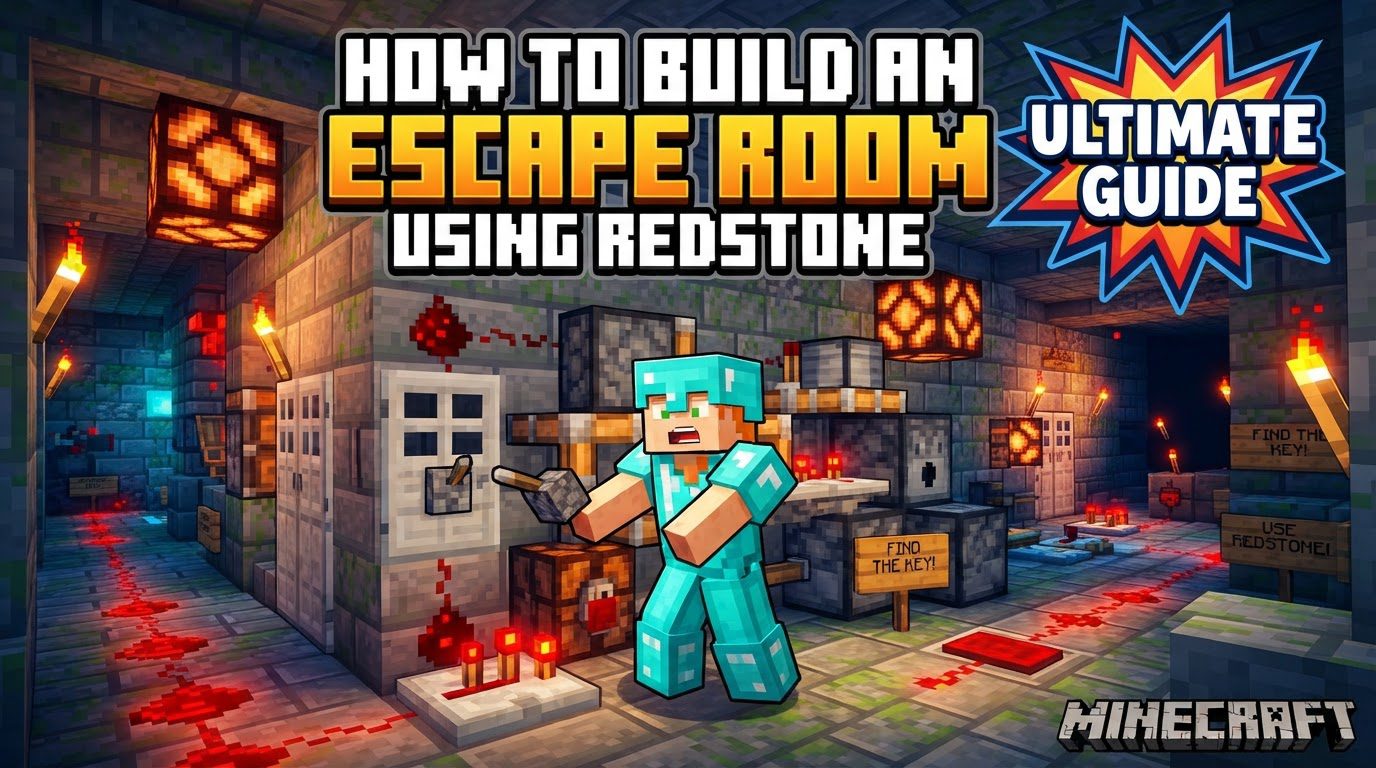
Understanding the Core Redstone Mechanics
Redstone is the lifeblood of any interactive contraption in Minecraft, acting as the wiring that powers your puzzles. Mastering its components and logic is fundamental.
- Key Redstone Components
- Redstone Dust: This is the basic conduit, used for signal transmission across distances, connecting various Redstone components to form a circuit.
- Repeaters: Essential for extending Redstone signals beyond their 15-block limit and for introducing precise delays, which are crucial for timing complex mechanisms.
- Redstone Torches: These versatile components can act as a constant power source or, more importantly, invert a Redstone signal, turning an “on” signal “off” and vice-versa.
- Comparators: Highly useful for reading the contents or state of certain blocks, such as containers (chests, dispensers) or item frames. They can also compare Redstone signal strengths, enabling sophisticated logic.
- Input Mechanisms
These are the triggers players will interact with to activate parts of your puzzles.
- Levers: Provide a continuous Redstone signal, acting as an on/off switch for duration-dependent puzzles.
- Buttons: Generate a momentary Redstone pulse, ideal for single-action events like opening a temporary door or triggering a one-time mechanism.
- Pressure Plates: Activated by players, mobs, or dropped items, they can be used for proximity-based triggers or weight-sensitive puzzles.
- Item Frames with Items: When an item is placed and rotated within an item frame, a comparator can read its orientation, allowing for combination lock puzzles.
- Item Filters (Hoppers/Droppers read by Comparators): By setting up a filter in a hopper or dropper, a comparator can detect when a specific key item is inserted, making for precise item-delivery puzzles.
- Output Mechanisms
These are the results or rewards of solving a puzzle, often powered by Redstone.
- Doors (especially Piston Doors): Redstone can open and close standard doors, but more impressively, it can control piston doors, creating hidden entrances, retractable walls, or secret passages.
- Lamps: Redstone lamps provide visual feedback, lighting up to indicate a puzzle has been solved or a stage completed.
- Dispensers: Can be triggered to dispense items, projectiles, or even buckets of lava, adding elements of surprise or progression.
- Other Contraptions: Redstone can power a multitude of other mechanisms, limited only by your imagination.
- Advanced Redstone Logic and Control
For truly complex and engaging puzzles, you’ll need to incorporate advanced Redstone logic.
- Logic Gates:
- AND Gate: Requires all input conditions to be met for an output signal.
- OR Gate: Produces an output if any one of multiple input conditions is met.
- NOT Gate: Inverts a signal (e.g., a Redstone torch next to a powered block).
- XOR Gate: Produces an output if one, but not both, of two input conditions is met, useful for specific toggles. These gates create complex puzzle logic where multiple conditions must be satisfied in a particular way.
- Signal Control:
- Pulse Extenders: Make short button presses last longer, ensuring mechanisms requiring sustained power activate correctly.
- Pulse Limiters: Shorten a continuous lever signal into a brief pulse, useful for single-action triggers from a lever.
- Clocks: Generate repetitive Redstone pulses, essential for timed events, automated sequences, or blinking lights.
- Memory & Toggles:
- Latches (Set/Reset Circuits): Crucial for maintaining a state, such as keeping a door open after a puzzle is solved, even if the input signal changes.
- Toggles: Mechanisms that switch between two states (on/off) with each activation, often used for lights or sequential puzzles.
- Secret Mechanics: Redstone is perfect for creating hidden elements that surprise players, such as concealed staircases that emerge from a wall, piston doors that vanish seamlessly, and rotating bookshelves that reveal secret passages.
- Logic Gates:
Step-by-Step Guide to Building Your Escape Room
Building a Redstone escape room is a methodical process that requires careful planning and execution.
- 1. Conceive Puzzles: Begin by designing the core challenges. Determine the solution for each puzzle and the desired sequence in which players will encounter and solve them. This initial design phase is crucial for a cohesive experience.
- 2. Room Layout: Construct the physical structure of your escape room. As you build, consider the placement of each puzzle and, critically, allow ample space for the hidden Redstone wiring and components that will power them.
- 3. Implement Individual Puzzles: Build the Redstone mechanisms for each puzzle independently. For example, you might construct an item filter that detects a specific key item, or a complex piston door that opens only when a sequence of buttons is pressed. Focus on making each puzzle fully functional on its own.
- 4. Connect Puzzles: Once individual puzzles are working, link their Redstone mechanisms. The output of one puzzle’s solution should serve as an input or trigger for the next, creating a clear and logical progression towards the escape.
- 5. Refine and Conceal: After all mechanisms are connected, meticulously hide all Redstone wiring and components. This is vital for maintaining immersion and preventing players from seeing the solutions or breaking the game.
- 6. Test Thoroughly: Playtest the escape room repeatedly, from start to finish, with different players if possible. This ensures all mechanisms work as intended, puzzles are solvable but challenging, and there are no unforeseen glitches or exploits.
Essential Tips for Success
To ensure your Redstone escape room is both functional and fun, keep these tips in mind during the construction process.
- Plan Ahead: Always design your Redstone circuits and puzzle mechanics first. It’s much easier to build the room’s physical structure around pre-planned Redstone than to try and fit complex wiring into an already-built space.
- Space is Key: Redstone circuits, especially complex ones involving logic gates or piston mechanics, can be quite large. Always provide ample room for wiring underneath, behind, or above your puzzle areas. Cramped Redstone is prone to errors and difficult to troubleshoot.
- Timing: Utilize Redstone repeaters to introduce precise delays. This is particularly important for mechanisms like piston doors, where pistons need to retract or extend in a specific order for smooth, functional movement.
- Transparency: Slabs can be a lifesaver in compact Redstone designs. They are transparent blocks that allow Redstone signals to pass through them, enabling more efficient vertical wiring and compact circuit layouts.
- Immovable Blocks: Be aware that certain blocks, such as furnaces, chests, or obsidian, cannot be pushed by pistons. This property can be intentionally used in puzzle design (e.g., a block that won’t move until a specific condition is met) or can impede movement if not accounted for.
- Command Blocks (Optional): While many purists prefer to build solely with Redstone, command blocks can simplify complex tasks, add unique features like custom messages, or manage player inventory more efficiently. However, remember they cannot be found in the creative menu and require specific commands to obtain and use.
Common Pitfalls to Avoid
Even experienced builders can fall victim to common mistakes. Being aware of these can save you significant time and frustration.
- Insufficient Space: As mentioned, not allocating enough room for Redstone wiring is a frequent error. This leads to cramped, inefficient, non-functional, or visible circuits, all of which detract from the escape room experience.
- Incorrect Timing: Improper delays in Redstone circuits are a leading cause of mechanism failure. Pistons might extend into each other, doors might not open fully, or sequences might misfire if repeaters aren’t set correctly.
- Player Cheating: Players might attempt to break blocks to bypass puzzles. Consider building your escape room in Adventure Mode to prevent block breaking, or implement anti-griefing measures to discourage cheating.
- Item Despawning: In puzzles involving dropping or placing items (e.g., item filters), ensure that items are collected, processed, or otherwise secured before they despawn. Items left on the ground will vanish after 5 minutes, potentially breaking a puzzle.
- Piston Logic Errors: For complex piston actions, especially those involving double or triple piston extenders, remember a crucial rule: the last piston in a sequence often needs to be powered first, and the first piston last, to achieve the desired smooth and complete movement. Incorrect powering order can lead to pistons getting stuck or leaving blocks behind.
Tags:
YOU MAY ALSO LIKE...