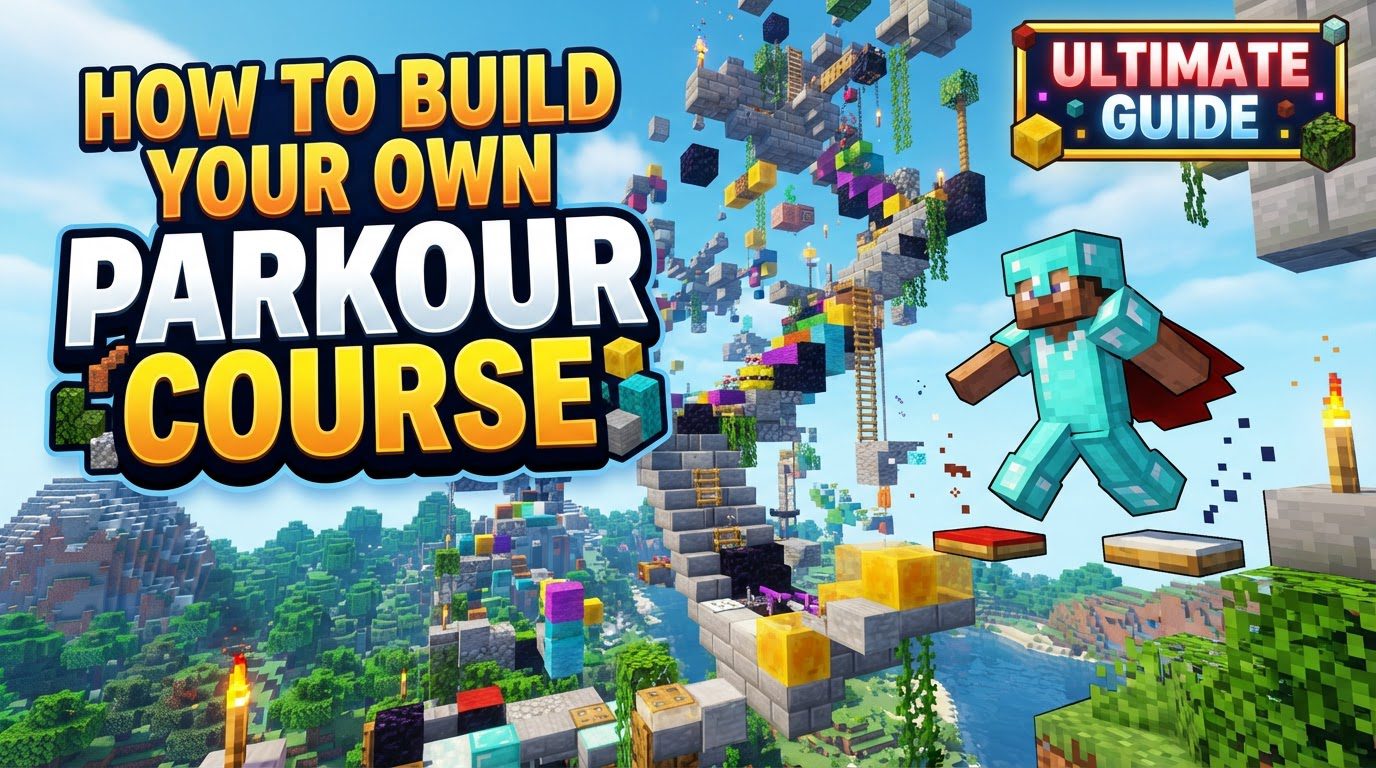
Building Your Own Parkour Course
Understanding Minecraft Parkour Mechanics
Building an effective and enjoyable parkour course in Minecraft requires a deep understanding of the game’s movement mechanics. Minecraft parkour fundamentally involves executing precise jumps and movements to successfully navigate a series of obstacles. The foundational aspect lies in mastering the various jump types and understanding how the game processes player input.
- Standard Jumps: Players can typically span gaps of 1 to 4 blocks. For longer jumps, particularly 4-block gaps, a sprinting start is absolutely crucial. Without sufficient momentum, these longer jumps are often impossible.
-
Specialized Jumps: Beyond the standard, several specialized jump techniques exist:
- Ladder Jumps: These involve precise timing to jump onto and ascend ladders, often requiring a specific approach.
- Slime Block Trampolines: Utilized for achieving higher bounces, allowing players to reach platforms that would otherwise be inaccessible.
- Neo Jumps: A technique used for navigating around corners, demanding careful positioning and timing.
- Ceiling Jumps: These focus on navigating low passages where players must jump without hitting their head, which can impede movement or cause falls.
- Diagonal Jumps: Jumps executed at an angle, often necessary for more complex course designs.
- Movement-Altering Blocks: Certain blocks can significantly impact player movement, adding layers of difficulty and variety to a course. Blocks like ice can make surfaces slippery, increasing speed but reducing control, while soul sand slows down movement considerably.
- Game Tick Precision: Minecraft’s game mechanics are updated every 0.05 seconds, known as one “tick.” This precise timing influences jump timings and overall movement precision, making understanding tick-based movements vital for advanced parkour.
- “Jamming” Technique: This involves holding the movement key (W), the jump key (space), and the sprint key simultaneously. It’s used to gain short-distance momentum quickly and efficiently.
- “Force Momentum” (FMM): FMM is a technique that allows players to gain momentum even in tight spaces. It’s achieved by initiating a jump without sprinting, and then sprinting mid-air to carry momentum forward.
- Crouching (Shift Key): Crouching is an invaluable tool for parkour. It helps in achieving safe landings, preventing accidental falls off edges, and allowing for precise positioning at the very edge of blocks before a jump.
- Game Version Differences: It’s important to note that certain game versions, such as 1.8 versus 1.9+, can slightly affect player movement and the exact distances possible for jumps. Builders should be aware of these subtle changes when designing courses for specific versions.
Step-by-step Process for Building Your Parkour Course
Creating an engaging and challenging parkour course is a systematic process that begins with planning and progresses through construction, testing, and refinement. Following these steps will help you build a well-structured and enjoyable experience for players.
- Start in Creative Mode: Always begin your build in Creative mode. This provides unlimited resources, the ability to fly, and instant block breaking, which makes the entire construction process significantly easier and faster.
- Designate Clear Start and Finish Points: Clearly mark the beginning and end of your course. This can be done using distinctive blocks, banners, or even simple signs. This helps players understand the objective and gives them a sense of progression.
- Plan the Course’s Flow: Before placing many blocks, envision the overall path and flow of your course. Integrate various obstacles such as different types of jumps, ladders, and potential traps to create variety and maintain player interest. Consider the progression of difficulty.
- Construct Jump Sections with Variety: Build jump sections that feature varying platform distances and heights. Include 1-block, 2-block, 3-block, and 4-block gaps. Also, incorporate vertical changes, requiring players to jump up or down to different levels.
- Incorporate Ladder Climbs: Add sections that require players to jump onto and ascend ladders. These elements add a different dimension to movement and precision, breaking up continuous jumping.
- Add Diverse Parkour Elements: Introduce a range of specialized parkour elements to keep the course fresh. This can include slime block bounce areas for high jumps, ice slides for tricky momentum control, or difficult corner jumps that require specific techniques.
- Consider Adding Traps: To challenge players further, integrate traps using mechanisms like dispensers firing arrows, pressure plates triggering pistons, or hidden pitfalls. Ensure these traps are challenging but do not make the course impassable or unfairly difficult.
- Place Checkpoints Strategically: Implement checkpoints using beds or respawn anchors at regular intervals. These should be placed in safe, easily accessible alcoves or platforms. Checkpoints are crucial for reducing player frustration by allowing them to restart closer to where they last fell.
- Thoroughly Test the Course: Once sections are built, test the course yourself. Perform runs, time your attempts, and identify any sections that feel excessively difficult, impossible, or too easy. This personal testing is vital for initial balancing.
- Invite Others for Feedback: After your own testing, invite friends or other players to test the course. Observe their attempts, listen to their feedback, and note areas where they consistently struggle or find exploits. Use this input to make necessary improvements and refinements.
- Utilize Command Blocks for Advanced Features: For more advanced courses, leverage command blocks. These can be programmed for features like teleporting players back to the last checkpoint upon failure, implementing currency systems for rewards, or clearing player effects at specific points.
- Integrate Parkour into a Main Build or Theme: Rather than just creating floating blocks, integrate your parkour course into a larger build or a specific theme. This enhances the aesthetic appeal and makes the experience more immersive and visually interesting for players.
Important Tips for Effective Parkour Course Design
Mastering the art of parkour building involves not just technical skill but also a keen eye for player experience and design principles. These tips will help you create courses that are both challenging and fair.
- Master Basic Jump Techniques: Before designing complex sequences, ensure you understand and can execute all basic jump types, including standing jumps, running jumps, and specialized techniques. This knowledge is fundamental to building realistic challenges.
- Utilize Full Block Space: For maximum distance, especially on longer jumps, always jump from the very edge of a block. This technique is essential for clearing 4-block gaps and maintaining momentum.
- Assign a Dedicated Sprint Key: Instead of relying on double-tapping ‘W’ to sprint, assign a dedicated sprint key (e.g., ‘Ctrl’). This provides more consistent and precise control over your sprint, which is critical for timed jumps.
- Crouch (Shift Key) Upon Landing: Make it a habit to crouch immediately upon landing on a platform. This prevents you from accidentally running off edges and allows for precise positioning, setting you up perfectly for the next jump.
- Adjust Mouse Sensitivity: Fine-tune your mouse sensitivity to a level that allows for accurate view control and precise air movement. This is crucial for neo jumps, diagonal jumps, and generally looking ahead to plan your next move.
- Always Assess Jumps: Before attempting any jump, take a moment to assess the distance and height required. Rushing into jumps without proper evaluation is a common cause of falls.
- Be Mindful of “Shoulders” and “Head-Hitters”: Pay attention to your character’s “shoulders” (hitting side blocks) and “head-hitters” (hitting overhead blocks). Both can cause you to lose momentum, get stuck, or fall, so design your course to avoid these impediments in critical jump paths.
- Sneak for Tricky Ladder Jumps: For ladder jumps that aren’t on a flat wall (e.g., jumping around a corner onto a ladder), sneaking when approaching the destination ladder can make the jump easier and more forgiving.
- Keep Ceilings Low in Specific Sections: Design sections with low ceilings to prevent players from bypassing obstacles by simply jumping over them. This forces them to engage with the intended challenge.
- Ensure All Gaps Are Realistically Possible: While challenge is good, frustration is not. Double-check that all gaps and obstacles are realistically possible for players to cross using standard game mechanics.
- Consider Mods for Optimal Timing: For serious parkour enthusiasts or builders of highly technical courses, using mods that help monitor in-game ticks can provide valuable data for optimizing jump timings and precision.
- Consistent Practice is Key: Both for building and playing, consistent practice is the most reliable way to improve your parkour skills and design intuition.
Common Mistakes to Avoid When Building Parkour Courses
Even experienced builders can fall into common traps when designing parkour courses. Being aware of these pitfalls can save you time and ensure a better experience for your players.
- Not Placing Enough Checkpoints: A frequent mistake is creating long, arduous sections without adequate checkpoints. This leads to immense frustration, especially for new players, who must restart from the very beginning after every fall.
- Creating Impossible Jumps or Gaps: Designing jumps that are physically impossible to clear, even with perfect execution, will quickly lead to a frustrating and unplayable experience. Always test thoroughly to ensure feasibility.
- Making Easy/Medium Courses Too Challenging: Tailor the difficulty to your intended audience. If a course is marketed as easy or medium, making it excessively difficult will deter players and create a negative impression.
- Designing a Flat, Two-Dimensional Path: A common oversight is building a course that lacks verticality and visual interest. Parkour is more engaging when integrated into a dynamic, three-dimensional environment rather than just a linear sequence of floating blocks.
- Allowing Unintended Shortcuts or Exploits: During testing, be vigilant for any ways players can bypass challenges or skip sections. These exploits undermine the intended difficulty and design of your course.
- Building Sections Too Far Below Start: Avoid placing parkour sections excessively far below the starting point (e.g., 35 blocks or more). This can interfere with the functionality of teleportation blocks and other command-based features designed to reset players.
- Holding/Pressing Jump on Slime Blocks: When landing on slime blocks, do not hold or repeatedly press the jump button. This can disrupt the natural bounce mechanic, often causing players to lose momentum or fall prematurely. Allow the block to propel you naturally.
- Forgetting Room for Running Starts: On longer jumps, especially 4-block gaps, players need sufficient space to build up a running start. Forgetting to provide this run-up space makes these jumps impossible.
- Ignoring Game Version Impact: Different game versions can have subtle differences in player movement physics. Ignoring these changes can lead to courses that are perfectly playable in one version but impossible or unfairly difficult in another. Always consider your target version.
Tags:
YOU MAY ALSO LIKE...