Calculating Saturation Restoration by Food Type (Step by Step)
Understanding Saturation in Minecraft: A Comprehensive Guide
In the vast world of Minecraft, managing your hunger is a fundamental aspect of survival and progression. While the visible hunger bar, depicted by drumstick icons, is straightforward, there’s a crucial, hidden statistic that plays an equally vital role: saturation. Understanding how saturation works and how different food types restore it is key to efficient resource management, sustained exploration, and consistent health regeneration. This guide will delve into the mechanics of saturation, how it’s restored by food, and strategies for maximizing its benefits.
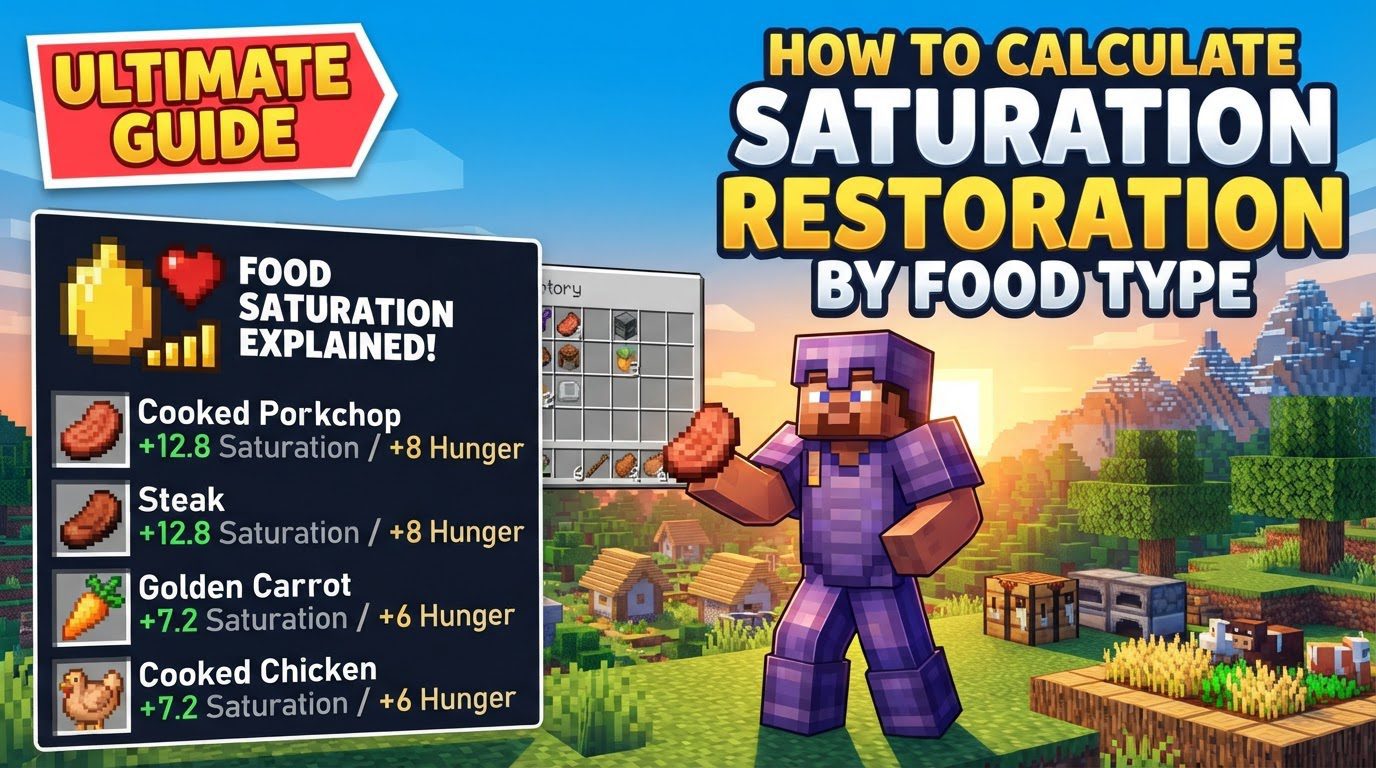
The Hidden Mechanic: What is Saturation?
Saturation is a hidden statistic that acts as a protective buffer for your visible hunger bar. Think of it as an invisible layer of fullness that must be depleted before your actual hunger points begin to decrease. When a player consumes food, both their visible hunger points and their hidden saturation points are replenished simultaneously. This dual restoration mechanism is central to how long you can perform actions before needing to eat again.
As you engage in various activities within Minecraft – such as sprinting, jumping, swimming, and attacking – your saturation level is the first to deplete. Only once your saturation has been completely exhausted will your visible hunger bar start to drop. This critical sequence means that a high saturation level grants you a significant period of activity without the immediate need for more food. A subtle visual cue that your saturation is depleted and hunger is about to fall is a slight bouncing or “rippling” animation on your hunger bar.
An important constraint to remember is that a player’s current saturation level cannot exceed their current hunger level. For instance, if your visible hunger bar is currently at 5 points (2.5 drumsticks), your hidden saturation level cannot be higher than 5 points, regardless of how much saturation the food you just ate might have theoretically provided. This ensures that saturation is always tied to the current state of your hunger.
Saturation’s Role in Health Regeneration
Beyond simply delaying hunger, saturation plays a pivotal role in your character’s ability to regenerate health. Automatic health regeneration occurs under specific conditions: your hunger bar must be at 18 hunger points (9 drumsticks) or more, AND you must have any amount of saturation left. If your hunger is high but your saturation is at zero, natural health regeneration will not occur. This makes maintaining a healthy saturation level crucial for survival, especially during combat or after taking damage. Foods that provide ample saturation directly contribute to your ability to heal over time, allowing you to sustain yourself without relying solely on potions or other healing items.
The Eating Process: How Food Restores Saturation
Every food item in Minecraft is designed with a predefined “saturation restored” value, in addition to its hunger restoration value. When you consume a food item, the game follows a specific two-step process:
- First, the game restores your hunger points up to your maximum hunger level, which is 20 points (10 drumsticks). Any hunger points provided by the food beyond what’s needed to reach 20 are effectively lost.
- After your hunger points are restored, the food’s specific “saturation restored” value is added to your current hidden saturation level. However, this addition is capped: your saturation level cannot exceed your current hunger level. This means if your hunger bar is at 15 points, your saturation cannot go above 15 points, even if the food would normally provide more.
This process highlights that while food provides both hunger and saturation, the saturation benefit is directly influenced by your current hunger state. Eating when your hunger is already high will still provide saturation, but eating when your hunger is very low will first prioritize filling the hunger bar before fully applying the saturation bonus.
Understanding Food Efficiency: “Nourishment” or “Effective Quality”
To truly understand how to optimize food consumption, it’s helpful to consider a concept often referred to as “effective quality” or “nourishment.” This metric helps you assess how efficient a food item is at maintaining your saturation relative to the hunger it restores. The formula for this efficiency is straightforward:
Saturation / Hunger Points Restored
Foods with a higher ratio from this calculation are considered more efficient for maintaining saturation. This means they provide a greater amount of saturation for each hunger point they replenish. For example, a food that restores 4 hunger points and 9.6 saturation points would have a nourishment value of 2.4. Another food that restores 6 hunger points and 7.2 saturation points would have a nourishment value of 1.2. In this scenario, the first food is significantly more efficient at providing saturation per hunger point. Prioritizing foods with a higher nourishment value is particularly beneficial when your hunger bar is already relatively full, as they top up your saturation without overfilling your hunger unnecessarily.
Strategic Eating: Important Tips for Maximizing Saturation
Mastering saturation management can significantly improve your Minecraft experience. Here are some important tips:
- Prioritize Foods with High Saturation Values: To stay full longer and consistently maintain health regeneration, always lean towards foods known for their high saturation. Golden carrots are widely considered among the best for saturation due to their excellent ratio. Similarly, cooked beef and pork chops also offer exceptional saturation, making them staple choices for efficient hunger management. These foods allow you to spend more time exploring, mining, or fighting and less time worrying about your hunger.
- Eat at the Right Time: Instead of waiting for your hunger bar to be critically low, aim to eat when your hunger bar first shows empty spots. Eating at this point maximizes the benefit of the food’s saturation. If you wait until your hunger is very low, a significant portion of the food’s value will go towards refilling your visible hunger bar, potentially limiting the saturation bonus due to the saturation cap equal to current hunger.
- Stock Up for Expeditions: For long mining trips, extensive explorations, or challenging combat encounters, highly saturating foods are indispensable. Items like golden carrots or perfectly cooked steaks (cooked beef) are highly recommended. Their ability to keep you full and regenerating health for extended periods reduces the need for frequent stops and allows for more productive gameplay.
- Mix and Match Foods: While high-saturation foods are excellent, sometimes you might have an abundance of other food types. Don’t be afraid to mix and match. Use lower-saturation foods to top off your hunger when it’s only slightly depleted, saving your premium high-saturation foods for when you need their full buffer effect. The goal is to keep both your hunger and saturation topped up effectively.
- Leverage Suspicious Stew: Certain varieties of suspicious stew can provide unique status effects. Specifically, stews crafted with a blue orchid or a dandelion can grant the “Saturation” status effect. This effect significantly boosts your saturation over a short period, offering a powerful temporary advantage for intense activities or quick recovery.
- Consider Nourishment Value for Efficiency: When your hunger bar is already relatively full, paying attention to the “nourishment value” (saturation-to-hunger ratio) becomes even more critical. Foods with a higher nourishment value are more efficient in this scenario, as they provide a greater saturation boost per hunger point, preventing waste and ensuring your hidden buffer is as robust as possible without overeating.
Common Pitfalls: Mistakes to Avoid
Even experienced players can make mistakes regarding hunger and saturation. Being aware of these common pitfalls can help you play more efficiently:
- Eating When Full: A common mistake is consuming food when your hunger bar and saturation are already full. This completely wastes the saturation benefits of the food, as neither hunger nor saturation can exceed their maximums. Always check your hunger bar before eating.
- Low-Saturation Foods for Strenuous Activities: Relying on low-saturation foods (like cookies or raw berries) for extended periods, especially when engaging in strenuous activities like sprinting or fighting, is inefficient. These foods will lead to much faster hunger depletion, forcing you to eat more frequently and potentially interrupting your activities.
- Allowing Hunger to Drop Too Low: Allowing your hunger bar to drop too low has severe consequences. If it falls below 6 hunger points (3 drumsticks), you will be unable to sprint. More critically, if it drops below 18 hunger points (9 drumsticks), natural health regeneration will cease, making you vulnerable to damage. Always keep your hunger above these thresholds.
- Ignoring the Hidden Saturation Mechanic: Many players focus solely on the visible hunger bar, not realizing the crucial role saturation plays. Ignoring this hidden mechanic means you’re missing out on a vital layer of defense against hunger depletion and an essential component of health regeneration. Understanding and actively managing saturation is a hallmark of efficient Minecraft gameplay.
By understanding and applying these principles, you can transform your hunger management from a constant struggle into a strategic advantage, allowing for more enjoyable and successful adventures in Minecraft.
Tags:
YOU MAY ALSO LIKE...