How to Calculate the Exact Optimal Y-Level for Branch Mining (Based on Your Goal)
If you’ve been playing Minecraft for years, you might still be digging at Y=11 out of habit. That needs to stop. Since the Caves & Cliffs update (1.18), the entire ore generation system was rewritten. The world now stretches from Y=320 down to Y=-64, and ores generate in “triangular” distribution patterns-meaning each ore type has a specific center Y-level where it’s most common, becoming rarer as you move away from that peak.
This completely changes the math of branch mining. The old “dig at Y=11 for everything” strategy is obsolete. Today, the optimal Y-level depends entirely on what you’re trying to find-and how much risk you’re willing to accept.
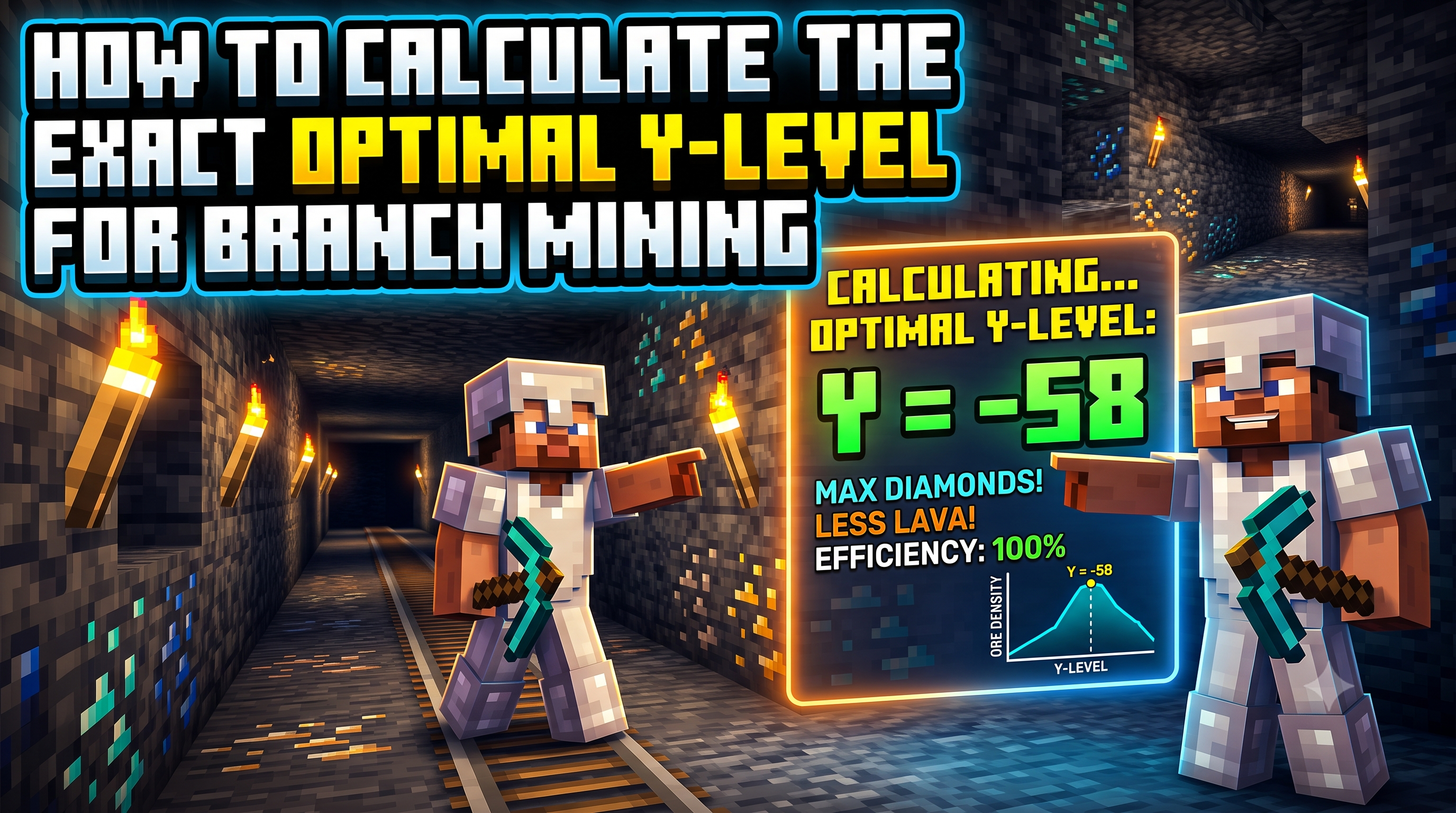
The Core Principle: Triangular Distribution
Before we dive into specific numbers, understand this: ore spawns are no longer uniform below a certain depth. Each ore follows a bell-curve-like distribution. The deeper you go (for most ores), the more you find-but only up to a point. Once you hit the peak, going deeper actually reduces your chances per block. This means precision matters more than ever.
Deepslate begins at Y=0 and extends down to bedrock at Y=-64. Deepslate takes significantly longer to mine than regular stone, so every block you dig at deep levels costs more time and durability. This is why choosing the right Y-level isn’t just about ore density-it’s about efficiency per second, not just per block.
Goal 1: Maximum Diamonds (Pure Yield)
If your only goal is to get as many diamonds as possible per hour, the math is clear. Diamonds generate between Y=-64 and Y=16, with the highest concentration at Y=-59. Multiple sources confirm that Y=-59 is the absolute peak for diamond density.
Recommended Y-Level: -59
At this level, you’re sitting just above bedrock. You’ll get the maximum diamond spawn rate possible. The trade-off? Lava lakes commonly generate at Y=-54. Mining at Y=-59 means you’re constantly dealing with lava-you’ll need water buckets, careful tunneling, and good reflexes. You’ll also be mining through deepslate the entire time, which is slower than stone.
For branch mining at Y=-59, experienced players recommend a main tunnel 2 blocks high and 1 block wide, with branch tunnels every 3 blocks. This spacing ensures you expose maximum ore while mining minimum blocks. One Reddit user bluntly stated that “the optimal y level to mine diamonds is between -58 and -61”-a sentiment echoed across the community.
Goal 2: Diamonds with Safety (Balanced Approach)
Not everyone wants to swim in lava every mining session. If you’re playing hardcore, or you just value your sanity, Y=-53 is the community’s consensus pick for the best balance of diamond density and safety.
Recommended Y-Level: -53
Y=-53 sits just above the primary lava layer (which typically starts at Y=-54). You’ll still find plenty of diamonds-the density is only slightly lower than at Y=-59-but you’ll encounter far fewer lava lakes. This means less time spent blocking lava, fewer deaths, and faster overall mining because you’re not constantly rerouting around hazards.
One guide notes that “Y=-54 is the lava pool level, making it easier to mine”, and many players actually prefer mining at Y=-54 for this exact reason. You give up a tiny bit of density to sit a few blocks above the worst of the lava, which makes branch mining safer and faster overall.
For hardcore players or those who simply hate losing gear to lava, Y=-53 is the optimal choice.
Goal 3: Redstone (Same as Diamonds)
Redstone follows the exact same distribution curve as diamonds. It spawns from Y=-64 to Y=16, with its peak at Y=-59.
Recommended Y-Level: -59 (or -53 for safety)
If you’re mining for redstone, you can use the exact same strategy as diamond mining. In fact, mining at Y=-59 is incredibly efficient because you’re getting diamonds, redstone, and some iron all in one trip. One guide calls this “the most efficient single Y-level for general mining”.
If you specifically need redstone and don’t care as much about diamonds, the same levels apply. Redstone is most abundant at deep levels, so branch mining at Y=-59 or Y=-53 will give you the best results.
Goal 4: Iron (High or Low)
Iron is unique because it has two optimal Y-levels. It spawns abundantly at Y=16 underground, but also at Y=232 inside mountains.
Recommended Y-Level: 16 (underground) or 232 (mountains)
For branch mining, Y=16 is your best bet. Iron is most common around this level, and you’ll be mining through regular stone rather than deepslate, which is much faster. If you’re near a mountain biome, mining at high elevations (around Y=232) can yield enormous iron veins. But for traditional branch mining, Y=16 is the community standard.
One Reddit user noted that “Y level 16-18 is ideal for iron”, and that you can find plenty of iron while strip mining for diamonds at Y=-54. However, if iron is your primary target, Y=16 is far more efficient because you avoid deepslate entirely.
Goal 5: The “Everything” Mine (Multi-Ore)
Sometimes you don’t want to specialize. You just want to come back with a full inventory of various ores. For this, the community has a clear favorite.
Recommended Y-Level: -59
At Y=-59, you get diamonds, redstone, and iron all in one location. This is the most efficient single Y-level for general mining. You’re hitting the peak for two of the most valuable ores (diamond and redstone) while still getting decent iron yields.
Some players argue for Y=9 as a “no deepslate” option that still gives access to multiple ores. However, the diamond density at Y=9 is significantly lower than at Y=-59. If you want diamonds, you need to go deep.
Goal 6: Ancient Debris (Nether)
The Nether is a different beast entirely. Ancient debris generates between Y=8 and Y=119, with its highest concentration at Y=15.
Recommended Y-Level: 15
Mining at Y=15 or Y=16 keeps you safely above the lava lake threshold in the Nether. If you hit a lava pocket, it drains downward rather than rushing into your face-a significant safety advantage.
For branch mining ancient debris, the same principles apply: dig a main hallway at Y=15, then branch out every 3 blocks. However, many veteran players recommend bed mining or TNT mining instead of traditional branch mining for ancient debris, as these methods clear large areas of netherrack much faster.
The Efficiency Formula: How to Calculate Your Optimal Level
If you want to calculate the exact optimal Y-level for your specific situation, here’s the formula the community uses:
Step 1: Identify your primary target ore. What are you mining for? Diamonds? Redstone? Iron? Each has a different peak.
Step 2: Consider your risk tolerance. Are you willing to deal with constant lava for maximum yield? Or do you prefer a safer, slightly less productive mine? Y=-59 is max yield; Y=-53 is safer.
Step 3: Factor in deepslate. Below Y=0, you’re mining deepslate, which takes longer. If your target ore has a peak above Y=0 (like iron at Y=16), you’ll be far more efficient mining there because you avoid deepslate entirely.
Step 4: Consider multi-ore efficiency. If you want multiple ores, Y=-59 gives you diamonds and redstone together. If you want iron and coal, Y=16 or Y=96 are better choices.
Step 5: Test and adjust. The community agrees that “Y=-59 for max density or Y=-53 to avoid lava” is the standard formula. But every world is different. Mine a few branches at different levels and track your yields. The numbers don’t lie.
Branch Mining Setup: The Standard Pattern
Once you’ve chosen your Y-level, the branch mining pattern itself is critical to efficiency. Here’s the community-standard setup:
- Main tunnel: 2 blocks high, 1 block wide, dug in a straight line for 20-50 blocks
- Branch spacing: Every 3 blocks along the main tunnel, dig a branch tunnel perpendicular to it
- Branch dimensions: 2 blocks high, 1 block wide, extending 10-20 blocks (or until you hit a cave)
- Efficiency: This pattern exposes approximately 40% of blocks while mining only about 10%
The 3-block spacing is critical. Closer spacing wastes time mining extra tunnels. Wider spacing misses ores that generate between branches. One analysis suggests that for diamonds, 3-block spacing is optimal.
Quick Reference: Optimal Y-Levels by Goal
| Your Goal | Optimal Y-Level | Why |
|---|---|---|
| Maximum Diamonds | Y=-59 | Peak diamond density; highest yield per block |
| Safe Diamonds (Hardcore) | Y=-53 | Above main lava layer; slightly lower density but much safer |
| Redstone | Y=-59 | Same distribution as diamonds |
| Iron (Underground) | Y=16 | Peak iron density; no deepslate |
| Iron (Mountains) | Y=232 | Mountain biomes have huge iron veins at high elevation |
| Gold | Y=-16 | Peak gold density in most biomes |
| Lapis Lazuli | Y=0 | Peak lapis density around sea level |
| Coal | Y=96 | Coal is most common in mountains; rare deep underground |
| Everything (Multi-Ore) | Y=-59 | Diamonds + redstone + iron in one trip |
| Ancient Debris (Nether) | Y=15 | Peak ancient debris density; above Nether lava lakes |
Final Thoughts from the Community
The Minecraft community has thoroughly tested these numbers. Reddit threads consistently confirm that Y=-59 is the tried-and-tested standard for diamond mining. Players report that “Y=-59 remains the most diamond-rich level, while Y=-53 offers a safer alternative in terms of lava hazards”.
One important note: caving has become significantly more effective since 1.18. The massive cave systems that generate deep underground often expose diamond ore on cave walls, making cave exploration faster than strip mining in many cases. However, branch mining remains the most reliable and predictable method-you know exactly what you’re getting and can calculate your expected yield per hour.
The old Y=11 strategy is dead. Embrace the new math, choose your Y-level based on your specific goal, and happy mining.
Tags:
YOU MAY ALSO LIKE...