Combining Applied Energistics 2 with Refined Storage Networks, Explained
Applied Energistics 2 (AE2) and Refined Storage (RS) are popular Minecraft mods offering centralized storage, automated crafting, and item transportation. Despite similar core functionalities, they operate on fundamentally different principles. This guide details how to combine these systems, not by direct merging, but by creating a bridge for shared resources, leveraging each mod’s strengths.
Understanding Key Mechanics
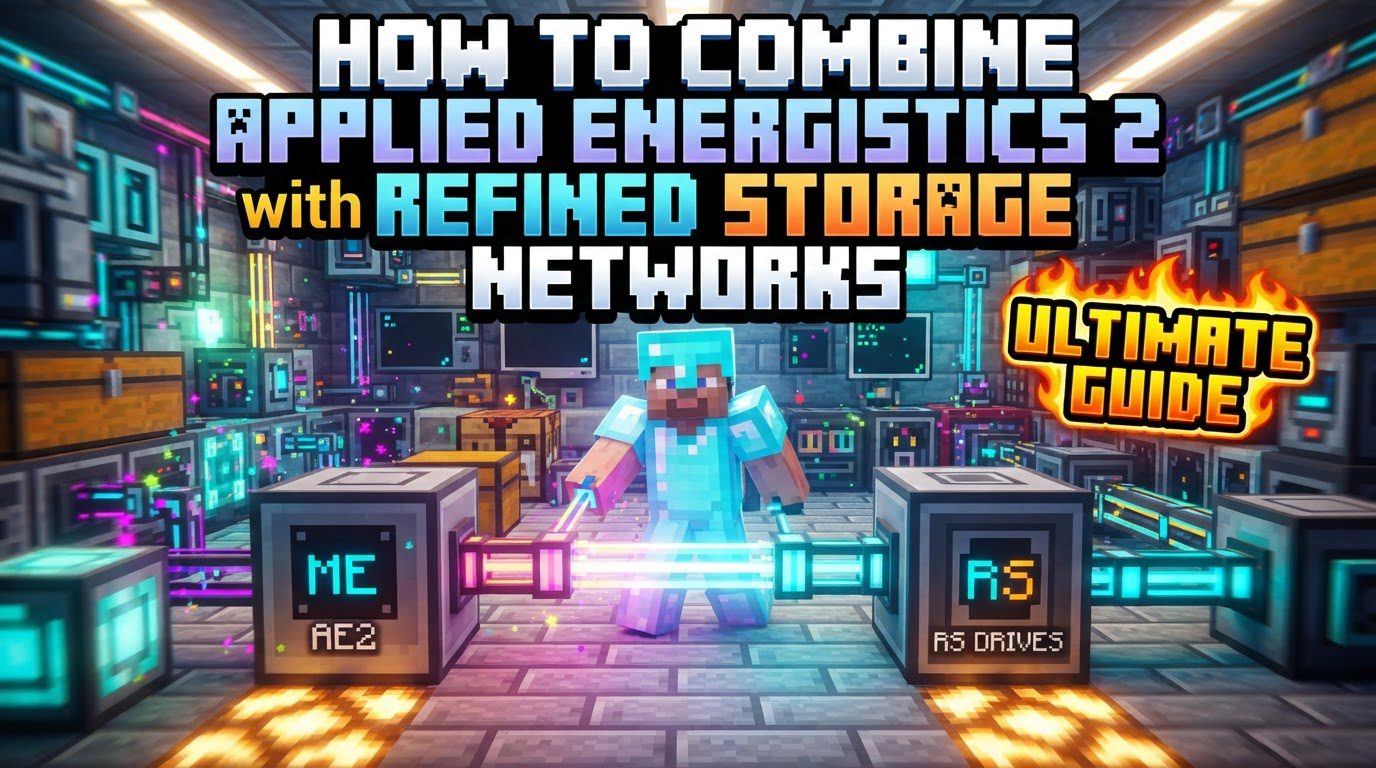
AE2 and Refined Storage are not designed for direct, seamless integration as primary storage systems. Their underlying philosophies and internal workings differ, making direct connections between their controllers or network cables impossible. Both mods use a central controller (AE2’s ME Controller or Energy Acceptor; RS’s Controller) for power and network functionality, along with dedicated storage components (AE2 ME Cells, RS Disks) and cables for item and power distribution.
A key distinction is AE2’s channel system, which limits devices per cable, requiring careful planning. Refined Storage lacks this limitation, often appearing simpler for beginners. While RS is more beginner-friendly and easier to set up, AE2 is generally considered more powerful and efficient for complex late-game automation.
Step-by-Step Process: Indirect Integration via Shared Inventory
Since direct integration is not possible, the most effective method to combine AE2 and Refined Storage networks involves a shared intermediate inventory. This allows both systems to access the same item pool.
- 1. Set up Independent Networks: Establish fully functional AE2 and Refined Storage systems separately. Each needs its own power, controller, storage, and access terminals. Ensure both networks are stable before attempting to link them.
- 2. Choose a Shared Inventory: Select an intermediate storage solution. A chest or barrel works, but a Storage Drawer system is highly recommended. Storage Drawers offer high capacity for single-item types, and their Controller Block exposes a vast, combined inventory, ideal for a central hub.
- 3. Connect AE2 to Shared Inventory: Place an AE2 ME Storage Bus directly onto the shared inventory (e.g., a Storage Drawer Controller or chest). Configure it to access the items, making them available through your AE2 network.
- 4. Connect Refined Storage to Shared Inventory: Place a Refined Storage External Storage block onto the *same* shared inventory. Configure it to monitor the items. Now, items in the shared inventory will appear in your RS grid.
- Alternative Connections: An RS External Storage can be placed on an AE2 Interface, or an AE2 ME Storage Bus on an RS Interface. This allows one system to view contents exposed by the other’s interface, providing another integration layer.
- 5. Configure Priorities (Recommended): Adjust priorities on the AE2 ME Storage Bus and Refined Storage External Storage. Different priority values dictate which system prefers to store new items or pull items out. This manages efficient item flow and prevents circulation.
- 6. For Bulk Item Transfer: For large item transfers between systems:
- From AE2 to an intermediate inventory for RS: Use an AE2 ME IO Port to extract items from AE2 ME Cells into an adjacent inventory, accessible by RS External Storage or an Importer.
- From RS to an intermediate inventory for AE2: Utilize an RS Disk Manipulator to pull items from Refined Storage disks into an adjacent inventory, accessible by an AE2 ME Storage Bus.
Important Tips for Effective Integration
- Utilize Storage Drawers: Pairing either AE2 or RS with Storage Drawers is highly effective. A Storage Drawer Controller centralizes access to many drawers. A single AE2 ME Storage Bus or RS External Storage on the Controller accesses a vast inventory, simplifying network design and reducing AE2 channel usage.
- Subnets for AE2: For larger AE2 systems, implementing subnets and P2P tunnels is critical. These manage and extend channel capacity, preventing devices from going offline due to limits. Subnets create isolated network sections, while P2P tunnels transmit multiple channels over a single cable, expanding AE2 setup complexity.
- Consider Specialized Add-ons: Some modpacks include add-on mods that bridge AE2 and RS, offering “RS-like drives” for AE2 or other compatibility enhancements. Check your modpack’s documentation for such additions.
- Performance: While indirect integration is generally stable, be mindful of performance. Large Refined Storage networks, especially with many NBT-heavy items, can sometimes lead to performance issues or chunk corruption. Monitor performance and optimize storage for NBT-heavy items.
Common Mistakes to Avoid
When integrating AE2 and Refined Storage, avoid these common pitfalls:
- Direct Controller Connection: Do not attempt to connect an AE2 Controller directly to an RS Controller, or merge their network cables. This is not how either mod works; such connections will fail.
- Ignoring AE2 Channels: Forgetting or misunderstanding AE2’s channel mechanics causes frequent problems. As your AE2 network grows, failing to manage channel usage with dense cables, subnets, and P2P tunnels will inactivate parts of your network.
- Incorrect Priority Settings: Neglecting proper priorities on AE2 ME Storage Buses and Refined Storage External Storages can cause inefficiencies. Items might circulate or fail to reach their intended destination.
- Expecting Full Cross-Mod Crafting: Automatic crafting recipes defined in one system generally cannot be directly accessed or initiated by the other. Crafting must be managed entirely within the system where the recipe is stored.
- Over-Reliance on RS for Extreme Storage: While RS is easy to use, for extremely massive storage or complex automation, AE2 offers better optimization, granular control, and advanced features, especially for deep integration with other mods. AE2 is often the more robust choice for colossal projects.
By understanding the distinct mechanics of AE2 and RS and employing indirect integration, you can successfully leverage both mods’ strengths. This approach allows building a comprehensive and efficient storage and automation infrastructure, combining RS’s beginner-friendliness with AE2’s late-game power.
Tags:
YOU MAY ALSO LIKE...