Comparing Boats Versus Walking for Ocean Travel (Step by Step)
Navigating Minecraft’s Oceans: Boats Versus Walking/Swimming
Exploring the vast oceans of Minecraft is an adventure filled with discovery, resources, and potential dangers. When faced with the expanse of a watery biome, players have two primary methods of traversal: utilizing a boat or relying on their own swimming and walking abilities. Each method presents unique advantages and disadvantages, impacting speed, safety, and resource management. Understanding these differences is crucial for any seasoned or aspiring Minecraft explorer looking to conquer the high seas.
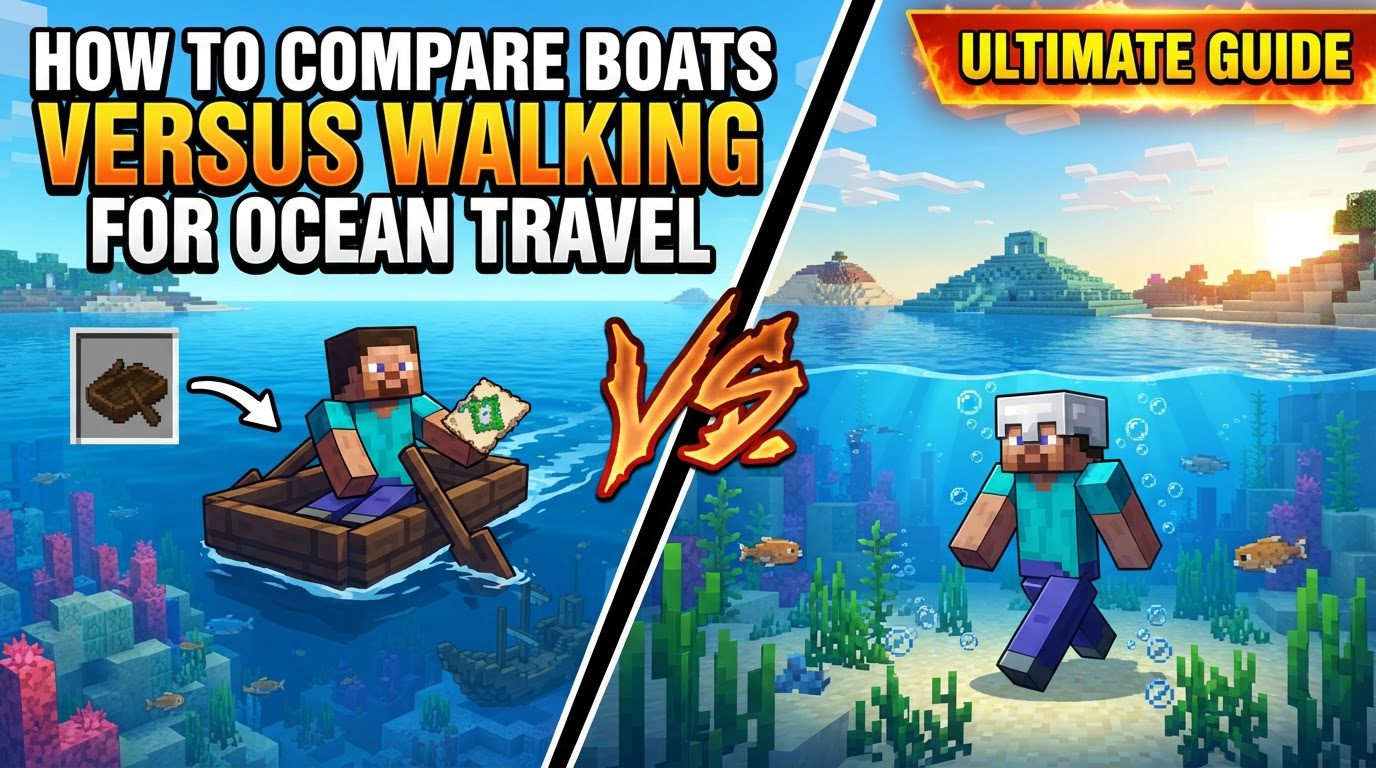
Boats: Navigating the Seas with Ease
Boats are a cornerstone of water travel in Minecraft, offering a dedicated vehicle for crossing large bodies of water efficiently.
Key Mechanics of Boat Travel
- Boats are purpose-built vehicles designed exclusively for transportation across water surfaces, providing a stable platform for travel.
- Crafting a boat is a straightforward process, requiring five wooden planks. In Java Edition, these planks must be of the same wood type, while console versions are more forgiving, allowing mixed wood types. The planks are arranged in a U-shape on a crafting table.
- On water, boats achieve a respectable speed of 28.8 kilometers per hour, which translates to approximately 8 blocks per second. This consistent speed makes them a reliable choice for covering significant distances.
- A single boat can comfortably accommodate two entities, meaning a player can travel with a friend, a tamed pet, or even transport certain mobs.
- Boats are remarkably durable against environmental damage. They float on water and are not damaged by typical collisions with blocks or other entities. However, they are vulnerable to specific hazards such as explosions, fire, lava, or direct attacks from players or mobs, which can destroy them.
- An important safety feature is the ability to enter sneak mode while inside a boat. This action can prevent the boat from breaking upon impact with land or other obstacles, allowing for smoother transitions.
- One of the most significant advantages for long journeys is that traveling in a boat does not consume a player’s hunger, allowing for extended exploration without worrying about food supplies.
Step-by-Step Boat Operation
- To begin your nautical journey, first craft a boat by placing five wooden planks in a U-shape on a crafting table.
- Once crafted, place the boat onto a water surface by right-clicking with the boat item in hand.
- To embark, simply right-click the boat. Your character will automatically enter and take the helm.
- Controlling the boat is intuitive. Use the standard movement keys (W, A, S, D) to steer, or simply look in the desired direction to guide your vessel.
- When you wish to disembark, press the Sneak key (which is Shift by default on most setups). This will safely eject you from the boat.
Essential Tips for Boat Journeys
- For any extended voyage, it is highly recommended to carry spare boats. Accidents happen, and having a backup can prevent being stranded far from home.
- To prevent getting lost in the vastness of the ocean, utilize coordinates accessed via the F3 debug screen, or craft a compass and link it to a lodestone at your base for reliable navigation.
- Boats can serve a strategic purpose beyond travel; they can be used to trap Drowned mobs, holding them in place until daylight, where they will burn.
- One of the most exciting uses for boats involves ice. Boats travel significantly faster on ice blocks, especially Blue Ice, which can boost speeds to an incredible 252 km/h (72 blocks per second). Constructing Blue Ice roads across oceans creates unparalleled fast travel routes.
- For adventurers with ample loot, boats with chests provide additional inventory space, allowing you to carry more resources or treasures during your ocean travels.
Common Boat Travel Pitfalls
- Beware of Magma Blocks lurking beneath the water’s surface. If a boat moves over these blocks, it will shake violently and eventually sink, expelling its passengers into the water.
- While the mechanic of boats breaking upon sprinting onto land has been largely addressed, rough landings can still be problematic, occasionally leading to the boat’s destruction.
- A critical mistake for any explorer is venturing out to sea without proper navigation tools. Getting lost in the endless ocean without coordinates or a compass can be a frustrating and time-consuming ordeal.
Walking/Swimming: The Player-Powered Journey
While slower, traversing water by swimming offers a more direct and unencumbered experience, allowing players to explore underwater environments.
Key Mechanics of Player Travel in Water
- Players can achieve a decent speed by sprint-swimming on the surface, moving at approximately 5.612 meters per second, or about 5.6 blocks per second. This is notably 30% faster than a player’s normal walking speed on land.
- Swimming underwater is generally slower than surface swimming, and moving against a current can further reduce speed, making deep ocean exploration more challenging.
- A significant constraint of underwater travel is the air meter. Players consume air while submerged and will begin to take damage if the meter depletes entirely, leading to potential drowning.
- The “Dolphin’s Grace” status effect provides a substantial boost to swimming speed, increasing it to 8 blocks per second, effectively matching the speed of a boat on water. This effect is granted by swimming near dolphins.
- The Frost Walker enchantment, when applied to boots, allows players to temporarily walk on water by freezing it into ice blocks beneath their feet.
Step-by-Step Water Movement
- To initiate swimming, simply move your character into any body of water.
- To achieve the fastest possible surface speed, press the sprint key while moving forward in the water, initiating a sprint-swim.
- To descend rapidly underwater, combine sprint-swimming with sneaking and looking downwards. To ascend quickly, jump while sprint-swimming and looking upwards.
Important Tips for Water Travel
- The Dolphin’s Grace effect is a game-changer for swimming. Dolphins are naturally attracted to players in boats, making it easier to find them and gain this speed boost.
- Combining the Depth Strider enchantment on boots with Dolphin’s Grace allows for incredibly fast underwater travel, reaching speeds of up to 48 blocks per second, making deep-sea exploration much more efficient.
- When exploring deep oceans or staying underwater for extended periods, carrying a Magma Block is invaluable. Placing it on the seafloor creates a downward-pulling bubble column that continuously replenishes your air supply.
- Frost Walker boots offer the unique ability to “walk on water” by freezing it. However, this effect requires continuous movement, and the ice created will melt in non-frozen biomes, so planning is key.
Common Water Travel Mistakes
- The most critical error when traveling underwater is failing to manage your air supply, which inevitably leads to drowning due to prolonged submersion.
- Attempting to walk on water without the Frost Walker enchantment is futile; players will simply fall into the water.
- Underestimating Drowned mobs, especially those armed with tridents, can be perilous. They are formidable underwater adversaries and can pose a significant threat to unprepared players.
Boats vs. Walking/Swimming: A Direct Comparison
Deciding between a boat and personal swimming capabilities often comes down to the specific needs of your journey.
- Speed:
- General Water Travel: Boats offer a consistent 8 blocks per second, making them generally faster than a player’s sprint-swim speed of 5.6 blocks per second.
- Enhanced Water Travel: With Dolphin’s Grace, a player’s sprint-swim speed matches a boat’s at 8 blocks per second. However, boats on Blue Ice reach an unparalleled 72 blocks per second, making them the undisputed champion for extreme speed. Depth Strider combined with Dolphin’s Grace allows for very fast underwater travel (up to 48 blocks per second), which boats cannot replicate.
- Safety and Hazards:
- Air Supply: Boats negate the need for air, allowing for indefinite surface travel. Swimming requires constant attention to the air meter, with the risk of drowning. Magma Blocks can mitigate this for swimmers.
- Mob Encounters: While both methods can encounter Drowned, boats can be used to trap them. Swimmers face Drowned directly, especially trident-wielding variants, which can be very dangerous.
- Environmental Dangers: Boats are vulnerable to Magma Blocks causing sinking, explosions, fire, and lava. Swimmers are immune to Magma Blocks but are slower and more exposed to underwater currents and hostile mobs.
- Inventory and Utility:
- Boats with chests provide extra inventory space, a significant advantage for resource gathering or long expeditions. Players swimming are limited to their personal inventory.
- Boats can carry two entities, allowing for transport of companions or mobs. Swimmers can only transport themselves.
- Resource Cost and Preparation:
- Crafting a boat is inexpensive, requiring only five wooden planks.
- Achieving optimal swimming speeds and safety often requires enchantments like Depth Strider and Frost Walker, which necessitate an enchanting setup and experience. Magma Blocks for air are also a specific item to acquire.
- Ease of Use:
- Boats offer a relatively hands-off experience once launched, requiring only directional input and no concern for hunger or air.
- Swimming requires more active management, especially underwater, due to air consumption and slower speeds.
In conclusion, for most long-distance ocean travel and general surface navigation, a boat remains the superior choice due to its consistent speed, hunger negation, and ease of use. However, for specialized tasks like rapid underwater exploration, or when equipped with specific enchantments and aided by dolphins, player swimming can offer unique advantages. Ultimately, the best method depends on the specific situation, the player’s resources, and their desired speed and depth of exploration.