Comparing Minecarts Versus Walking for Cave Travel, Explained
Comparing Minecarts Versus Walking for Cave Travel
Navigating the treacherous depths of Minecraft’s cave systems presents a fundamental choice for players: to construct intricate rail networks or to rely on the time-honored method of walking. Both approaches offer distinct advantages and disadvantages, impacting resource investment, travel speed, and overall safety. This comprehensive guide will delve into the core mechanics, practical steps, crucial tips, and common pitfalls associated with each method, enabling players to make an informed decision for their subterranean explorations.
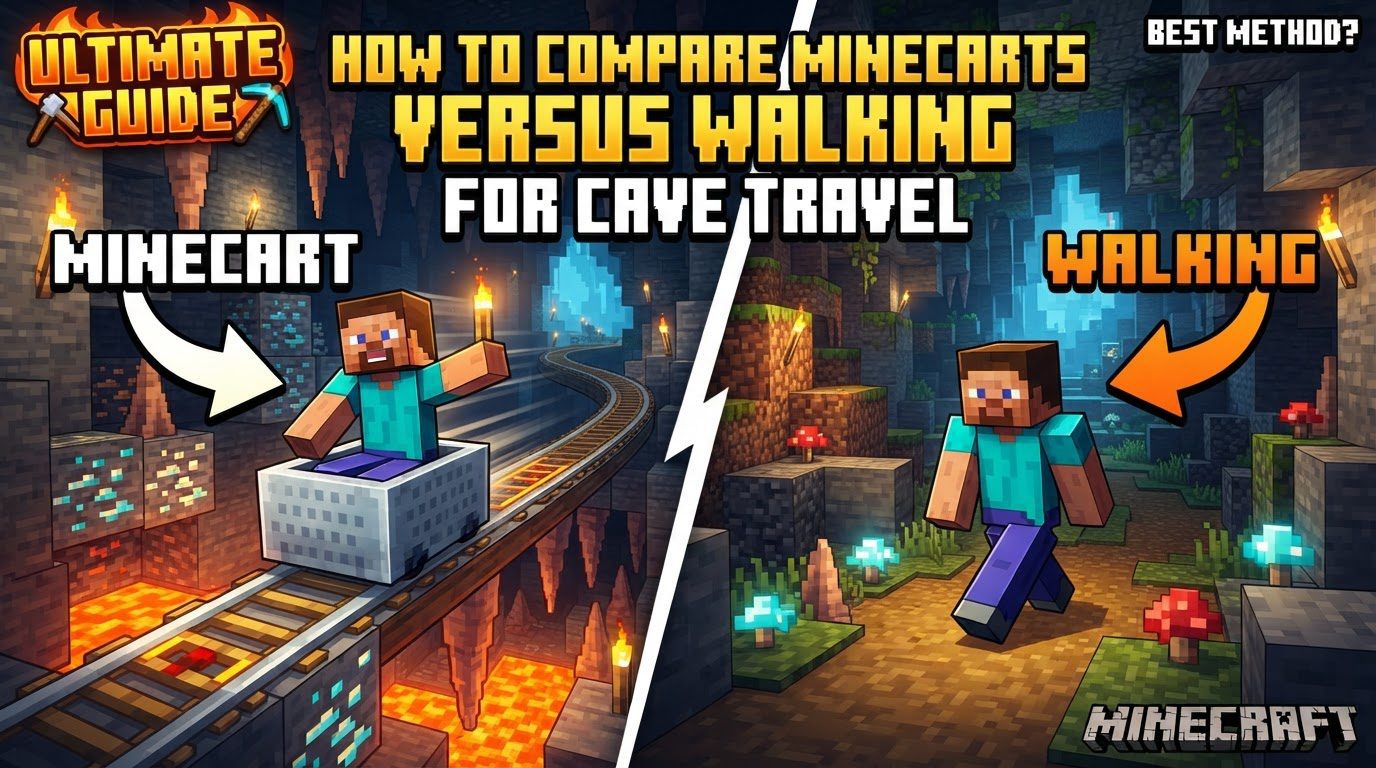
Key Mechanics of Movement
Understanding the fundamental ways minecarts and walking operate is crucial for effective cave travel.
- Minecarts:
- Minecart travel necessitates a significant initial investment in infrastructure. Players must craft various types of rails, including regular, powered, detector, and activator rails, each serving a specific function within a rail system.
- Beyond the tracks, specific minecart items are required: standard minecarts for player transport, chest minecarts for item storage, furnace minecarts for self-propelled movement (though less common for player transport), and hopper minecarts for automated item collection.
- On a straight track, a minecart’s base speed is a brisk 8 meters per second (m/s). Interestingly, diagonal movement can achieve an even faster speed, reaching approximately 11.314 m/s.
- To maintain this momentum, especially on inclines or over long distances, powered rails are indispensable. They provide the necessary boost to keep minecarts moving continuously and prevent them from losing speed or stopping.
- Minecarts offer versatility in transportation, capable of moving players, various passive and hostile mobs (often for farming purposes), and large quantities of items when utilizing chest or hopper minecarts.
- Walking:
- Walking is the default and most accessible method of movement in Minecraft. A player’s standard walking speed is approximately 4.317 m/s.
- Sprinting offers a faster alternative, but even then, it is about 30% slower than the base speed of a minecart on a straight track.
- Environmental factors can significantly impede walking speed. Terrain elements such as soul sand or water will naturally slow down a player’s movement.
- Furthermore, status effects play a critical role; positive effects like the Speed potion can significantly increase movement, while negative effects like Slowness potions will drastically reduce it.
- A notable change since Minecraft 1.11 is that basic movement (walking or sprinting) no longer directly consumes hunger or saturation, making it a resource-efficient method in terms of food for basic travel.
Step-by-Step Process for Cave Travel
Implementing either method involves a distinct set of procedures, from crafting to navigation.
- Minecarts:
- The first step is resource gathering and crafting. Rails are crafted using iron ingots for regular rails, while powered rails require a combination of gold ingots, a stick, and Redstone.
- Once crafted, tracks must be laid out in the desired path through the cave. Crucially, powered rails need to be integrated at regular intervals to ensure consistent speed. For player transport, a pattern of one powered rail every 34 blocks is generally sufficient. However, for utility carts carrying heavy loads or operating in more complex setups, a denser placement of one powered rail every 6 blocks might be necessary to ensure full utility.
- Powered rails, as their name suggests, require a Redstone power source. This can be achieved by placing Redstone torches adjacent to them, using levers to activate them, or by placing a block of Redstone directly next to or beneath them.
- To initiate travel, place a minecart on the track. Players then right-click to enter the minecart. Movement can be started by pressing the forward key, or by simply placing the minecart on an incline or a powered rail that provides an initial push.
- Walking:
- Walking requires no special setup beyond the player’s existing movement keys. Players simply use the assigned controls (typically W, A, S, D) to navigate the terrain.
- A critical aspect of walking through caves is lighting. Torches must be placed frequently to illuminate the path, not only for visibility but also to prevent hostile mobs from spawning in darkened areas, ensuring a safer passage.
- For easier navigation, especially when exploring extensive cave systems, adopting a consistent torch placement strategy is highly recommended. For instance, always placing torches on the right-hand wall when exploring deeper into a cave can serve as a reliable breadcrumb trail for finding the way back out.
Important Tips for Efficient and Safe Travel
Maximizing the benefits and mitigating the risks of each travel method involves adhering to specific strategies.
- Minecarts:
- For optimal balance between speed and resource efficiency, a common pattern for track laying is one powered rail followed by four regular rails. This provides good speed while conserving valuable gold and Redstone.
- Minecarts are surprisingly versatile and can function underwater. However, it’s important to note that their speed will be reduced in aquatic environments compared to dry land.
- Building a comprehensive track infrastructure requires a substantial investment of resources. Iron ingots for regular rails and gold ingots for powered rails are consumed in large quantities, making minecart systems a mid-to-late-game endeavor for extensive cave networks.
- Minecarts, particularly chest and hopper minecarts, excel at bulk item transport. They are an excellent solution for moving large quantities of mined resources or gathered items efficiently to and from a main base or storage area.
- Walking:
- Thorough preparation is paramount when venturing into caves on foot. Players should be well-equipped with durable tools for mining, effective weapons and armor for combat, a shield for defense, a generous supply of torches for lighting, and plenty of food to restore hunger and health.
- Carrying a water bucket is a versatile tool for any cave explorer. It can be used to negate fall damage by placing water just before impact, or to create upward or downward water flows for vertical movement in areas without stairs or ladders.
- A cardinal rule of Minecraft exploration is to avoid digging straight down. This practice carries a high risk of falling into lava pools, deep pits, or dangerous mob spawners, often leading to instant death and loss of items.
- In complex and sprawling cave systems, getting lost is a significant threat. Using signs, distinct blocks (like cobblestone in a dirt wall), or even a trail of easily recognizable items as markers can help players navigate and find their way back.
- To prevent being overwhelmed, especially in large cave systems, it’s advisable to explore at a measured pace and tackle the cave in manageable sections, lighting up and securing one area before moving to the next.
Common Mistakes to Avoid
Awareness of potential pitfalls can save players time, resources, and even their lives.
- Minecarts:
- One of the most frequent errors in minecart system design is the inefficient placement of powered rails. Too few or improperly powered rails will cause minecarts to lose momentum, slow down, or come to a complete stop, rendering the system ineffective.
- Failing to plan for junctions, turns, and changing directions can lead to a chaotic and difficult-to-use rail system. Without proper Redstone logic or manual intervention, minecarts might go the wrong way or get stuck.
- Despite their utility, minecarts can sometimes encounter technical issues. They can get stuck, occasionally due to chunk borders not loading correctly or desynchronization issues between the client and server, requiring manual intervention to get them moving again.
- Walking:
- Getting lost is a major and common risk when exploring extensive and labyrinthine cave systems on foot. Without a reliable navigation system or consistent marking, players can quickly become disoriented.
- Taking too many valuable items, such as diamonds, rare enchantments, or large stacks of resources, into a cave significantly increases the penalty upon death. The risk of losing these items permanently is high, especially if a recovery attempt is unsuccessful.
- Underestimating the threat posed by hostile mobs and failing to adequately light explored areas are common mistakes. Poor lighting allows mobs to spawn freely, leading to frequent and often deadly encounters.
- A critical oversight is failing to properly light areas that have already been explored. Mobs can spawn in unlit sections behind a player, leading to surprise attacks and potentially overwhelming situations.
Ultimately, the choice between minecarts and walking for cave travel hinges on the player’s goals, available resources, and playstyle. Minecarts offer speed and efficiency for established routes and bulk transport, demanding significant upfront investment. Walking provides immediate accessibility and flexibility, requiring careful preparation and constant vigilance. By understanding the intricacies of each method, players can confidently navigate the dark and dangerous world beneath the surface.
Tags:
YOU MAY ALSO LIKE...