How to craft and enchant a trident in Minecraft?
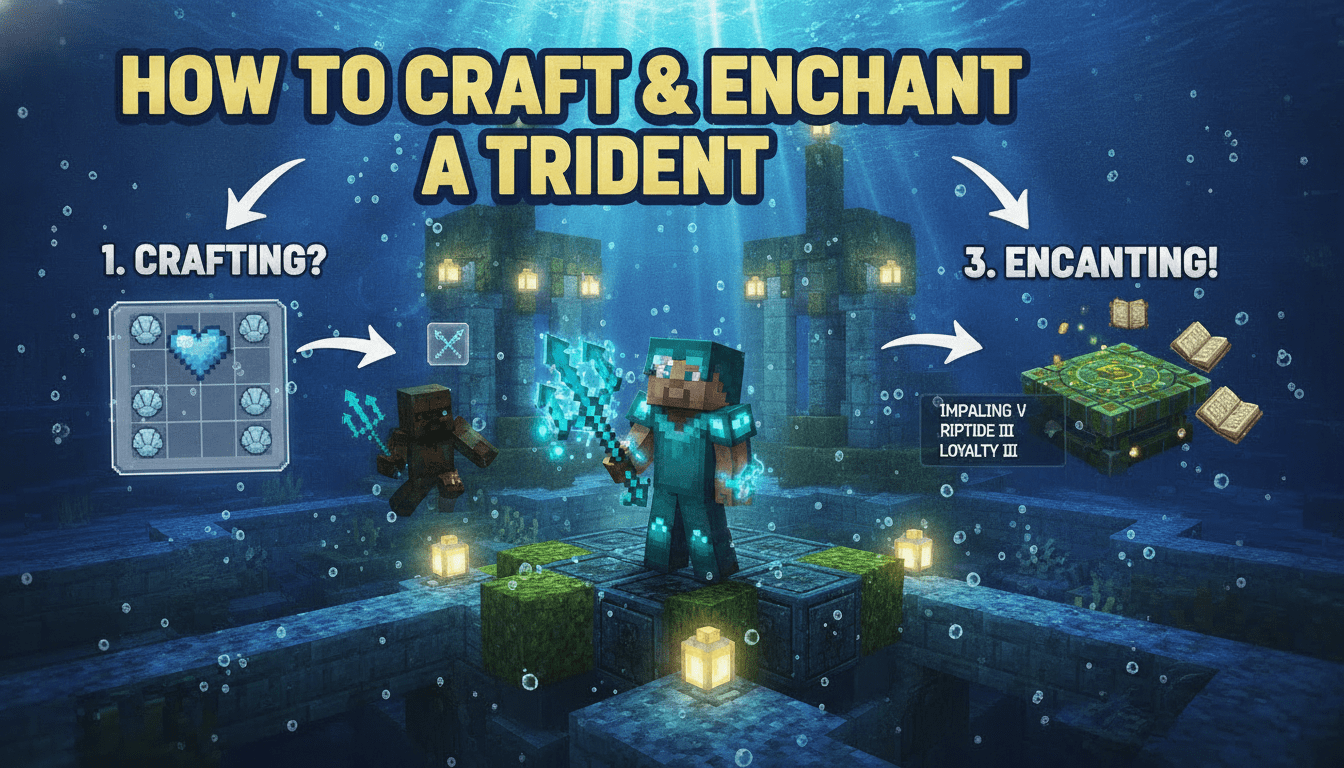
To truly master aquatic combat and unique movement, knowing how to craft and enchant a trident in Minecraft is essential. This guide will walk you through obtaining this powerful, non-craftable weapon and applying its unique enchantments.
What You’ll Need
- Diamond or Netherite Sword (with Looting III recommended): Used to kill Drowned more efficiently and increase the drop rate of tridents.
- Where to get it: Crafted from Diamonds (found deep underground) or Netherite Ingots (crafted from Netherite Scraps found in the Nether) and Sticks. Enchanting with Looting III significantly boosts your chances.
- Armor (preferably enchanted): For protection against Drowned and other hostile mobs while farming.
- Where to get it: Crafted from various materials (leather, iron, gold, diamond, netherite) or found in chests.
- Food: To replenish hunger and health during extended farming sessions.
- Where to get it: Farmed from animals or crops, or found in chests.
- Potions of Water Breathing (optional but recommended): To explore underwater more easily and safely when hunting Drowned.
- Where to get it: Brewed with a Brewing Stand using Water Bottles, Nether Wart, and Pufferfish.
- Enchanting Table: To apply enchantments directly to the trident.
- Where to get it: Crafted with 4 Obsidian, 2 Diamonds, and 1 Book. Requires bookshelves around it for higher-level enchantments.
- Lapis Lazuli: Required for enchanting items at an Enchanting Table.
- Where to get it: Mined deep underground, often found near diamond level.
- Anvil: To combine enchanted books with the trident, repair it, or combine tridents.
- Where to get it: Crafted with 3 Iron Blocks and 4 Iron Ingots.
- Enchanted Books (Loyalty, Riptide, Impaling, Channeling, Unbreaking, Mending, Curse of Vanishing): To apply specific enchantments to the trident using an Anvil.
- Where to get them: Found in chests, traded with librarian villagers, fished up, or obtained by enchanting other items and disenchanting them.
- Experience Levels: Required for both enchanting at an Enchanting Table and combining items on an Anvil.
- Where to get them: Killing mobs, mining, smelting, farming, trading, and completing advancements.
Step-by-Step
Obtaining a Trident
Tridents are unique because they cannot be crafted in vanilla Minecraft. Any recipes you might encounter are from mods or data packs, not the base game. The only way to get a trident is by defeating a specific mob: the Drowned.
-
Locate Drowned:
- Drowned are aquatic zombies that spawn in oceans, rivers, and sometimes within ocean ruins.
- Focus your search in deep ocean biomes or large rivers for higher concentrations. Ocean ruins often have Drowned guarding them.
- They typically spawn in groups, especially at night or in dark underwater areas.
-
Identify Trident-Wielding Drowned:
- Not all Drowned carry tridents. You need to find one that is actively holding a trident in its hand.
- Java Edition: Approximately 6.25% of Drowned will spawn holding a trident.
- Bedrock Edition: Approximately 15% of Drowned will spawn holding a trident.
-
Engage and Defeat Trident-Wielding Drowned:
- Approach the Drowned cautiously. They are hostile and will attack you with their trident (if they have one) or by punching you.
- Use your sword to defeat them. A Looting III enchantment on your sword is highly recommended here, as it significantly increases the chance of the Drowned dropping its trident.
- Drop Rates (after killing a trident-wielding Drowned):
- Java Edition: If a Drowned is holding a trident, it has an 8.5% chance to drop it upon death. With Looting III, this increases to 11.5% (Looting I), 14.5% (Looting II), and 17.5% (Looting III).
- Bedrock Edition: If a Drowned is holding a trident, it has a 25% chance to drop it upon death when killed by a player. With Looting III, this increases to 31.25% (Looting I), 37.5% (Looting II), and 43.75% (Looting III).
- Keep hunting Drowned until you successfully obtain a trident. This can be a time-consuming process due to the low drop rates, especially in Java Edition.
Enchanting a Trident
Once you have your trident, you can enhance its capabilities through enchanting. There are two primary methods: using an Enchanting Table or an Anvil with enchanted books.
Method 1: Using an Enchanting Table
- Set up your Enchanting Table: Place your Enchanting Table and surround it with 15 bookshelves (each with an empty block of air between the table and the shelf, and on the same level or one block higher than the table) to unlock the highest-level enchantments.
- Place Trident and Lapis Lazuli: Open the Enchanting Table GUI. Place your trident in the left slot and up to 3 Lapis Lazuli in the right slot.
- Select an Enchantment: Three random enchantment options will appear on the right. Each option displays its required experience levels and Lapis Lazuli.
- The enchantments offered are random and can include any of the compatible trident enchantments (Loyalty, Riptide, Impaling, Unbreaking, Mending, Curse of Vanishing).
- Remember: Loyalty and Riptide are mutually exclusive. If you get one, you won’t get the other on the same trident from the table.
- Enchant: Select the desired enchantment. The trident will be enchanted, consuming the Lapis Lazuli and experience levels.
Method 2: Using an Anvil with Enchanted Books
This method gives you more control over the specific enchantments you apply.
- Obtain Enchanted Books: Gather enchanted books with the desired trident enchantments. You can find these in chests, trade with librarian villagers, or get them by enchanting other items and then disenchanting them using a Grindstone (though this destroys the item).
- Recommended Books: Loyalty III, Impaling V, Unbreaking III, Mending I. Choose either Loyalty or Riptide, as they cannot be combined. Channeling I is also useful for specific purposes.
- Place Trident and Book on Anvil: Open the Anvil GUI. Place your trident in the first slot and the enchanted book in the second slot.
- Combine: The resulting enchanted trident will appear in the third slot, along with the experience cost.
- Combine one book at a time to manage experience costs.
- You can also combine two tridents on an Anvil to repair them or combine their enchantments.
- You can apply multiple enchanted books to a single trident, as long as the enchantments are compatible.
Understanding Trident Enchantments
- Loyalty (I-III): When thrown, the trident will return to you after a short delay. Higher levels reduce the return time. Essential for ranged combat.
- Riptide (I-III): Propels you forward when the trident is thrown while you are in water or during rain. It does not work during snowfall or if you’re not in water/rain. Excellent for mobility.
- Incompatible with Loyalty. Choose one or the other based on your preferred playstyle.
- Impaling (I-V): Increases damage dealt by the trident.
- Java Edition: Only boosts damage against aquatic mobs (e.g., squids, guardians, Drowned underwater, turtles).
- Bedrock Edition: Increases damage against all mobs if they are in water or rain (considered “wet”). This makes it much more versatile in Bedrock.
- Channeling (I): Summons a lightning bolt at the location where the thrown trident hits a mob, but only during a thunderstorm. The target must have a clear sky above it to be struck.
- Bedrock Edition: Lightning can also be summoned during regular rain if the trident hits a lightning rod.
- Useful for creating Charged Creepers or converting villagers into witches.
- Unbreaking (I-III): Increases the trident’s durability, making it last longer before breaking. Highly recommended as tridents are rare.
- Mending (I): Repairs the trident using experience points collected by the player while holding it in their main or off-hand. Crucial for maintaining your valuable trident.
- Curse of Vanishing (I): The trident will disappear permanently from the game upon your death. Generally undesirable, but can sometimes appear on drops or from enchanting tables.
Tips for Efficiency
- Build a Drowned Farm: For dedicated trident farming, consider building an efficient Drowned farm. These usually involve channeling water to concentrate Drowned into a killing chamber, often using a mob grinder design. This is especially effective in Bedrock Edition due to higher base drop rates.
- Prioritize Mending and Unbreaking: Tridents are rare and have limited durability. Applying Mending and Unbreaking early on will save you from needing to hunt for a new one frequently.
- Choose Your Primary Enchantment Wisely: Decide whether you want a Loyalty trident for reliable ranged attacks or a Riptide trident for powerful aquatic/rain mobility. Since they are mutually exclusive, you might consider obtaining two separate tridents, each with one of these enchantments.
- Use Potions: Potions of Water Breathing and Night Vision can greatly assist in underwater Drowned hunting, making it safer and easier to spot targets.
- Bring a Bow: While hunting Drowned, a bow can be useful for picking off other hostile mobs or damaging Drowned from a distance before engaging them in melee.
FAQ
Q: Can I craft a trident in Minecraft?
A: No, tridents cannot be crafted in vanilla Minecraft. They are exclusively obtained as a rare drop from Drowned mobs.
Q: What’s the best way to get a trident quickly?
A: The most effective method is to hunt Drowned in oceans or rivers, especially at night or in dark areas. Use a sword enchanted with Looting III to maximize your chances of a drop. Building a Drowned farm can also be very efficient.
Q: Which enchantments are best for a trident?
A: It depends on your playstyle. Mending and Unbreaking are universally recommended for durability. For utility, choose between Loyalty (for ranged combat and retrieval) or Riptide (for fast movement in water/rain), as they cannot be combined. Impaling is excellent for damage, especially in Bedrock Edition. Channeling is situational but can be fun for specific interactions.
Q: Why can’t I put Loyalty and Riptide on my trident?
A: Loyalty and Riptide are mutually exclusive enchantments. This means a trident can only have one or the other, but not both. You’ll need two separate tridents if you want both functionalities.
Q: Does Impaling work against all mobs?
A: In Java Edition, Impaling only increases damage against aquatic mobs. In Bedrock Edition, it increases damage against any mob that is in water or rain.
May your underwater adventures be swift and your tridents sharp!
Tags:
YOU MAY ALSO LIKE...