How to Create Server Economies That Don’t Collapse
The single most common reason a Minecraft server economy crumbles is a fundamental failure to balance money generation with its removal. Without careful consideration of both income streams and expenditure, even the most well-intentioned server can quickly devolve into a state of hyperinflation, where currency becomes worthless, or deflation, where players struggle to earn anything meaningful. A robust and engaging economy is not just about numbers; it’s a critical pillar for long-term player retention, fostering community interaction, and adding significant depth to the gameplay experience.
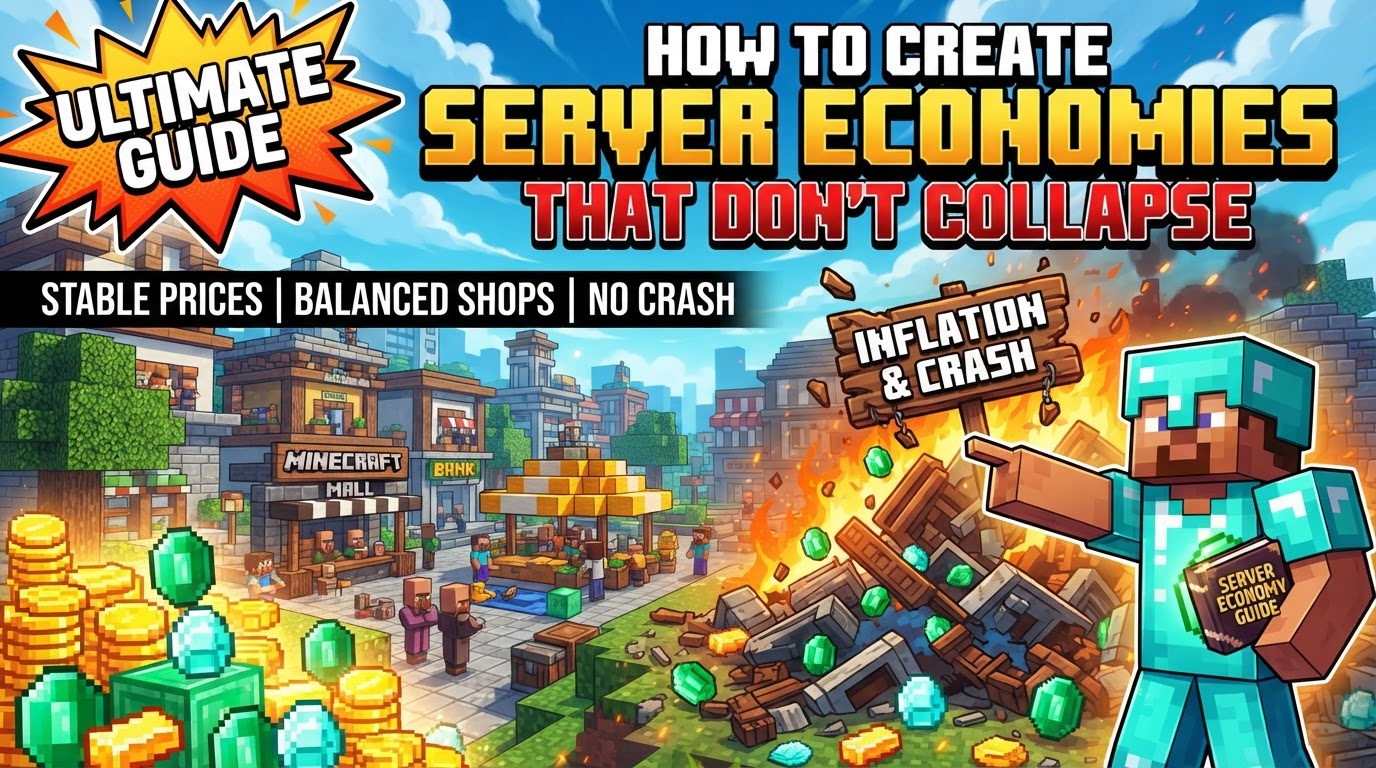
Creating a stable economic ecosystem on your Minecraft server requires thoughtful design, careful implementation, and continuous monitoring. It provides players with tangible progression paths, encourages trade and cooperation, and adds a layer of strategy to their in-game activities.
Core Economic Mechanics
A functional server economy is built upon several foundational mechanics that work in concert to facilitate trade, reward effort, and maintain balance. Understanding these components is the first step towards a thriving marketplace.
- Currency System: At its heart, an economy needs a defined currency. Plugins such as EssentialsX are commonly used to establish a virtual currency that players can earn, spend, and exchange, giving value to their efforts and resources.
- Vault API: This is a crucial, foundational plugin that acts as a bridge. It allows various economy-related plugins (like shop plugins, job plugins, and permissions plugins) to communicate and share data, ensuring your currency system operates seamlessly across all economic features.
- Shops (Admin & Player): A dual shop system is often most effective. Server-run “admin shops” provide a stable baseline for essential item prices, preventing extreme market fluctuations. Complementing these are “player shops” (e.g., ChestShop, QuickShop), which empower players to set their own prices and trade directly with each other, creating a dynamic, player-driven marketplace.
- Income Streams (Jobs): Players need diverse and engaging ways to earn money. “Jobs” plugins, like Jobs Reborn, allow players to choose professions such as mining, farming, or building, and earn money for performing associated activities. This incentivizes various playstyles and ensures broad participation in the economy.
- Money Sinks: These are vital mechanisms designed to remove currency from circulation, thereby combating inflation. Examples include taxes, upkeep fees for land claims, costs for repairing items, and listing fees for auction houses. Without effective money sinks, an economy will inevitably inflate.
- Supply and Demand: By strategically managing the availability of certain valuable resources, server owners can influence their market value. Limiting the ease of obtaining rare items encourages players to work harder for them, increases their perceived value, and stimulates player-to-player trading.
Building Your Economy: A Step-by-Step Guide
Implementing a robust economy requires a structured approach. Follow these steps to lay a solid foundation for your server’s financial system.
- Install Core Plugins: Begin by installing Vault. This indispensable plugin is the API layer that allows all other economy-related plugins to function together. Immediately follow this with a primary economy plugin, such as EssentialsX Economy, which handles the core currency management and player balances.
- Configure Currency: Define the details of your server’s currency. Choose a name that fits your server’s theme, set a modest starting balance for new players (a range of 500-1000 units is a good starting point), and establish how the currency will be displayed in-game.
- Implement Shops: Install plugins for both server-managed and player-managed trading. For admin shops, plugins like EconomyShopGUI are excellent for setting fixed prices. For player shops, ChestShop or QuickShop enable players to establish their own storefronts, fostering player-driven commerce.
- Set Initial Prices: Exercise caution when configuring server shop prices. It is significantly easier and less disruptive to lower prices later if they prove too high than it is to raise them without causing player frustration or economic shock. Aim for conservative pricing initially.
- Introduce Jobs: Add a jobs plugin, such as Jobs Reborn, and configure a variety of professions. Start with relatively low initial payouts for activities. These payouts can be gradually adjusted upwards as you observe the economy’s development and player wealth distribution.
- Establish Money Sinks: Proactively implement various money sinks. These could include fees for using server warps, periodic upkeep costs for player land claims, or charges for repairing tools and armor. The goal is to consistently remove money from the economy.
- Monitor and Adjust: Economic balance is not a set-and-forget task. Regularly review player wealth distribution using commands like
/baltop. Be prepared to make ongoing adjustments to job payouts, shop prices, and the values associated with money sinks to maintain a healthy and balanced economic environment.
Strategies for Long-Term Stability
Maintaining a healthy server economy requires continuous vigilance and proactive strategies to prevent common pitfalls and encourage player engagement.
- Balance is Key: This cannot be overstated. Constantly monitor the flow of money into the economy (income sources) and out of it (money sinks). An imbalance will lead to either hyperinflation, where money loses value rapidly, or deflation, where it becomes too difficult for players to earn.
- Avoid Overpowered Admin Sales: Refrain from selling rare or highly valuable items, such as diamonds or Netherite, directly through admin shops, especially at low prices. Doing so devalues these items, undermines player efforts to acquire them, and removes a significant incentive for economic activity.
- Prevent Exploitation: Design your server shops to prevent infinite money glitches. A crucial rule is to ensure that server shop sell prices are always lower than their buy prices. This prevents players from buying items cheaply from the server, crafting them, and then selling them back for a profit.
- Control Automated Income: Be mindful of how automated farms or AFK activities can generate wealth. Implement limits or reduced payouts for such activities to prevent a few players from accumulating excessive wealth without active gameplay, which can distort the economy.
- Diversify Income: Offer a range of income sources beyond just jobs. This could include rewards for voting for the server, daily login bonuses, or special event payouts. Diverse options cater to different playstyles and keep earning engaging.
- Integrate Progression: Give players compelling reasons to spend their accumulated wealth. Allow them to purchase desirable goals such as ranks, special perks, unique items, or cosmetic upgrades. This provides long-term motivation and ensures money has a purpose.
- Encourage Player Interaction: Design your server to foster player-to-player trading. This can be achieved through well-implemented player shops, auction houses, and by creating a natural interdependence where players need each other’s goods or services.
- Utilize Taxation: A moderate taxation system, perhaps on transactions or land ownership, can serve as an effective money sink without overtly penalizing players. It subtly removes currency and can help regulate the overall economy.
- Listen to Feedback: Pay close attention to your player base. Their feedback on prices, earning rates, and spending opportunities, combined with economic statistics, will be invaluable for making informed adjustments that keep the community engaged and the economy healthy.
Pitfalls to Avoid
Many server economies fail due to common, avoidable mistakes. Being aware of these can save you significant trouble and ensure your server’s longevity.
- Ignoring Balance: As mentioned, this is the most critical error. Neglecting the equilibrium between money generation and money removal will inevitably lead to either runaway inflation, where currency becomes worthless, or crippling deflation, where players cannot earn enough to progress.
- Lack of Money Sinks: An insufficient number or ineffective implementation of money sinks means that currency will continuously accumulate, leading to inevitable inflation. Every source of income must eventually be balanced by a way for that money to leave the economy.
- Overpowered Admin Shops: Selling valuable items too cheaply or having unbalanced buy/sell ratios in server shops can quickly destabilize the entire economy. It trivializes player effort and removes the need for player-driven trade.
- Underestimating Player Automation: Players are incredibly creative. Failing to account for automated farms and their potential impact on income can lead to a select few accumulating vast, unspendable wealth, disrupting the economic hierarchy.
- Artificial Scarcity/Excessive Intervention: Overly restrictive rules or constant administrative intervention to force scarcity can create a frustrating and tyrannical economic environment rather than a natural, player-driven market. Let the market breathe, with gentle guidance.
- No Reason to Spend/Trade: If players can easily acquire everything they need through other means, or if there are no compelling reasons to spend their money or trade with others, the economy will stagnate. Money needs a purpose and a flow.
- Linking In-Game to Real-World Currency: Directly connecting in-game money to real-world value is fraught with risks. It can lead to severe problems if the server’s economy falters and can introduce legal and ethical complexities.
- Poor Plugin Management: Using too many unoptimized plugins, or neglecting the proper configuration and updates of economy-related plugins, can cause server lag and instability. This indirectly harms the economy by creating a poor user experience and making economic activity frustrating.
Building a stable and thriving Minecraft server economy is an ongoing process of design, implementation, and continuous refinement. By understanding the core mechanics, following a structured setup process, applying sound stability strategies, and actively avoiding common pitfalls, you can create an engaging economic environment that enhances player experience and ensures the long-term success of your server.
Tags:
YOU MAY ALSO LIKE...