

Farming Cocoa Beans From Jungle Trees
Cocoa beans are a valuable resource in Minecraft, primarily used for crafting brown dye, which has various applications from coloring wool and concrete to dyeing leather armor. They also serve as a food source, although a very minor one. Farming cocoa beans is a straightforward process, relying on jungle trees and a few simple mechanics. This guide will walk you through everything you need to know to establish an efficient cocoa bean farm.
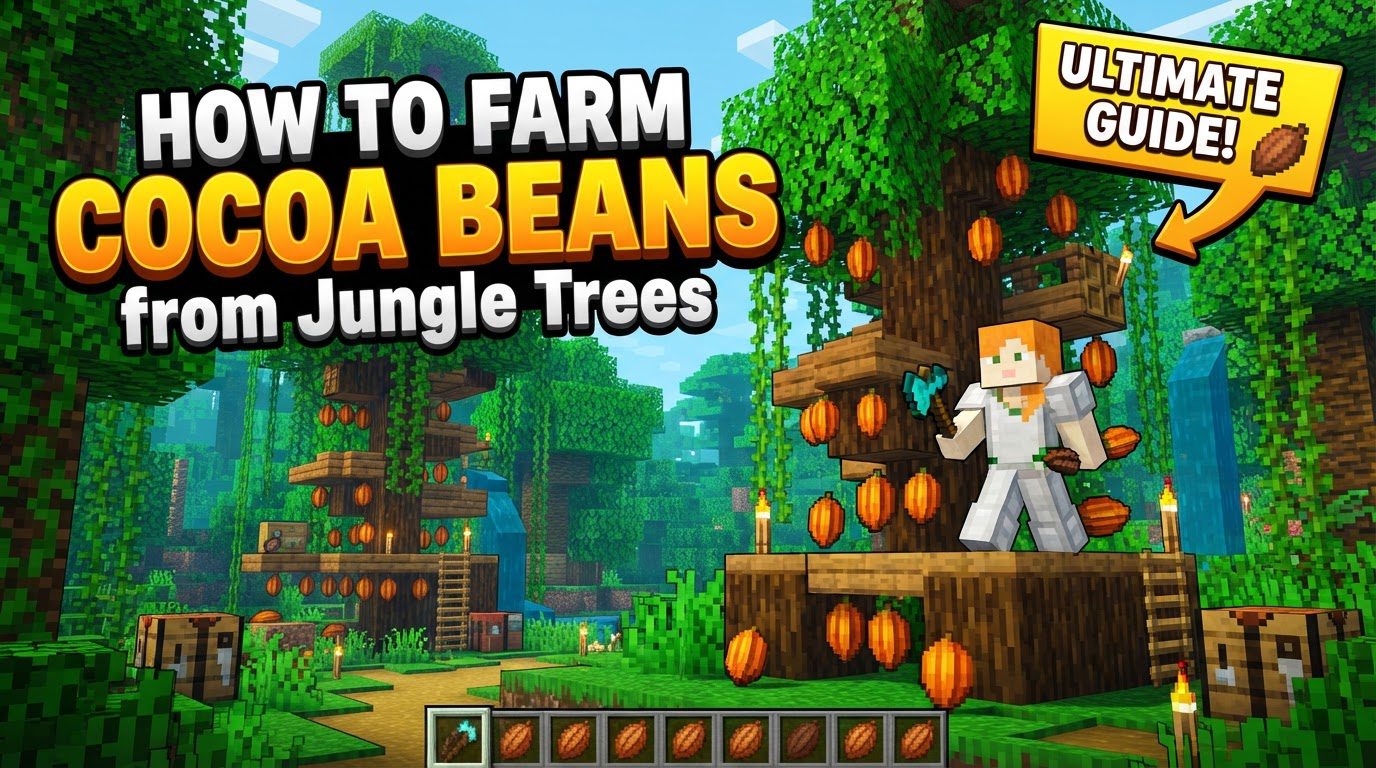
Understanding Cocoa Bean Mechanics
To successfully farm cocoa beans, it’s crucial to understand their unique growth requirements and behaviors:
- Exclusive Growth Surface: Cocoa beans can only be planted on the sides of specific jungle wood blocks. This includes jungle logs, jungle wood, stripped jungle logs, and stripped jungle wood. No other block type, such as oak wood, dirt, or cobblestone, will support cocoa bean growth. The jungle wood block does not need to be part of a living tree; you can harvest jungle logs and place them anywhere in your base or farm area.
- Growth Stages: Cocoa pods progress through three distinct growth stages. They start as a small green pod, then advance to a medium tan pod, and finally become a large orange pod. Only fully grown, large orange pods will yield the maximum number of cocoa beans upon harvest.
- Light Independence: Unlike many other crops in Minecraft, cocoa pods do not require a specific light level to grow. They will grow at any light level, from complete darkness to full daylight. This flexibility allows for farm designs in various environments, including underground or in dimly lit areas.
- Yield: A fully grown cocoa pod yields a different number of cocoa beans depending on your game edition. In Java Edition, a mature pod will drop 3 cocoa beans. In Bedrock Edition, the yield is slightly higher, ranging from 3 to 4 cocoa beans per fully grown pod. Harvesting prematurely will only yield one bean, making it inefficient.
- Breaking Mechanics: Cocoa pods can be broken in several ways. The most common method is to directly hit the pod itself. They will also break and drop their items if the jungle wood block they are attached to is destroyed or moved by a piston. Historically, water could also break them, but this mechanic changed with the Update Aquatic; water flowing into the space occupied by a cocoa pod may no longer break it directly, making older water-based harvesting systems ineffective.
- Bone Meal Application: Bone meal can be used to instantly advance a cocoa pod by one growth stage. This is an incredibly useful tool for speeding up production, especially in smaller farms or when you need cocoa beans quickly. Applying bone meal multiple times will rapidly bring a pod to its fully grown state.
Step-by-Step Guide to Farming Cocoa Beans
Follow these steps to set up and manage your cocoa bean farm:
- Obtain Initial Cocoa Beans: Your first step is to find existing cocoa pods. These naturally generate on the sides of jungle trees within a jungle biome. Explore a jungle, locate these pods, and break them to collect your starting supply of cocoa beans. You will typically need only a few to begin your farm.
- Gather Jungle Logs: Once you have some cocoa beans, you’ll need the blocks to plant them on. Chop down jungle trees to acquire jungle logs (or jungle wood, which can be crafted from logs). You can use an axe for efficient tree felling. These logs are essential as they form the foundation of your farm. Remember, you can transport these logs to any location you choose for your farm.
- Construct Your Farm Structure: With your jungle logs, begin building the structure for your farm. The most common and efficient designs involve placing jungle wood blocks in vertical columns or long walls. This maximizes the planting surface area while keeping the pods easily accessible for planting and harvesting. Consider building multiple layers or rows to increase your farm’s capacity.
- Plant Cocoa Beans: With cocoa beans in your hand, right-click on the side of any placed jungle wood block. A small green cocoa pod will appear, indicating a successful planting. Ensure you have enough space around the block for the pod to grow, although they are quite compact.
- Wait for Growth: After planting, the cocoa pods will begin to grow. They will naturally progress through their small green, medium tan, and finally, large orange stages. Growth time can vary, but patience is key. Monitor your pods and wait until they are visibly large and orange before harvesting.
- Harvest Fully Grown Pods: Once the cocoa pods have reached their large orange stage, they are ready for harvest. You can break them with your bare hand, but an axe is the most efficient tool, speeding up the breaking process significantly. Each fully grown pod will drop 3 (Java) or 3-4 (Bedrock) cocoa beans.
- Replant for Continuous Production: Immediately after harvesting, use some of the collected cocoa beans to replant new pods on the now-empty jungle wood blocks. This creates a continuous cycle of production, ensuring a steady supply of cocoa beans. Always reserve a portion of your harvest for replanting.
Important Tips for an Efficient Cocoa Bean Farm
Consider these tips to optimize your cocoa bean farming operation:
- Farm Design for Accessibility: When designing your farm, prioritize easy access for both planting and harvesting. Walls or long rows of jungle logs are highly effective, allowing you to walk along and quickly interact with multiple pods. Vertical farms, where logs are stacked high, can be space-efficient, but ensure you have platforms or staircases to reach the upper levels comfortably. Consider leaving a 1-block gap between rows of logs to allow for easy movement and harvesting from both sides.
- Leveraging Bone Meal: Bone meal is a game-changer for cocoa bean farming. It can instantly advance a cocoa pod by one growth stage, significantly accelerating your production. For small-scale needs or rapid bursts of cocoa beans, manual bone meal application is sufficient. For larger, more automated farms, you can integrate dispensers filled with bone meal. These dispensers can be activated by redstone to automatically apply bone meal to rows of pods, speeding up the entire growth cycle.
- Efficient Harvesting Tools: While any item or your bare hand can break a cocoa pod, an axe is the fastest tool for harvesting. Using an axe will minimize the time spent breaking pods, allowing you to collect your harvest more quickly and move on to replanting.
- Semi-Automatic Farm Designs: While fully automatic planting of cocoa beans is not possible with dispensers, you can create semi-automatic harvesting systems. These often involve pistons that can push the jungle log blocks the pods are attached to, or directly push the pods themselves. When the block is moved or the pod is pushed, the cocoa beans will break and drop as items, which can then be collected by hoppers. Such designs reduce the manual effort required for harvesting, making large-scale farms more manageable.
- Adequate Lighting: Although cocoa beans grow regardless of light level, it is still crucial to ensure your farm area is well-lit. Proper lighting, typically above light level 7, prevents hostile mob spawns. Hostile mobs can interfere with your farming activities, damage your farm structures, or pose a threat to you while you are working. Torches, glowstone, sea lanterns, or other light sources should be strategically placed around your farm.
Common Mistakes to Avoid
Being aware of these common pitfalls can save you time and resources:
- Using Incorrect Wood Types: A frequent mistake is attempting to plant cocoa beans on non-jungle wood blocks. Cocoa beans are highly specific and will only grow on jungle logs, jungle wood, stripped jungle logs, or stripped jungle wood. They will not attach to oak, birch, spruce, acacia, dark oak, crimson, or warped wood, nor will they grow on dirt, stone, or any other block type. Always double-check that you are using the correct jungle wood blocks.
- Harvesting Pods Prematurely: Patience is a virtue in cocoa bean farming. Harvesting cocoa pods before they are fully grown (i.e., when they are still small green or medium tan) will yield only one cocoa bean per pod. This is highly inefficient compared to the 3-4 beans you get from a fully grown, large orange pod. Always wait for the pods to reach their final, orange stage for maximum yield.
- Designing Overly Complex Systems: While the idea of a fully automated farm is appealing, it’s important to remember that dispensers cannot plant cocoa beans. This means that at least the planting stage will always require manual intervention. Overly complex redstone contraptions for harvesting, while impressive, may not always be more efficient or yield higher returns than simpler manual or semi-automatic setups, especially for smaller or medium-sized farms. Sometimes, a straightforward wall of logs is the most practical solution.
- Relying on Outdated Water Harvesting Methods: If you’re playing on newer versions of Minecraft (post-Update Aquatic), be aware that older water-based harvesting designs for cocoa beans are no longer effective. Due to changes in waterlogging mechanics, flowing water over cocoa pods generally does not break them anymore. Attempting to use these outdated designs will result in no harvest and wasted effort. Stick to direct breaking, piston-based harvesting, or bone meal acceleration.
By understanding these mechanics and following the outlined steps and tips, you’ll be able to establish a thriving cocoa bean farm, providing you with an abundant supply for all your crafting and dyeing needs.
Tags:
YOU MAY ALSO LIKE...


