How to Find the Stronghold in Minecraft Fast Using the Triangulation Method
Introduction
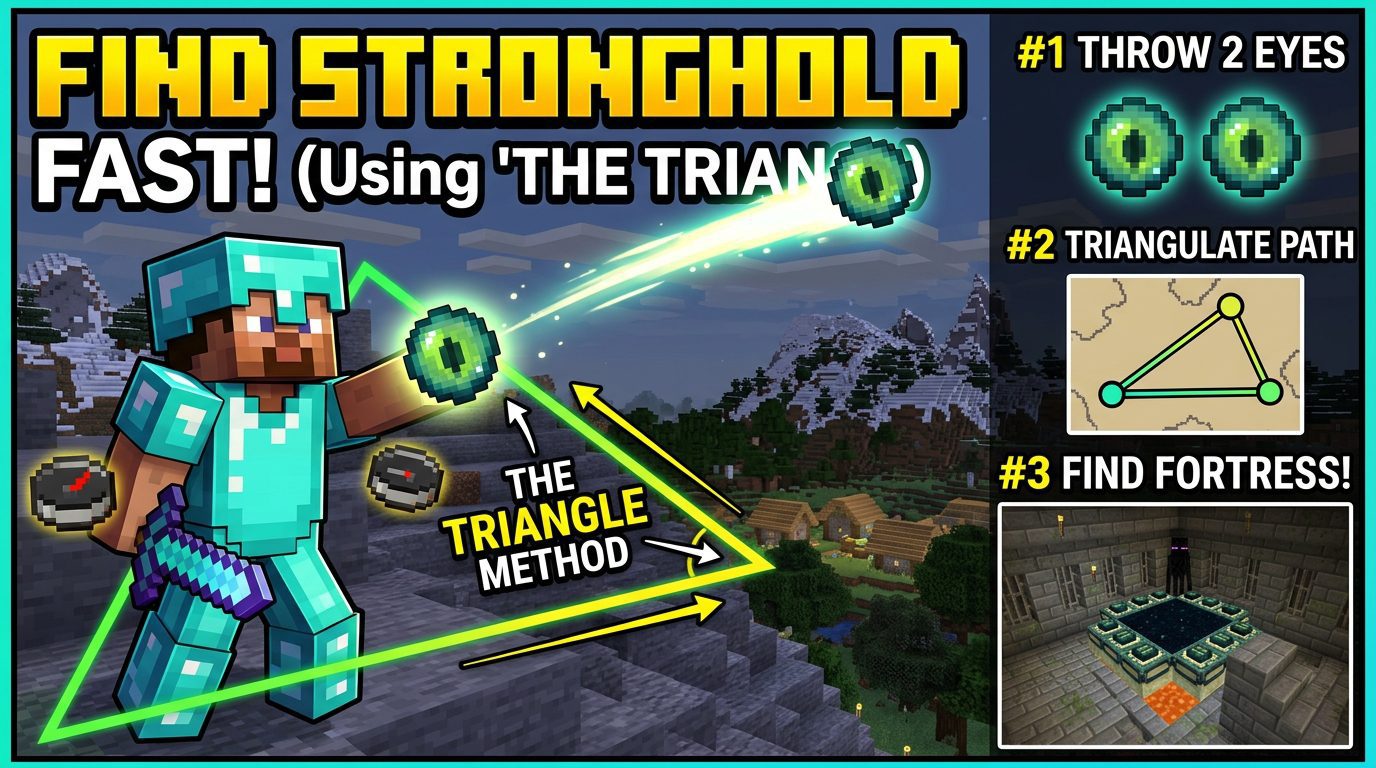
Finding the Stronghold in Minecraft is a critical milestone for any player aiming to reach the End dimension and defeat the Ender Dragon. While the standard method of throwing Eyes of Ender and following them works, it can be inefficient, wasteful, and sometimes lead you in circles. The triangulation method, a more systematic approach based on geometry and coordinate math, allows you to locate the Stronghold with as few as two or three Eyes of Ender throws. This guide will teach you how to perform this technique fast, saving resources and time. We’ll cover the mechanics of Eye of Ender behavior, the mathematics behind triangulation, step-by-step instructions for both Java and Bedrock editions, and common pitfalls to avoid. By the end, you’ll be able to pinpoint a Stronghold in under 10 minutes, even on a fresh world.
Understanding Strongholds and Eye of Ender Mechanics
Before diving into triangulation, it’s crucial to understand how Strongholds generate and how Eyes of Ender behave. In Minecraft, Strongholds are underground structures that contain the End Portal. They generate in concentric rings around the world origin (0,0) in Java Edition, with specific ring distances between 1408 and 2688 blocks from spawn, then further rings outward. Bedrock Edition uses a different algorithm, but strongholds still exist in fixed locations per seed.
An Eye of Ender, when thrown, flies towards the nearest Stronghold’s initial spawn point (not the portal room itself, but the staircase entrance). It travels about 12 blocks before either dropping down or popping. After traveling, it leaves a trail of purple particles and can be recovered (with a 20% chance of breaking). The direction it indicates is the direction to the Stronghold. However, because it only points in a straight line from your position, following it in a straight line will eventually get you there, but you’ll need many eyes and often overshoot. Triangulation uses multiple throws from different positions to calculate the intersection point-the location of the Stronghold.
Why Triangulation?
The standard “follow the eye” method requires you to keep throwing Eyes of Ender every few hundred blocks, each time adjusting your course. This is resource-intensive (each eye costs an Ender Pearl and Blaze Powder) and time-consuming. Triangulation lets you determine the exact coordinates of the Stronghold from a safe distance using minimal eyes. You don’t need to dig or explore caves until you have the exact location. It’s especially useful in Hardcore mode or when you’re low on supplies. The method works in both Java and Bedrock, though Bedrock has some nuances with eye behavior.
Prerequisites
- At least 2 Eyes of Ender (3+ recommended for accuracy).
- Access to coordinates (F3 on Java, “Show Coordinates” setting on Bedrock).
- A clear, flat area to stand and throw without obstruction. Trees, hills, or caves can cause the eye to deflect.
- A way to mark positions (torches, F3 coordinates mental note, or a minimap mod).
- Basic understanding of angles and averages (not required for the simple method).
Step-by-Step Triangulation: The Two-Throw Method (Java Edition)
This is the most common and fastest method. It assumes you are on ground level and the Stronghold is within range (under 2000 blocks). We’ll use two throws from two different positions to get two directional vectors, then find where they cross.
Step 1: Choose Your First Point
Stand somewhere relatively flat. Open your debug screen (F3) and note your X, Z coordinates. For example, X=200, Z=-150. This is Point A.
Step 2: Throw the First Eye
Right-click to throw the Eye of Ender. Let it fly and watch its trajectory. After it stops (either popping or floating), note the direction it traveled. For precision, look at the angle you are facing when you throw. The eye will move in the direction you are looking, but slightly corrected towards the Stronghold. To get the true bearing, after the eye stops, stand exactly where you threw it and look in the direction it went. Note the yaw value in F3 (the horizontal angle). Yaw runs from -180 to 180, with 0 being south, 90 west, -90 east, 180/-180 north. Write down the yaw. For example, yaw = 45 (southwest).
Step 3: Move to a Second Point
Travel a significant distance away from your first point, ideally at least 200 blocks perpendicular to the direction you just got. The farther you move, the more accurate the intersection will be. Avoid moving exactly along the eye’s direction. A good rule: move 100-300 blocks to the left or right of the vector. For example, if your first yaw was 45 (southwest), move toward northwest or southeast. Mark your new position as Point B. Note its coordinates: X=350, Z=-50.
Step 4: Throw a Second Eye
At Point B, throw another Eye of Ender. Again, note the yaw direction after the throw. Suppose it’s now yaw = 30 (still southwest but more south).
Step 5: Calculate the Intersection
Now you have two lines: Line A starting at (200, -150) with direction angle 45°, and Line B starting at (350, -50) with direction angle 30°. To find where they cross, you can use math: convert each angle to a slope (tan of angle), solve the line equations. But for speed, you can use an online triangulation calculator or do it manually on graph paper. Alternatively, use the “trial and error” method: from each point, walk in the direction of the eye until you think you’re near the intersection, then adjust.
Step 6: Dig Down at the Intersection
Once you have estimated coordinates, go to that point. Dig straight down (or dig a staircase). The Stronghold usually generates between Y=0 and Y=50. You’ll find stone bricks, libraries, rooms, and eventually the portal room. If you don’t hit it immediately, dig a 3×3 shaft around that area. The Stronghold can be a few blocks off due to angle measurement errors.
Advanced Triangulation: The Three-Throw Method for Higher Accuracy
If your first two throws give a large triangle (intersection far away) or you’re playing Bedrock (where eyes behave differently), use three throws. This method eliminates error and gives a precise point.
Step 1: Throw from Three Different Locations
Choose three points spaced roughly 100-200 blocks apart, forming a triangle around the suspected area. From each point, note the exact coordinates and the exact direction (yaw) of the eye. For best accuracy, stand at the exact same altitude (or ground level) and ensure no blocks are in the way.
Step 2: Compute the Intersection Using Averages
You can calculate manually:
- For each throw, determine the line equation: line passes through (x1,z1) with direction (sin(yaw), cos(yaw)). Note: Minecraft yaw uses different axes; we’ll simplify later.
- Find the intersection of line1 and line2, and line2 and line3, then average the two intersection points.
- Or use a triangulation tool online (many Minecraft-specific ones exist that accept yaw and coordinates).
Step 3: Dig and Confirm
Once you have the averaged coordinates, dig down at that location. In Bedrock, the Stronghold may generate between Y=0 and Y=30. Use a water bucket or ladder for safe descent.
The Math Behind Triangulation (For Those Interested)
Understanding the math helps you do it without tools. In standard trigonometry, given a point (x1, z1) and an angle θ (measured from positive Z axis clockwise?), but Minecraft’s yaw is measured from south (0) clockwise? Actually: In Minecraft, yaw = 0 points south, 90 points west, 180 (or -180) points north, -90 points east. So direction vector = (sin(yaw_rad), cos(yaw_rad)) for (x, z) components? Let’s define: For yaw=0 (south), vector = (0, 1) meaning x doesn’t change, z increases. For yaw=90 (west), vector = (-1, 0). So x component = -sin(yaw_rad) and z component = cos(yaw_rad) after converting yaw degrees to radians? Actually simpler: use the tangent: tan(yaw_rad) = dx/dz? But due to infinite slopes, better to use parametric form.
Parametric line: x = x1 + t * sin(yaw_rad), z = z1 + t * cos(yaw_rad). But careful: In Minecraft, yaw is in degrees, and the trigonometric functions need conversion. For yaw = 45°, sin(45°)=0.707, cos(45°)=0.707 → both positive, meaning x increases and z increases (southwest). So the direction is (sin(yaw_rad), cos(yaw_rad)). So from point A, line: (Xa + t*sinθ, Za + t*cosθ). From point B, line: (Xb + s*sinφ, Zb + s*cosφ). Set equal, solve for t and s. Two equations, two unknowns. The solution gives the intersection. This is exact but requires algebra. Most players use approximation.
Simplified Graphical Method
Draw a map on paper. Mark your two points. From each, draw a line at the angle you observed. Extend them until they cross. The crossing point is the Stronghold. This works well if your angles are accurate to within 5 degrees and your distance between points is large.
Tips for Accurate Throws
- Stand still when throwing. Don’t move or jump.
- Face exactly horizontal. Looking up or down changes the eye’s trajectory and the apparent direction.
- Use the F3 crosshair to align your view. The eye will travel in the direction you are facing, but it may curve slightly. To get the true bearing, after the eye stops, look at the direction from your original standing point to where the eye ended up. You can do this by holding a bow and watching the arrow? Or simply note the yaw when you are facing the direction of the eye.
- Ignore the eye’s height. The vertical movement doesn’t affect horizontal direction for triangulation; only the yaw matters.
- Throw multiple eyes at the same point to confirm the direction. If the yaw varies by a few degrees, average them.
Bedrock Edition Differences
In Bedrock, Eyes of Ender behave slightly differently: they travel farther (about 15 blocks) and do not always pop immediately after 12 blocks. They also have a chance to break on each throw (20% as well). However, the triangulation method still works, but you need to be more careful because the eye’s direction may be less consistent due to the different world generation. Bedrock strongholds also generate in a similar ring pattern but with a different formula. The main difference is that the eye points to the “stronghold starter piece” which is the entrance staircase. In Bedrock, that starter piece is at a fixed chunk coordinate. Also, strongholds can generate under water or in ravines. Use the same technique, but consider that the intersection point might need to be checked a few blocks in each direction. Also, Bedrock players should use the “Show Coordinates” option in world settings.
Tags:
YOU MAY ALSO LIKE...