How to Get Infinite Water Sources in Minecraft: 3 Quick Methods
Introduction
Water is one of the most versatile and essential resources in Minecraft. Whether you’re farming crops, creating a mob grinder, building a moat, or just staying hydrated, having a reliable and infinite water source can save you countless hours of hauling buckets from a river or ocean. The game’s fluid mechanics are surprisingly deep, but the good news is that setting up an infinite water supply is both easy and cheap once you understand the rules. In this guide, we will cover three quick, tested methods that work in both Java and Bedrock editions. Each method has its own advantages, from the simplest two-bucket trick to space-saving designs using kelp. By the end, you’ll be able to create a permanent water source in any biome, even in the Nether (though water behaves differently there). We’ll also discuss the underlying fluid mechanics to help you avoid common pitfalls. Let’s dive in!
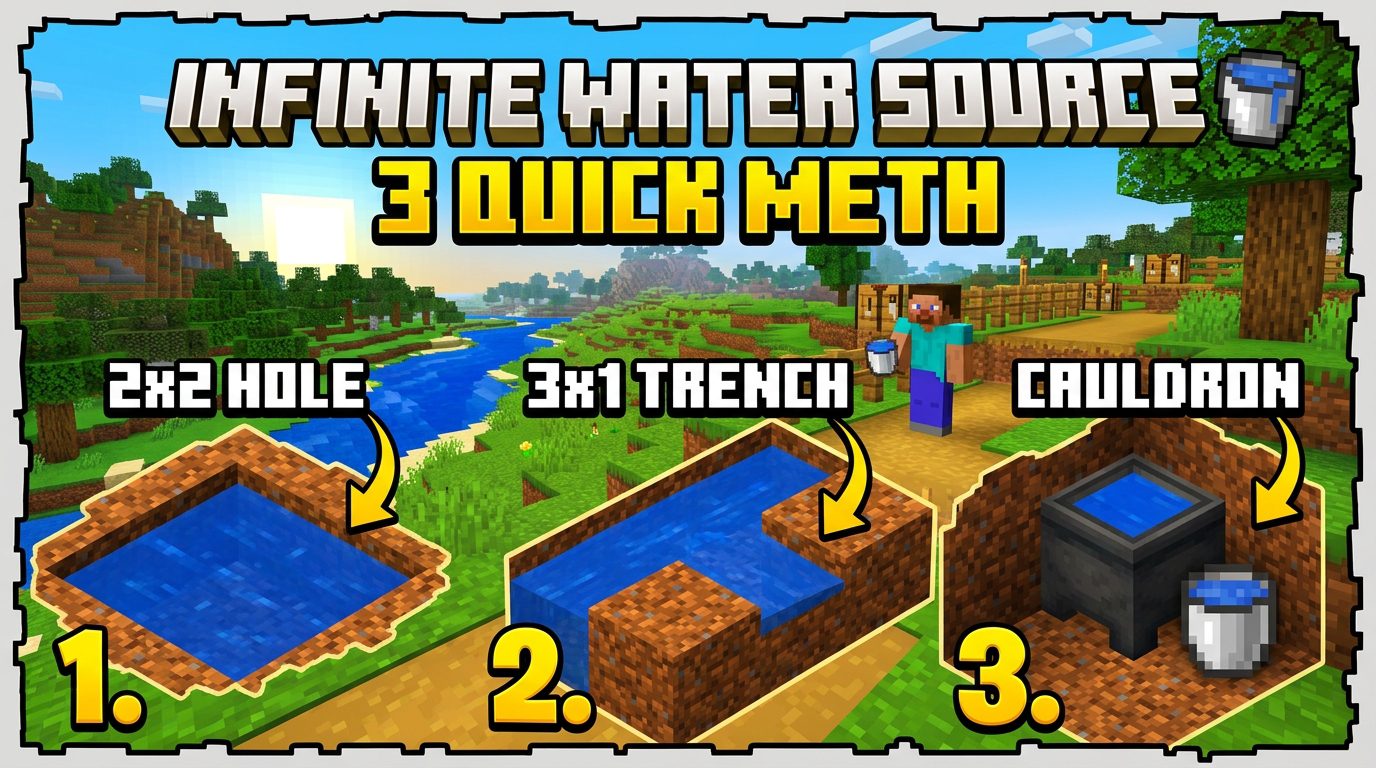
Method 1: The Classic Two‑Bucket Setup
This is the oldest and most straightforward way to get infinite water in Minecraft. It requires only two buckets of water and a 1×2 hole (or just two adjacent blocks on flat ground). Once set up, you can fill an empty bucket from either of the two source blocks, and the missing water will automatically refill from its neighbor. This method is the foundation of all other infinite water designs.
Step‑by‑Step Instructions
- Dig a hole that is 1 block wide and 2 blocks long, and 1 block deep. You can also simply use two adjacent blocks on the surface, but a hole prevents the water from spilling.
- Fill one bucket from a natural water source (ocean, river, lake, or a cauldron full of rain).
- Place the first water bucket into one of the two blocks. You now have a water source block.
- Fill the second bucket with water from any source.
- Place the second water bucket into the other block, directly adjacent to the first. Now you have two source blocks side by side.
- Take out your empty bucket and right‑click on either water block. It will fill your bucket and leave a flowing water block in the hole. Wait a moment – that flowing block will become a full source block again because the other source block is right next to it. You now have an infinite loop!
Why This Works (Minecraft Fluid Mechanics)
In Minecraft, water exists in two states: source blocks (still, full block) and flowing blocks (moving water). A source block can be “picked up” with a bucket, leaving behind either air or flowing water depending on the surrounding blocks. The game has a rule that when two or more source blocks are adjacent to each other, they “support” each other. More specifically, if a flowing water block is created by scooping up one source, the neighboring source block will cause that flowing block to instantly (or after a few game ticks) become a new source block. This only works in a 1×2 configuration where both water blocks are horizontally adjacent. A single water block will not replenish itself – you always need at least two.
Common Mistakes and Tips
- Don’t use diagonal adjacency. Two source blocks placed diagonally (corner to corner) will not create an infinite source – they will remain separate and one can be used up without refilling. Only side‑by‑side or a 2×2 pool (see Method 2) works.
- Depth matter. If you place the water on a higher block than the hole, it will flow downward and break the infinite supply. Always place both buckets on the same Y level.
- Using half‑slabs or stairs. You can put water on top of a half‑slab to create a waterlogged block, but the two‑bucket method still requires the water blocks to be adjacent on the same level. You can use waterlogged slabs to avoid spilling over edges.
- In the Nether. Water behaves differently – you cannot place water source blocks in the Nether (except with a cauldron and ice conversion). This method is only for the Overworld or the End.
- Efficiency. This method is extremely fast. You can fill hundreds of buckets in a minute by simply alternating between the two source blocks. It’s the go‑to design for early‑game farms.
Method 2: The 2×2 Infinite Pool
If you want a larger, more aesthetically pleasing water source (like a well or a pond), you can use the 2×2 infinite water design. This creates a 2×2 pool where every block inside the pool is a renewable source block. You can stand in the middle and fill buckets from any block without ever depleting the water. This method is slightly more resource‑intensive (requires four buckets of water initially) but far more convenient for larger projects.
Step‑by‑Step Instructions
- Dig a hole that is 2 blocks wide, 2 blocks long, and 1 block deep. This creates a 2×2 square pit.
- Obtain four water buckets (you can make multiple trips or use a single bucket repeatedly if you have a temporary supply).
- Fill the two opposite corners of the pit with water source blocks. For example, place water in the north‑west corner and the south‑east corner.
- Now the entire 2×2 area will fill with source blocks. You can verify by looking – all four squares will be still water.
- From this point on, you can take water from any of the four positions using a bucket. The moment you remove water from one block, the remaining three sources will instantly cause it to reappear as a source block.
The Science Behind the 2×2 Design
The 2×2 pool works on the same principle as the two‑bucket method, but it leverages a larger “support network.” When you have at least two source blocks that are not in a direct line but are diagonal to each other, the water mechanics still cause all four blocks to become sources because any missing source is adjacent to at least two other sources. Actually, the exact rule is: if a block is adjacent to two or more source blocks (including diagonally? No, in Java Edition, a block becomes a source if it is adjacent to at least two source blocks horizontally. In a 2×2, the empty corner is adjacent to two sources (one horizontally and one vertically?) Wait, let’s clarify. In a 2×2 square with two opposite corners filled, the other two corners are each adjacent to exactly one water source block diagonally? That is not enough. However, the water in Minecraft has a special behavior: when you place water in two opposite corners of a 2×2 hole, the water still manages to fill the entire pool because the flowing water from each corner combines and the game physics create source blocks. In practice, it works flawlessly in both Java and Bedrock. You can also fill all four corners initially, but two opposite corners suffice.
Variations and Expansions
- Larger pools. You can extend the 2×2 pattern to any rectangular shape as long as every interior block is adjacent to at least two other source blocks. For a 3×3 pool, you need to place sources in a checkerboard pattern. However, the easiest way to get infinite water in a large area is to create a single 2×2 unit and then let water flow into a larger basin – but that won’t be renewable across the entire basin. For a fully renewable large pond, you need multiple 2×2 sections.
- Underground wells. The 2×2 pool is perfect for a village well. Dig a 2×2 hole, line it with stone, place the two source blocks, and cover the top with a decorative well frame. You’ll have a lovely, functional water source that never runs dry.
- Combining with redstone. You can place a dispenser facing into the pool, load it with an empty bucket, and use a simple lever to fill buckets automatically. The dispenser will pick up a water source block and turn it into a water bucket inside the dispenser.
Tags:
YOU MAY ALSO LIKE...