

How to get Netherite Scraps in Minecraft
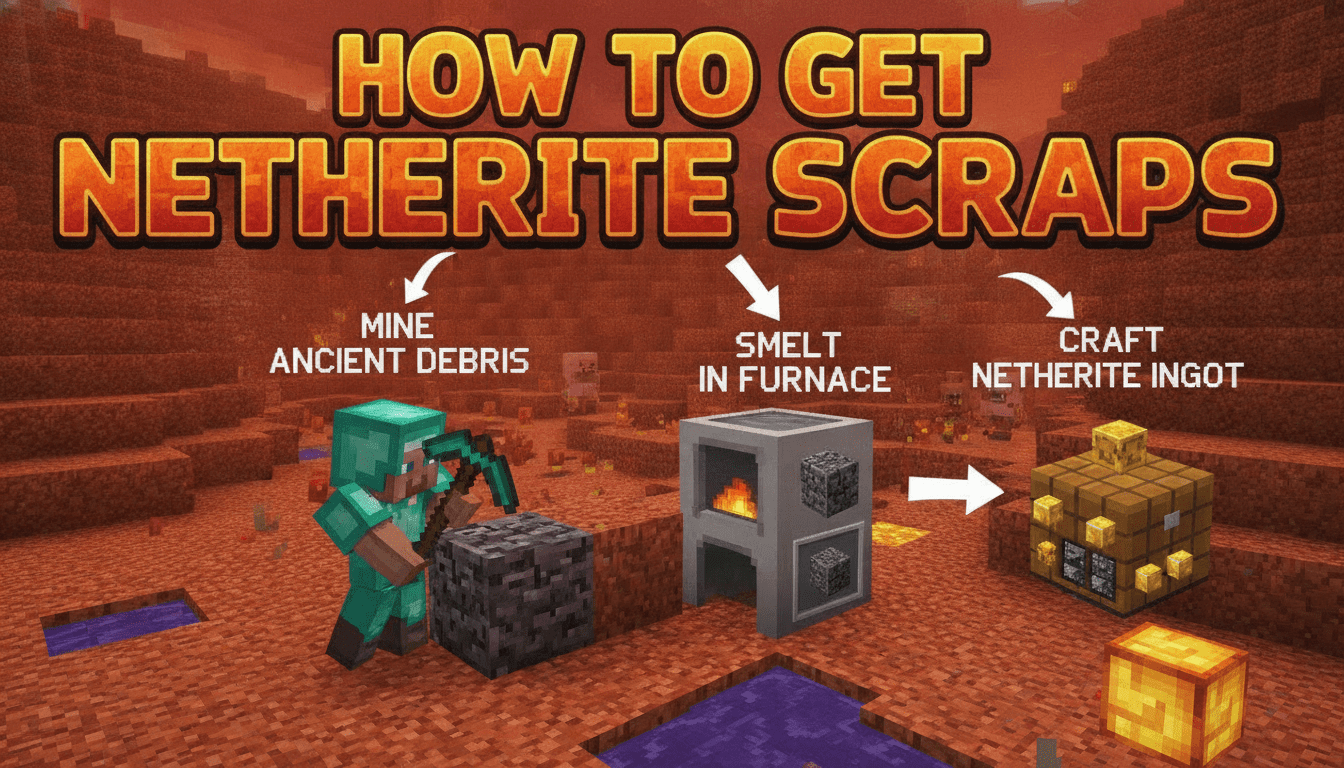
Delving into the fiery depths of the Nether to upgrade your gear to the strongest material in Minecraft can be a daunting but rewarding challenge. This guide will walk you through the precise steps to acquire Netherite Scraps, the crucial component for crafting Netherite Ingots.
What You’ll Need
To successfully gather Netherite Scraps, you’ll need a specific set of tools and resources. Preparation is key to a productive and safe trip into the Nether.
- Diamond Pickaxe (or Netherite Pickaxe): This is absolutely essential. Ancient Debris, the source of Netherite Scraps, will only drop if mined with a Diamond Pickaxe or a Netherite Pickaxe. Any other tool, including lower-tier pickaxes, will destroy the block without yielding any drops. You can craft a Diamond Pickaxe using 3 Diamonds and 2 Sticks on a crafting table.
- Blast Furnace or Furnace: To transform Ancient Debris into Netherite Scraps, you’ll need a smelting device. A Blast Furnace smelts items twice as fast as a regular Furnace, making it more efficient for processing large quantities of Ancient Debris. A Furnace is crafted with 8 Cobblestone (or Blackston/Deepslate) in a crafting table, while a Blast Furnace requires 5 Iron Ingots, 1 Furnace, and 3 Smooth Stone.
- Fuel: Any fuel source will work for smelting, such as Coal, Charcoal, Lava Buckets, or Blaze Rods. A Lava Bucket is the most efficient single fuel source, smelting 100 items.
- Explosives (Optional, but highly recommended):
- Beds: Beds explode when used in the Nether (or End), making them an incredibly efficient and relatively cheap way to clear large areas of Netherrack and expose Ancient Debris. You’ll need 3 Wool and 3 Wood Planks to craft one bed. Bring many!
- TNT: TNT also works well for clearing blocks. You’ll need 5 Gunpowder (from Creepers) and 4 Sand (found in deserts or beaches) to craft one TNT block.
- Fire Resistance Potions (Optional, but highly recommended): The Nether is full of lava. Fire Resistance Potions offer invaluable protection, allowing you to traverse lava lakes and survive accidental dips. Brew them using Nether Wart (from Nether Fortresses) and Magma Cream (from Magma Cubes or crafted from Slimeball + Blaze Powder).
- Food: Keep your hunger satiated to regenerate health and sprint.
- Building Blocks: Cobblestone, Netherrack, or any non-flammable block is useful for bridging over lava, creating safe mining tunnels, or blocking off Ghasts.
- Shulker Boxes or Ender Chest (Optional): For extended mining trips, these allow you to carry more Ancient Debris and other loot without needing to return to your base frequently.
Step-by-Step
Acquiring Netherite Scraps is a multi-stage process that begins with locating and mining Ancient Debris, followed by smelting it.
Step 1: Prepare for the Nether
Before you even step foot in the Nether, ensure you have all the necessary items listed above, especially your Diamond Pickaxe and some form of defense. Enchantments like Unbreaking and Mending on your pickaxe will extend its durability.
Step 2: Enter the Nether
Build a Nether Portal using 10-14 Obsidian blocks and light it with a Flint and Steel. Step through to enter the Nether dimension. Be prepared for hostile mobs and the dangerous environment.
Step 3: Navigate to the Optimal Y-Level
Ancient Debris is found at specific Y-levels.
* Press F3 (Java Edition) or enable “Show Coordinates” in settings (Bedrock Edition) to view your current Y-level.
* The optimal Y-level for finding Ancient Debris is Y=15. While it can generate anywhere between Y=8 and Y=119, the highest concentration is found in the lower layers, particularly around Y=15.
* Dig down to Y=15. Be extremely cautious when digging straight down in the Nether, as you might fall into a lava lake or a cavern teeming with hostile mobs. It’s safer to dig a staircase or a diagonal tunnel.
Step 4: Mine for Ancient Debris
Once you are at Y=15, you have two primary methods for finding Ancient Debris:
Method A: Explosive Mining (Recommended)
This is the most efficient method due to Ancient Debris’s high blast resistance, meaning it won’t be destroyed by explosions.
- Dig a Tunnel: Create a long, straight tunnel at Y=15. Make it at least 2 blocks high.
- Place Explosives:
- Beds: Place a bed at the end of your tunnel, then stand a safe distance away (usually 3-4 blocks back, around a corner or behind a blast-resistant block like Obsidian) and right-click the bed to attempt to sleep. Since you cannot sleep in the Nether, the bed will explode, clearing a significant area of Netherrack. Repeat this process, moving forward as you clear paths.
- TNT: Place TNT blocks in a line or pattern, then ignite them with a Flint and Steel or a Redstone Torch. Again, stand clear of the blast radius.
- Collect Ancient Debris: After each explosion, carefully survey the exposed area for Ancient Debris blocks. They are dark brown, somewhat textured, and emit a faint glow.
- Repeat: Continue placing explosives, clearing areas, and collecting Ancient Debris as you extend your tunnel.
Method B: Strip Mining
This method is slower but safer if you’re low on explosives or prefer a more methodical approach.
- Dig a Main Tunnel: Create a long, straight tunnel at Y=15, at least 2 blocks high.
- Dig Branch Tunnels: From your main tunnel, dig parallel branch tunnels every 3-4 blocks. These branches should also be at Y=15 and 2 blocks high. This pattern ensures you cover a wide area without re-mining blocks.
- Look for Ancient Debris: As you mine through the Netherrack, keep an eye out for Ancient Debris. Remember, it never generates exposed to air, so you’ll always find it embedded within other blocks.
- Mine with Diamond Pickaxe: When you find Ancient Debris, mine it with your Diamond Pickaxe (or Netherite Pickaxe). It will drop as an Ancient Debris block.
- Generation Details:
- Java Edition: Expect around 1.65 Ancient Debris blocks per chunk on average. One cluster of 0-3 blocks generates between Y=8 and Y=24, and another cluster of 0-2 blocks generates evenly from Y=6 to Y=119.
- Bedrock Edition: You might find slightly more, with up to five clusters per chunk. Two clusters of 0-3 blocks generate with a triangle distribution from Y=8 to Y=24, and three clusters of 0-2 blocks generate evenly from Y=6 to Y=119. Regardless of edition, Y=15 remains the sweet spot.
Step 5: Smelt Ancient Debris into Netherite Scraps
Once you have a stack of Ancient Debris, it’s time to process it.
- Place Smelting Device: Set up your Blast Furnace or Furnace. If you’re still in the Nether, ensure it’s in a safe, protected area.
- Add Fuel: Place your chosen fuel (e.g., Coal, Lava Bucket) into the bottom fuel slot of the furnace.
- Add Ancient Debris: Place the Ancient Debris blocks into the top input slot of the furnace.
- Collect Netherite Scraps: Each Ancient Debris block will smelt into one Netherite Scrap. Collect them from the output slot. Smelting each block also grants 2 experience points.
Alternative Method: Bastion Remnant Loot
While smelting Ancient Debris is the primary method, you can also find Netherite Scraps as loot in Bastion Remnants.
- Locate Bastion Remnants: These massive, dangerous structures are found exclusively in the Nether. They are inhabited by Piglins and Hoglins, so come prepared for a fight.
- Search Chests: Within Bastion Remnants, various types of chests (Treasure, Hoglin Stable, Generic) have a chance to contain Netherite Scraps. The “Treasure” chests, often found in the central chamber of a Bastion, typically have the highest chance of containing valuable loot, including Netherite Scraps.
- Caution: Bastion Remnants are extremely perilous. Piglins are hostile unless you wear at least one piece of Gold Armor, and Brutes are always aggressive. Be prepared for intense combat. This method is generally less reliable for mass production of Netherite Scraps compared to mining Ancient Debris.
Tips for Efficiency and Safety in the Nether
- Fire Resistance is Your Best Friend: Always have Fire Resistance Potions active or readily available. They are invaluable for surviving lava falls and accidental dips.
- Keep Gold on Hand: Piglins are neutral if you wear at least one piece of gold armor. You can also barter with them by right-clicking them with Gold Ingots, which can sometimes yield useful items (though not Netherite Scraps).
- Bring Water (for utility, not fire): While water evaporates in the Nether, an empty bucket can still be used to pick up lava, which is useful for clearing small lava sources or creating a protective barrier.
- Mark Your Path: The Nether can be disorienting. Place torches or distinctive blocks to mark your way back to your portal or main tunnels.
- Secure Your Portal: Build a small shelter around your Nether portal to protect it from Ghast fire and prevent mobs from immediately attacking you upon arrival.
- Don’t Dig Straight Down: This is a golden rule in all dimensions, but especially in the Nether where lava is abundant.
- Bring an Ender Chest/Shulker Boxes: These are perfect for safely storing your valuable Ancient Debris and Netherite Scraps, preventing loss if you die.
- Use Potions: Beyond fire resistance, Strength, Regeneration, and Swiftness potions can greatly aid your mining and combat efforts.
FAQ
Q: Can I find Netherite Scraps in the Overworld or End?
A: No, Netherite Scraps are exclusively obtained from Ancient Debris found in the Nether, or rarely as loot in Nether Bastion Remnants.
Q: What happens if I mine Ancient Debris with an Iron Pickaxe?
A: Mining Ancient Debris with any pickaxe less than a Diamond Pickaxe (e.g., stone, iron, gold) will destroy the block without dropping anything. You will not get Ancient Debris.
Q: How many Netherite Scraps do I need for one Netherite Ingot?
A: You need 4 Netherite Scraps and 4 Gold Ingots to craft one Netherite Ingot in a crafting table.
Q: Is there a way to duplicate Netherite Scraps?
A: No, there are no legitimate in-game methods to duplicate Netherite Scraps. Any claims of duplication glitches are typically either patched or exploits that can corrupt your world.
Q: What’s the fastest way to get Netherite Scraps?
A: The fastest way is generally to use the explosive mining method (beds or TNT) at Y=15 in the Nether to clear large areas and expose Ancient Debris, then smelt it in a Blast Furnace.
With careful preparation and a strategic approach, gathering Netherite Scraps will pave the way for you to forge the most powerful gear in Minecraft.
Tags:
YOU MAY ALSO LIKE...


