

Powering a Train Using a Boiler in Create, Explained
Powering a Train with a Boiler in Create
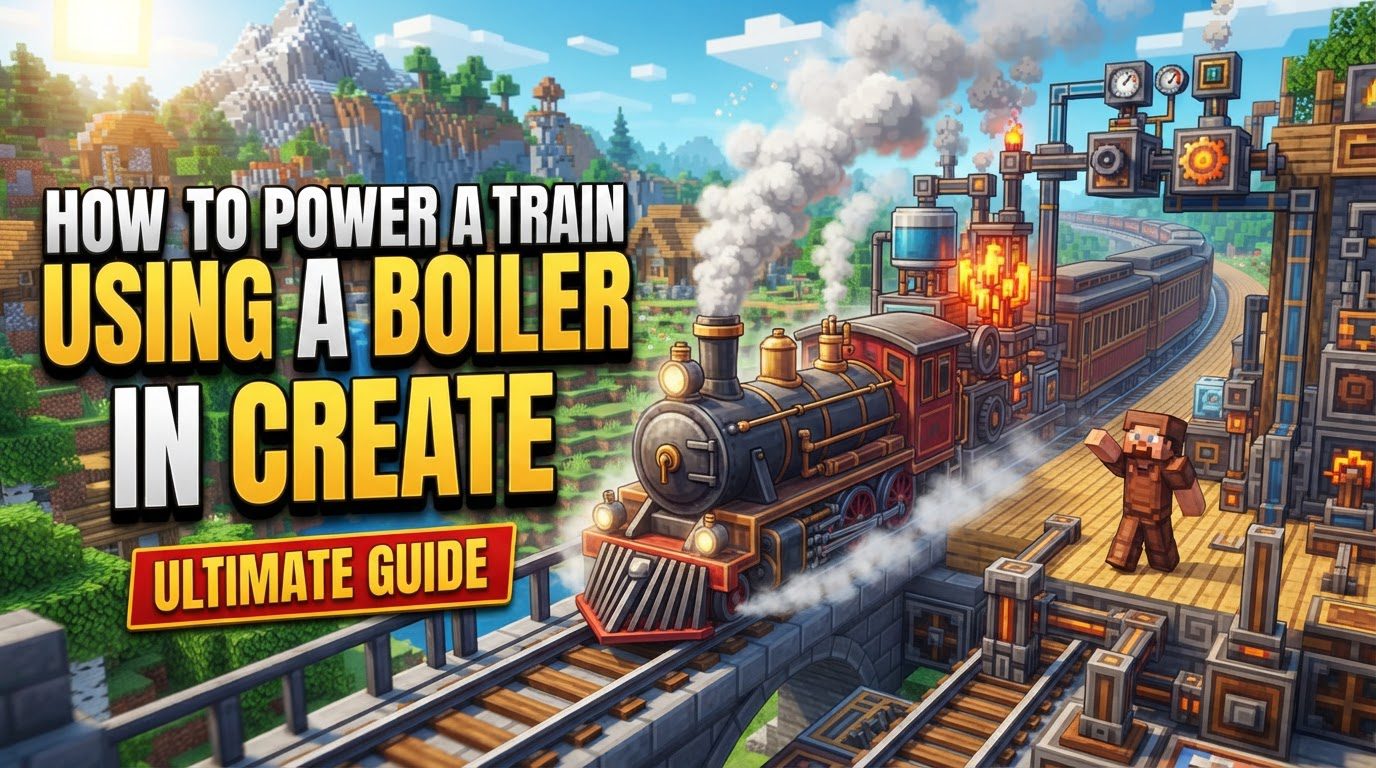
To propel a train effectively within the Create mod, especially when aiming for steam-powered locomotion, mastering the construction and maintenance of a steam boiler is essential. This intricate process involves generating Stress Units (SU) through the boiler to drive the train’s kinetic mechanisms. While the Create mod provides foundational mechanics, the “Create: Steam ‘n’ Rails” addon significantly expands the possibilities, introducing dedicated components crucial for building functional steam trains.
Key Mechanics of Boiler Operation
Understanding the fundamental mechanics behind Create boilers is paramount to successful train operation. These systems are designed with several interconnected elements that dictate their overall performance and power output.
- Boiler Power Source: The boiler serves as the primary power source for all Create steam engines. It converts heat and water into steam, which is then harnessed to produce kinetic energy. Without a properly functioning boiler, steam engines cannot operate.
- Power Level: A boiler’s overall power output is encapsulated in its “Power Level.” This level is dynamically determined by the *lowest* of three critical internal statistics: Size, Heat, and Water. This means that even if a boiler has abundant size and heat, a low water supply will cap its entire power output to that insufficient water level. Maintaining a balance across all three stats is therefore crucial for optimal performance.
- Stress Units (SU): Steam engines are the components that convert the boiler’s steam into usable kinetic stress, measured in Stress Units (SU). Each individual steam engine possesses the capacity to generate up to 16,384 SU. This amount of SU generation is equivalent to one full boiler level. For larger, more powerful boilers that produce higher power levels, multiple steam engines can be strategically attached. This allows for the extraction of a greater total amount of kinetic power, fully utilizing the boiler’s capacity.
- Steam ‘n’ Rails: This specific mod is an expansion for Create, designed to enhance and broaden the railway system. It introduces a variety of new components and functionalities that are specifically necessary for the construction and operation of authentic and functional steam trains, making it an indispensable part of this specific endeavor.
Step-by-Step Process for Boiler Construction and Train Integration
Building and integrating a boiler-powered train involves a series of sequential steps, each critical for ensuring efficient and reliable operation.
- Construct the Boiler: The foundation of your steam train’s power lies in the boiler itself. This is built using fluid tank blocks. These specialized blocks will automatically combine to form the overarching boiler structure. To achieve an active boiler-meaning one that can operate at level 1 or higher-you must incorporate a minimum of four fluid tank blocks into its design. The size and shape can vary, but this minimum block count is essential for functionality.
- Add Heat Source: Once the boiler structure is in place, the next crucial step is to provide it with a consistent and powerful heat source. These heat sources must be positioned directly underneath the boiler structure. Blaze burners are highly recommended for their efficiency; a standard blaze burner provides a good amount of heat. For significantly higher heat levels and thus greater boiler power, superheated blaze burners are ideal, with each providing two heat levels. Passive heat sources, such as simple campfires or pools of lava, can also be used, but it’s important to note that they offer a very low heat output, severely limiting the boiler’s potential power level.
- Supply Water: A continuous and abundant supply of water is absolutely vital for any active steam boiler. This is best achieved by utilizing mechanical pumps to feed water into the boiler. The rate of flow needs to be fast and constant to prevent the water level from dropping, which would in turn reduce the boiler’s overall power level. To ensure an uninterrupted supply, it is highly advisable to set up an infinite water source from which your pumps can continuously draw.
- Attach Steam Engines: With the boiler constructed, heated, and watered, the next step is to convert its steam into kinetic energy. This is done by placing steam engine blocks directly onto the boiler. These engines are specifically designed to harness the steam generated by the boiler and transform it into kinetic stress (SU), which is the usable form of energy for your train’s propulsion.
- Monitor with Engineer’s Goggles: Throughout the construction and operation phases, precise monitoring of your boiler’s internal statistics is critical. Wearing Engineer’s Goggles allows you to observe these vital stats directly, including the boiler’s current Level, its Size, its Heat input, and its Water level. Pay close attention to the visual cues: if any of these categories display red bars, it indicates an insufficient level in that particular stat, signaling a bottleneck in your boiler’s power output.
- Integrate with Train Mechanics: The final step is to connect the kinetic power generated by your steam engines to the train’s driving mechanisms. This typically involves using shafts and gearboxes to transmit the SU from the steam engines to the train’s driving wheels. Properly routed kinetic power will enable the train’s movement. Additionally, trains in Create can consume burnable blocks placed in an attached chest; this mechanism serves to increase the train’s speed, offering an extra layer of control over its performance.
Important Tips for Optimal Boiler Performance
To ensure your boiler operates at its peak efficiency and your train performs reliably, consider these key tips:
- Balance Stats: Always strive to maintain a perfect balance between your boiler’s Size, Heat, and Water levels. As established, the boiler’s overall power level is capped by the lowest of these three statistics. A deficiency in any one area will limit the performance of the entire system, rendering excess in other areas redundant.
- Maximize Heat: For the highest possible power output from your boiler, prioritize the use of superheated blaze burners. These provide significantly more heat than standard burners or passive sources, directly translating to higher steam production and a greater potential power level.
- Adequate Water Flow: Invest in a robust and high-capacity water pumping system. A consistent, high-volume flow of water is essential to keep the boiler’s water level topped up, preventing it from becoming the limiting factor in your power generation.
- Multiple Engines for Output: If your boiler is capable of generating a high power level, ensure you attach a sufficient number of steam engines. Each engine extracts a certain amount of SU. By adding more engines, you can fully utilize the boiler’s generated stress capacity, converting all available steam into kinetic energy.
- Aesthetic Detail: Beyond pure functionality, consider the aesthetic appeal of your train. For a realistic steam train appearance, incorporate decorative elements such as steam domes and sand domes. Furthermore, pay attention to the proper scaling of the boiler, the cab, and the wheelbase to create a visually cohesive and authentic-looking locomotive.
Common Mistakes to Avoid
Even experienced players can encounter issues when setting up complex Create contraptions. Being aware of common pitfalls can save significant time and resources.
- Insufficient Water Supply: This is perhaps the most frequently encountered problem. A boiler that runs out of water, or has a consistently low water level, will exhibit drastically reduced performance. The solution is to either increase the speed of your existing mechanical pumps or to add more pumps to ensure a constant and robust water flow into the boiler.
- Inadequate Heat Sources: Relying solely on passive heat sources, such as campfires or small lava pools, will severely limit your boiler’s power output. These sources provide minimal heat, preventing the boiler from reaching higher power levels necessary for effective train propulsion. Always opt for blaze burners, especially superheated ones, for serious power generation.
- Ignoring Stat Balance: A common oversight is focusing too much on one or two stats while neglecting the third. For example, having a massive boiler (high Size) with plenty of water (high Water) but only a single campfire for heat (low Heat) will mean the boiler’s overall power is still very low. Always remember that the lowest of the three core stats-Size, Heat, and Water-will cap the boiler’s maximum power output.
- Over-stressing Components: While the boiler itself is designed to handle its generated power, the kinetic components connected to it are not always as robust. Connected steam engines and the shafts and gearboxes transmitting the power can be over-stressed if the kinetic load exceeds their capacity. Monitor your kinetic network to ensure no components are breaking or stalling due to excessive stress.
- Self-Fueling Loop: A critical mistake to avoid is attempting to power the mechanism that fuels your blaze burners directly from the active boiler you intend to power the train with. This creates a dependency loop where if the boiler runs out of fuel (or water, or heat), the system powering its own fuel supply will also fail, leading to a complete stall. Instead, use an alternative, independent power source for the blaze burner fueling mechanism, such as a windmill, a water wheel, or a separate, smaller, passive boiler dedicated solely to that task.
Tags:
YOU MAY ALSO LIKE...


