

Setting Up a Mekanism Fusion Reactor (Step by Step)
Understanding the Mekanism Fusion Reactor
The Mekanism Fusion Reactor represents a pinnacle of energy generation in Minecraft, capable of producing immense power through controlled nuclear fusion. A thorough understanding of its operational mechanics, precise construction, and careful management is paramount to harnessing its full potential, ensuring both maximum energy output and reactor stability.
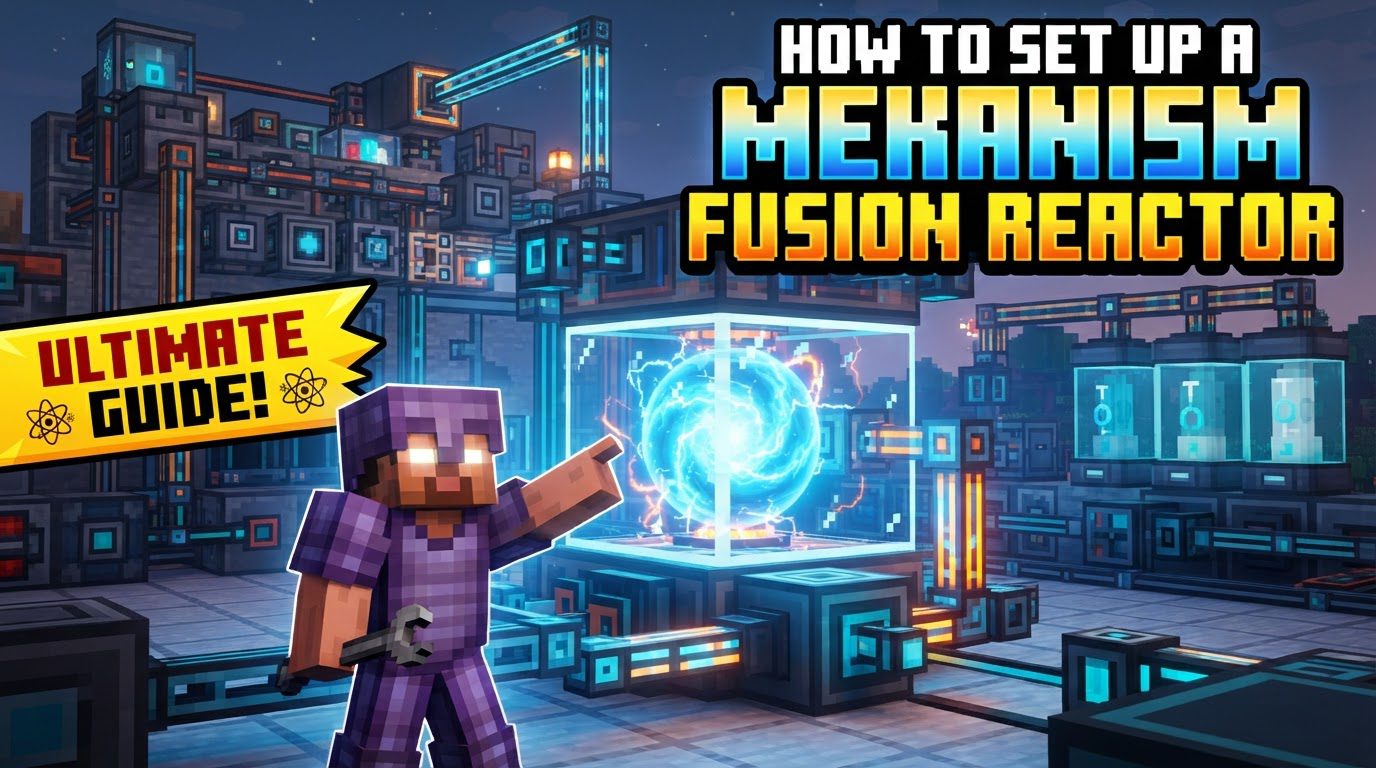
This multiblock structure functions by combining light atomic nuclei, specifically isotopes of hydrogen, into heavier, more stable isotopes. This process releases a significant amount of excess energy, which can then be harnessed for various industrial applications within your Minecraft world.
- Core Fuel Source: The reactor primarily utilizes Deuterium and Tritium as its foundational fuel. These two isotopes can be directly fed into the reactor or, more efficiently, pre-combined into D-T Fuel.
- Ignition Requirement: To initiate the fusion reaction, the reactor’s internal plasma must reach an astonishing temperature of 100 MK (equivalent to 1 million °C). Additionally, a filled Hohlraum containing D-T Fuel is an absolute prerequisite for successful ignition.
- Energy and Steam Output: Energy generated by the fusion process can be extracted through dedicated Reactor Ports. These ports are highly versatile and can also be configured to facilitate water cooling, which in turn produces vast quantities of steam. This steam is optimally used to power Industrial Turbines, further amplifying your power generation capabilities.
- Monitoring and Control: The reactor’s operational status and critical parameters are accessible via its graphical user interface (GUI). This GUI is brought up by right-clicking the Reactor Controller and provides vital information such as plasma temperature, case temperature, current fuel levels, and the active fuel injection rate, allowing for precise control over the reactor’s performance.
Step-by-Step Reactor Setup
Setting up a Mekanism Fusion Reactor involves several distinct phases, from gathering specialized materials to the delicate process of ignition and ongoing management.
1. Gather Materials
The construction of a fusion reactor requires specific, often advanced, components:
- Reactor Frames: You will need approximately 75 Reactor Frames. These are crucial for the structural integrity of the multiblock. Polonium pellets, derived from the nuclear waste produced by a Fission Reactor, are a key ingredient in crafting these frames.
- Reactor Ports: Acquire at least two Reactor Ports specifically for fuel input. Depending on your desired setup, you may need additional ports for energy extraction and, if opting for water cooling, for water input and steam output.
- Reactor Controller: A single Reactor Controller block is essential. This block serves as the central control unit and interface for the entire reactor.
- Reactor Glass: Obtain at least 8 Reactor Glass blocks. These can replace non-corner Reactor Frames, allowing for visual inspection of the reactor’s interior and potentially reducing the Polonium cost.
- Laser Focus Matrix: One Laser Focus Matrix is required if you plan to use the laser ignition method.
2. Construct the Multiblock Structure
The reactor’s physical construction follows a precise pattern:
- Build a 5x5x5 spherical structure. This structure should be primarily composed of Reactor Frames.
- The Reactor Controller must be placed as the top-center block of this spherical structure.
- For structural flexibility and resource optimization, any non-corner Reactor Frames within the 5x5x5 sphere can be substituted with Reactor Glass, additional Reactor Ports, or the Laser Focus Matrix.
3. Place Ports and Laser Focus Matrix
Strategic placement of specialized blocks is vital for reactor functionality:
- Ensure you include at least two Reactor Ports dedicated to fuel input. These can be used to feed Deuterium and Tritium separately, or to input pre-mixed D-T Fuel.
- Allocate at least one Reactor Port for energy output to extract the generated power.
- If you intend to implement water cooling, designate additional Reactor Ports for water input and steam output.
- A Laser Focus Matrix must be integrated into one side of the reactor structure. This block acts as the target for the ignition laser. Note that the Laser Focus Matrix is not needed if you opt for the Resistive Heater ignition method.
4. Produce Deuterium
Deuterium, a heavy isotope of hydrogen, is a primary fuel component:
- Begin by using an Electric Pump equipped with a Filter Upgrade. Place this pump in contact with a water source to produce Heavy Water.
- Process the obtained Heavy Water in an Electrolytic Separator. This machine will split the Heavy Water into Deuterium and Oxygen.
5. Produce Tritium
Tritium, another heavy isotope of hydrogen, is the second critical fuel component:
- Acquire Lithium, which is typically obtained from processing brine.
- Feed the Lithium into a Solar Neutron Activator. This device will convert Lithium into Tritium.
6. Create D-T Fuel (Optional but Recommended)
Combining Deuterium and Tritium into D-T Fuel offers significant advantages:
- Utilize a Chemical Infuser to combine your produced Deuterium and Tritium. This process yields D-T Fuel.
- The use of D-T Fuel allows for much higher fuel injection rates into the reactor, directly correlating to increased power output. However, it necessitates a robust and continuous supply chain, as the reactor consumes it instantly.
7. Fill Hohlraum
The Hohlraum is a critical component for reactor ignition:
- Insert an empty Hohlraum into a Chemical Infuser that contains D-T Fuel.
- The Chemical Infuser will fill the Hohlraum with D-T Fuel. A filled Hohlraum is absolutely essential for the reactor to ignite.
8. Ignite the Reactor
Igniting the fusion reaction requires a significant energy input to reach the target plasma temperature:
- Laser Method:
- Construct a chain of Laser Amplifiers. These amplifiers must be precisely aimed, with the final amplifier’s red dot facing directly into the Reactor’s Laser Focus Matrix.
- The laser chain must accumulate a substantial amount of energy – at least 1 GFE (Giga-FE) or 400 MFE (Mega-FE) – before firing.
- Set the Laser Amplifier to “Normal” redstone mode. This configuration allows it to accumulate energy. Once fully charged, a redstone pulse will trigger the laser to fire, igniting the reactor.
- Resistive Heater Method (Mekanism v10+):
- Place a Resistive Heater and connect it to a Reactor Port on the fusion reactor.
- Configure the Resistive Heater to output 10 MFE/t.
- This method gradually heats the reactor to the required 100 MK plasma temperature, offering a more passive ignition process compared to the instantaneous laser method.
9. Monitor and Adjust
Once ignited, continuous monitoring and adjustment are key to optimal performance:
- Right-click the Reactor Controller to access its GUI.
- From the GUI, you can set the fuel injection rate, a crucial parameter that dictates the reactor’s power output.
- Closely monitor the plasma temperature and energy generation to ensure the reactor is operating efficiently and stably.
Important Tips for Optimal Operation
- Fuel Management Strategy: While piping Deuterium and Tritium separately allows for granular control over the injection rate, pre-mixing them into D-T Fuel enables significantly higher production rates. However, this demands an extremely consistent and high-volume supply, as the reactor consumes D-T Fuel instantly.
- Injection Rate Control: Always begin with a conservative, low injection rate (the minimum is 2). Gradually increase this rate while observing the reactor’s performance to find the optimal balance between fuel consumption and energy generation.
- Cooling Considerations: Water cooling is highly effective for producing steam, which can then power Industrial Turbines. Be aware that this process generates steam at an extremely rapid pace, often necessitating multiple max-sized turbines to handle the output. For simpler setups or in scenarios where steam is not the primary goal, running the reactor “dry” (without water cooling) can simplify the overall system and enhance safety in case of operational interruptions.
- Energy Extraction Efficiency: Use a Configurator tool to set your designated Reactor Ports to output mode. This ensures that the generated energy is correctly transferred out of the reactor to your power network.
- System Optimization: To maximize efficiency across your entire fuel production chain, ensure that all machines involved in Deuterium and Tritium production are fully upgraded with speed and energy upgrades. Additionally, strategically using Reactor Glass in parts of the reactor structure can help reduce the overall cost of Polonium pellets.
- Redstone Control for Lasers: When using the laser ignition method, implement redstone control for your Laser Amplifier. This allows you to precisely control when the laser fires, ensuring it only discharges its energy once fully charged, preventing wasted shots.
Common Mistakes to Avoid
Preventing these common pitfalls will save you time and resources during your fusion reactor setup:
- Insufficient Ignition Energy: A frequent error is failing to accumulate enough energy (at least 400 MFE/1 GFE) in the Laser Amplifier before attempting ignition. An undercharged laser will simply fail to ignite the reactor.
- Forgetting the Hohlraum: The reactor absolutely requires a filled Hohlraum to be inserted into the Reactor Controller before it can start. This is a critical step often overlooked.
- Running Out of Fuel: If the reactor completely depletes its fuel supply, it will shut down. This necessitates a full re-ignition process, including obtaining a new filled Hohlraum and re-charging the laser amplifier (or reheating with the Resistive Heater).
- Incorrect Laser Setup: Ensure that the red dot on the Laser Amplifier is directly facing the Reactor’s Laser Focus Matrix. While other lasers can charge the amplifier from different sides, the amplifier itself must point directly at the focus matrix for ignition. Also, never stand in front of a firing laser.
- Unbuffered D-T Fuel Supply: When opting for pre-mixed D-T Fuel, an inconsistent or intermittent supply (e.g., from an inadequately configured AE2 exporter) can cause the reactor to instantly consume all available fuel and immediately shut down. Always use large chemical tanks as buffers to ensure a continuous and stable fuel supply.
- Minimum Injection Rate Violation: The minimum operational injection rate for both Deuterium and Tritium is 2. Attempting to set the rate lower than this value will cause the reactor to turn off.
- Ignoring Waste Management: Although not directly a fusion reactor operational mistake, remember that Polonium pellets, vital for crafting Reactor Frames, are produced from nuclear waste generated by Fission Reactors. Proper disposal and management of this waste are crucial for long-term sustainability and environmental safety within your Minecraft world.
Tags:
YOU MAY ALSO LIKE...


