

How to tame a Camel in Minecraft
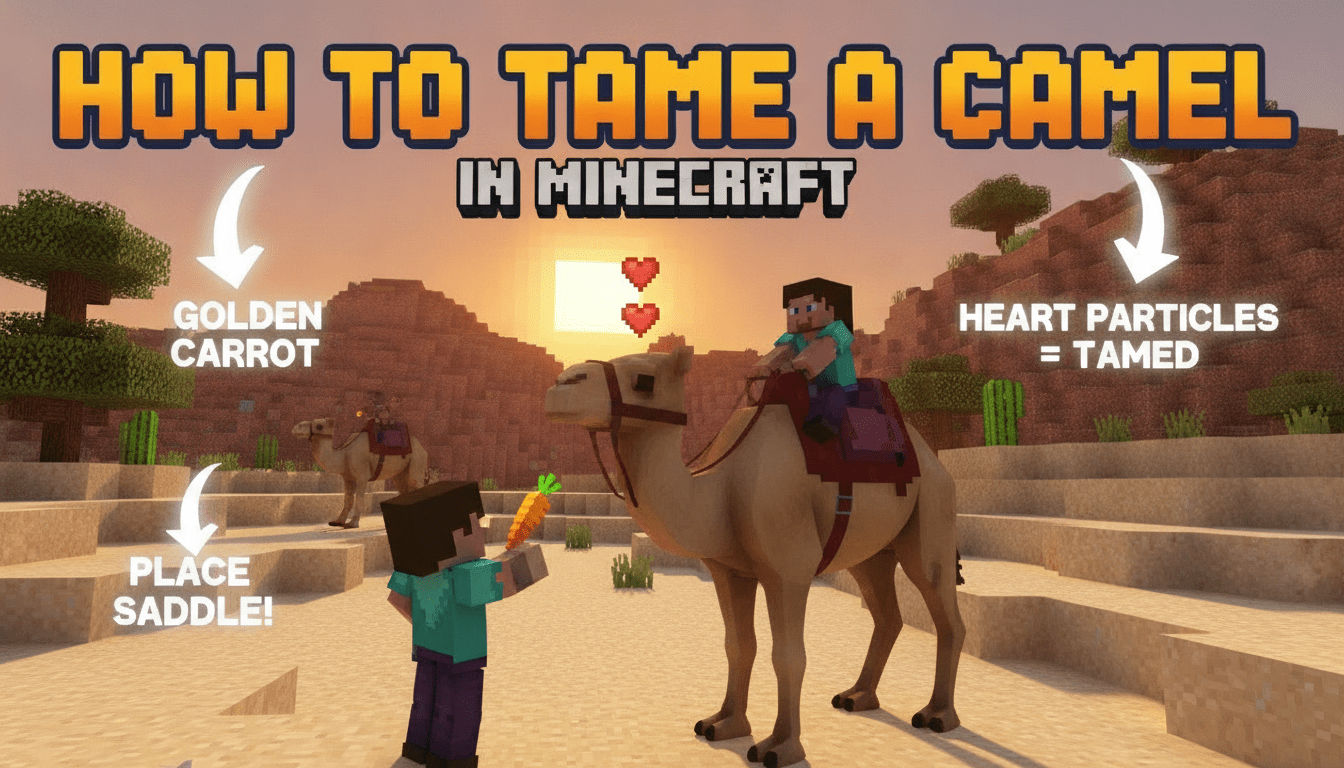
Journey across the vast deserts of Minecraft with a loyal companion! This guide will walk you through everything you need to know about interacting with, riding, and even breeding camels, ensuring you can master these unique desert dwellers.
What You’ll Need
- Saddle: Essential for controlling and steering your camel.
- Where to Get: Found in various loot chests across the world (e.g., dungeons, desert temples, strongholds, nether fortresses, end cities, bastion remnants, village chests) or obtained by trading with master leatherworker villagers.
- Lead: Useful for moving a camel around before you have a saddle, or for safely transporting it.
- Where to Get: Crafted using 4 String and 1 Slimeball (arranged in a 2×2 square with the Slimeball in the middle, and String filling the remaining slots). Can also be found in loot chests or traded with wandering traders.
- Cactus: The exclusive food source for camels, used for healing and breeding.
- Where to Get: Abundantly found growing naturally in desert biomes. Cactus blocks can be harvested and replanted on sand blocks in any biome to create a farm.
Step-by-Step
Camels are unique among Minecraft’s rideable mobs because they don’t require traditional “taming” like horses or donkeys. Instead, you simply need to equip them with a saddle to gain control.
Step 1: Locate a Camel
Camels are native to the desert biomes and are primarily found in desert villages. They typically spawn near the center of these villages. You’ll usually find only one camel per desert village, so you might need to explore a few villages if you’re looking for multiple camels.
Step 2: Acquire a Saddle
Before you can truly ride and control a camel, you’ll need a saddle. Saddles cannot be crafted, making them a valuable item to find.
* Loot Chests: Explore structures like dungeons, desert temples, jungle temples, strongholds, nether fortresses, end cities, bastion remnants, and even village chests. These are common locations to find saddles.
* Villager Trading: Master-level leatherworker villagers have a chance to offer saddles for emeralds as one of their trades.
Step 3: Mount the Camel
Once you’ve found a camel and have a saddle in your inventory, approach the camel.
* Java Edition: Right-click on the camel.
* Bedrock Edition: Use the “Mount” button that appears when you look at the camel.
You will now be sitting on the camel’s back, but you won’t be able to steer it yet.
Step 4: Equip the Saddle
While you are mounted on the camel, open your inventory. This will also open the camel’s inventory panel, which has a single slot specifically for a saddle.
* Drag the saddle from your inventory and place it into the designated saddle slot in the camel’s inventory.
As soon as the saddle is equipped, you will gain full control of the camel. You can now use your movement keys (W, A, S, D by default) to steer it and explore the world!
Step 5: Using a Lead (Optional)
If you haven’t found a saddle yet but want to move a camel to a different location, you can use a lead.
1. Craft a lead using 4 String and 1 Slimeball.
2. Approach the camel and right-click (or use the action button) with the lead in your hand. This will attach the lead to the camel.
3. You can now walk, and the camel will follow you. This is useful for bringing a camel back to your base before you have a saddle.
Camel Care and Breeding
Camels are not just mounts; they can also be bred to create more desert companions!
Feeding Your Camel
Camels have a specific diet: cactus.
* To Heal: Feeding a camel one cactus will restore 2 hearts (4 health points) to its health bar. This is useful after a tough journey or an encounter with hostile mobs.
* To Attract: If you hold a cactus in your hand, nearby camels will follow you. This is particularly useful for guiding multiple camels or luring them out of a village.
* Java Edition: Camels will follow within a 10-block radius.
* Bedrock Edition: Camels have a slightly larger following range, up to 16 blocks.
Breeding Camels
To breed camels, you’ll need two adult camels and some cactus.
1. Locate Two Adult Camels: Find two adult camels that are not currently on cooldown from a previous breeding session.
2. Feed Each Camel Cactus: Hold a cactus in your hand and right-click (or use the action button) on each of the two adult camels.
3. Enter Love Mode: After being fed, both camels will enter “love mode,” indicated by red hearts appearing around them. They will then approach each other.
4. Baby Camel Spawns: A baby camel will appear, and the two adult camels will have a 5-minute cooldown before they can breed again.
5. Speed Up Growth: Baby camels will naturally grow into adults over time. You can accelerate this process by feeding baby camels additional cactus. Each cactus fed will slightly reduce the remaining growth time.
Unique Camel Abilities and Advantages
Camels offer several distinct advantages over other mounts in Minecraft, making them excellent choices for desert exploration and general travel.
Two-Player Riding
One of the most notable features of camels is their ability to carry two players simultaneously.
* The first player to mount the camel will be in the front seat and will control the camel’s movement.
* A second player can then mount the camel and will ride as a passenger in the back. This is perfect for multiplayer adventures or for safely transporting a friend across dangerous terrain.
Height Advantage Against Mobs
Camels are tall creatures, and this height provides a significant defensive advantage.
* When you are riding a camel, most hostile melee mobs (such as zombies, skeletons, creepers, and husks) cannot reach you to attack. Their attack range is too low to hit a player on a camel’s back.
* However, be aware that certain mobs can still reach you, including spiders (who can climb), wolves, slimes, magma cubes, and any mob that can jump or fly. Ranged mobs like skeletons also pose a threat.
Dash Ability
Instead of a traditional jump, camels possess a unique dash ability.
* Hold down the jump button (Spacebar by default) to charge the dash.
* Release the button, and the camel will launch itself forward up to 12 blocks and one block upward. This is excellent for quickly covering ground or crossing small gaps.
Block Stepping
Camels have a superior block-stepping ability compared to other mounts.
* They can automatically step up 1.5-block-high walls without needing to jump or dash. This allows for smoother traversal over uneven terrain, making them less prone to getting stuck on small obstacles.
Sitting Behavior
Camels will occasionally sit down for a short period (between 2 to 7 seconds).
* While sitting, they cannot be pushed, making them temporarily immobile.
* They will quickly stand up and flee if they take any damage, so they won’t remain vulnerable for long.
Persistence
Once a camel has been ridden by a player, it becomes persistent.
* This means it will not despawn naturally, ensuring that your beloved desert companion will remain in your world indefinitely, even if you travel far away.
FAQ
Q: Do I need to “tame” a camel like a horse?
A: No, camels do not require traditional taming. You simply need to mount them and then place a saddle in their inventory to gain control.
Q: What do camels eat?
A: Camels exclusively eat cactus. Feeding them cactus will heal them and is also necessary for breeding.
Q: Can camels take damage from cactus even though they eat it?
A: Yes, despite consuming cactus, camels will still take damage if they walk into a cactus block in the environment. Be careful when navigating through desert landscapes.
Q: How many players can ride a camel at once?
A: Camels can carry two players simultaneously. The front player controls the camel, while the second player rides as a passenger.
Q: What’s the difference between Java and Bedrock Edition for camels?
A: The core mechanics for riding and breeding are the same. The main difference is the following distance when holding cactus: 10 blocks in Java Edition and 16 blocks in Bedrock Edition.
Mastering the camel will make your desert explorations and general travel much more efficient and enjoyable.
Tags:
YOU MAY ALSO LIKE...


