

Using a Large Cogwheel to Double Rotation Speed — A Quick Guide
Understanding Cogwheel Mechanics for Speed Doubling
In the intricate world of Minecraft’s Create mod, understanding how to manipulate rotational power is crucial for building efficient and powerful contraptions. Cogwheels serve as the fundamental components for transferring and transforming this rotational energy, much like gears in real-world machinery. The interaction between different sizes of cogwheels offers a direct method for altering rotation speed, a key aspect for optimizing your automated systems.
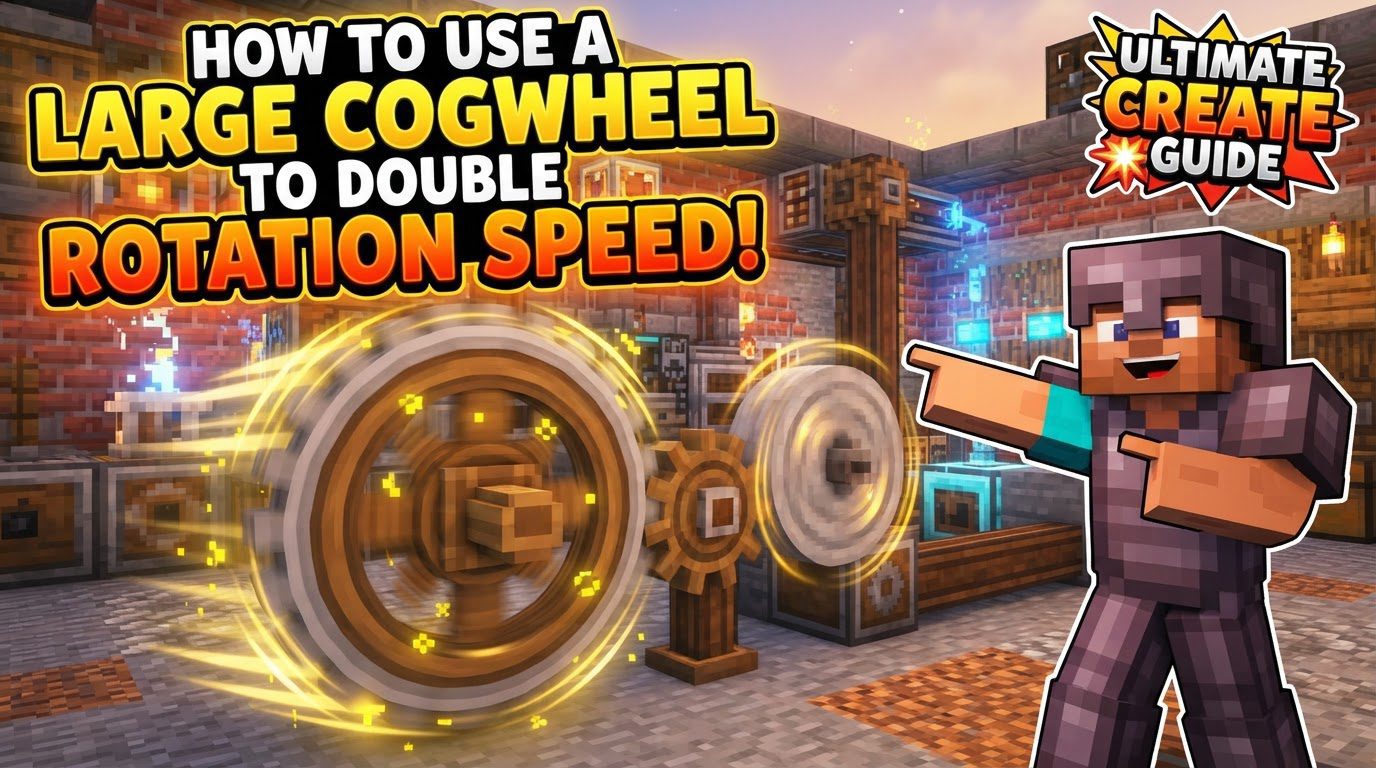
One of the most valuable mechanics involves the specific interaction between a Large Cogwheel and a Small Cogwheel. When a Large Cogwheel powers a Small Cogwheel, a specific mechanical advantage is achieved: the Small Cogwheel rotates at precisely twice the speed of the Large Cogwheel driving it. This speed is quantified in Revolutions Per Minute (RPM), a metric that can be precisely viewed and monitored using a Speedometer in the game. This doubling effect is a cornerstone for designing high-speed machinery.
However, this increase in speed does not come without consequence. Doubling rotation speed inherently increases the stress requirement on all mechanical components involved in that power transfer chain. This means that while you gain speed, you must ensure your power generation and transmission infrastructure can handle the increased mechanical load. Failing to account for higher stress requirements can lead to machinery breakdowns. Another important characteristic of meshed cogwheels is that the direction of rotation also inverts when power is transferred between them. This is a crucial detail for planning the orientation of your contraptions and ensuring components spin in the desired direction.
Step-by-Step Process: Doubling Rotation Speed
Achieving doubled rotation speed with cogwheels is a straightforward process once the core mechanics are understood. Follow these steps to implement this powerful gearing technique:
-
Generate Initial Power:
The first step in any rotational power setup is to establish a reliable source of initial rotational energy. Common early-game power generators include water wheels or windmills, which provide a foundational RPM and stress capacity. It is generally recommended to begin your gearing setup by attaching a large gear directly to the shaft of your power source. This provides a robust starting point for subsequent speed modifications.
-
Attach Large Cogwheel:
Once your power source is established, the next step is to place a Large Cogwheel directly onto the shaft extending from your generator. This Large Cogwheel will serve as the primary driver for the speed-doubling mechanism. Ensure it is securely placed and rotating from your power source.
-
Place Small Cogwheel for Doubling:
This is the critical step for achieving the speed increase. Position a Small Cogwheel diagonally adjacent to the Large Cogwheel you just placed. The diagonal placement is essential for this specific gearing ratio. When correctly positioned, the teeth of the Small Cogwheel will mesh with those of the Large Cogwheel. This setup will immediately cause the Small Cogwheel to spin at precisely double the speed of the Large Cogwheel. Observe this interaction, and perhaps use a Speedometer to confirm the RPM increase. The direction of rotation of the Small Cogwheel will also be inverted compared to the Large Cogwheel.
-
Repeat for Further Speed Increase:
The beauty of this system is its scalability. To continue doubling the speed exponentially, you can repeat the process. First, place a shaft onto the now-faster Small Cogwheel. This shaft will carry the doubled rotation speed. Next, attach another Large Cogwheel to this new shaft. This Large Cogwheel will now be spinning at the doubled speed. Finally, repeat the previous step by placing another Small Cogwheel diagonally adjacent to this new Large Cogwheel. This will cause the second Small Cogwheel to spin at double the speed of the second Large Cogwheel, effectively quadrupling your initial speed. This chain of alternating large and small cogwheels, connected diagonally, can be repeated as many times as necessary to achieve extremely high rotational speeds, provided you manage stress and stay within RPM limits. Each repetition multiplies the speed by two.
Important Tips for Optimal Gearing
To maximize efficiency and prevent common issues, keep the following tips in mind when designing your speed-doubling setups:
- Start with Large Gear: For optimal scaling and to provide a stable foundation for your speed-doubling chains, always attach a Large Cogwheel first to your power generator. This initial large gear can then drive smaller gears, which are used for the speed increase. This approach allows for a more robust and expandable system.
- Use Shafts for Efficiency: Shafts are incredibly versatile components. They can effectively extend rotational power over distances, allowing you to route power to different parts of your contraption. More importantly, shafts can create crucial space for more complex gearing arrangements. By extending a shaft, you can position cogwheels precisely where they need to be, facilitating intricate speed-doubling chains without components clashing or incorrectly meshing.
- Compact Designs: When space is at a premium, or you simply desire a cleaner build, Andesite Casing offers an excellent solution. This casing can be placed over large cogs to cover their shaft connections. This not only makes your designs look more integrated but also prevents unintended connections from other rotational components. By encasing large cogs, you can achieve more compact designs without the need for additional shafts solely for spacing purposes, as the casing visually and functionally separates the components.
- Speed Controllers: For builds that require very precise control over both speed and direction, especially in later stages of game progression, consider incorporating specialized speed controllers. A Rotation Speed Controller allows you to set an exact RPM for an output shaft, while an Adjustable Chain Gearshift provides flexible control over speed ratios and direction changes. These advanced components offer greater finesse than simple cogwheel setups for fine-tuning your machinery.
Common Mistakes to Avoid
While the speed-doubling mechanic is powerful, several pitfalls can lead to frustration or component breakage. Being aware of these common mistakes will help you build more robust and functional contraptions:
-
Exceeding Max RPM:
One of the most critical limitations in Create mod is the maximum rotation speed for mechanical components. The default maximum RPM for most components is 256. If a cogwheel or any other rotational component attempts to spin faster than this limit, it will immediately break. This is a particularly common issue when attempting to chain speed-doubling mechanisms. For example, if you have an input rotating at 128 RPM and you double it, the output will be 256 RPM. Attempting to double this 256 RPM output again will cause the component to break, as it would try to reach 512 RPM, which is beyond the limit. Always monitor your RPMs with a Speedometer, especially when building multi-stage speed doublers.
-
Confusing Speed and Stress:
It’s easy to conflate a powerful generator with high speed, but these are distinct concepts. While increasing speed demands a higher stress capacity from your mechanical components, simply having a powerful generator (one that produces a high number of stress units) does not automatically increase the speed of your machinery. Speed scaling is achieved through specific gear ratios and component interactions, such as the Large Cogwheel driving a Small Cogwheel. A powerful generator ensures you have the stress capacity to handle high-speed operations, but it does not inherently make components spin faster; that requires correct gearing.
-
Incorrect Placement:
The precise placement of cogwheels is paramount for achieving desired effects. Placing large cogwheels directly next to each other, for instance, will not result in speed doubling. This configuration is typically used for transferring power at a 1:1 ratio or, more commonly, for making 90-degree turns in power transmission. The speed doubling mechanic specifically relies on a large cogwheel driving a diagonally placed small cogwheel. Any other arrangement will either transfer power differently or not at all. Always ensure the small cogwheel is positioned one block diagonally from the large cogwheel to activate the speed-doubling effect.
Tags:
YOU MAY ALSO LIKE...


