

Minecraft How to Build a Nether Portal
One of the most frequently made mistakes for new players eager to explore Minecraft’s dangerous dimensions is attempting to mine obsidian with an inadequate tool. This tough, purplish-black block is the cornerstone of interdimensional travel, specifically for constructing a Nether Portal, but only the strongest pickaxes in the game can successfully harvest it. Without a diamond or Netherite pickaxe, any attempt to break obsidian will simply destroy the block without yielding any resources, a frustrating waste of time and effort.
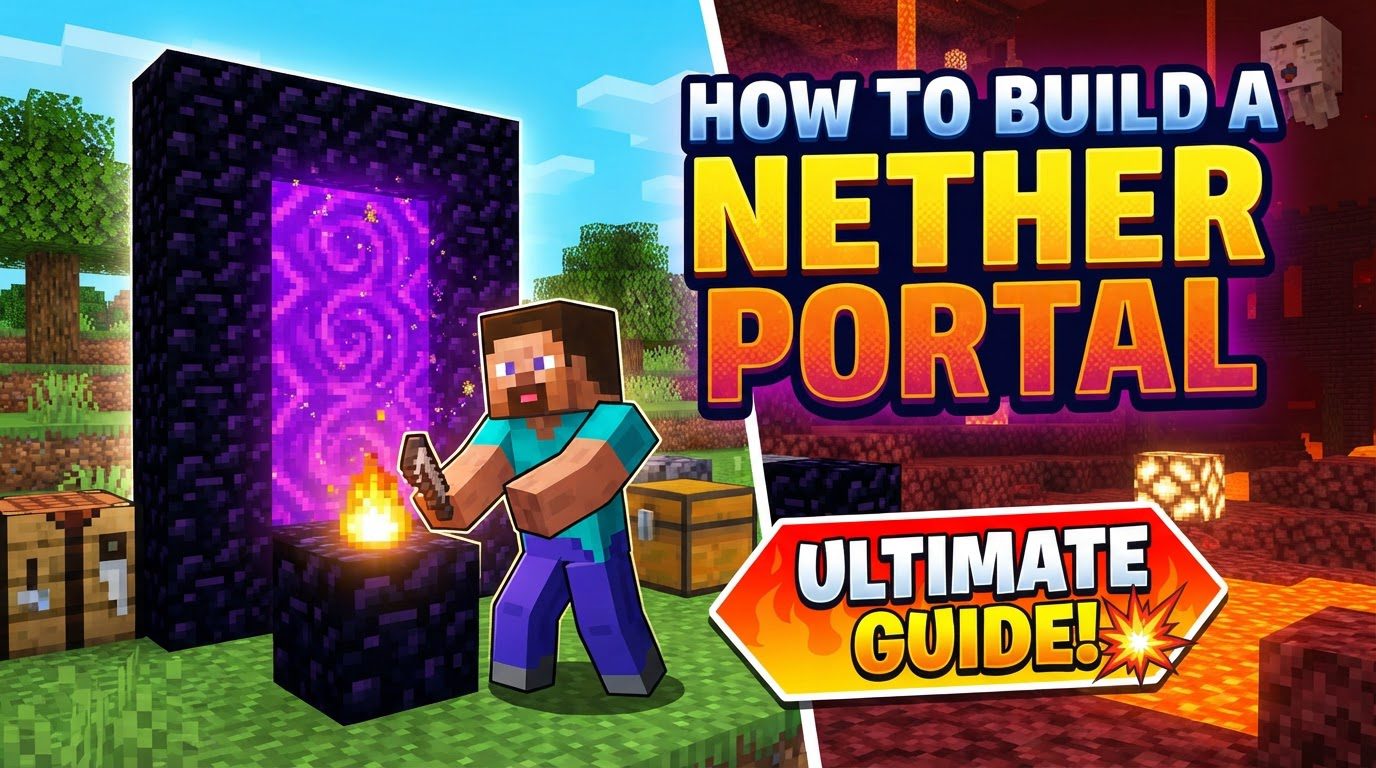
The Nether Portal is an essential structure in Minecraft, serving as a gateway to the Nether, a fiery and perilous dimension teeming with unique mobs, valuable resources, and crucial advancements. Mastering its construction and understanding its mechanics is vital for progression, resource gathering, and unlocking new adventures. This guide will walk you through every aspect of building and utilizing a Nether Portal, from gathering materials to advanced linking strategies.
The Foundation of Interdimensional Travel: Understanding Nether Portal Mechanics
Before you even think about placing your first obsidian block, it’s crucial to grasp the fundamental principles that govern Nether Portals. These mechanics dictate everything from material requirements to how you navigate between dimensions.
- Core Materials: The absolute prerequisite for a Nether Portal is obsidian. You’ll need a minimum of 10 blocks for the most basic, functional frame. To activate the portal once built, you’ll also need a fire source. The most common and reliable is Flint and Steel, but a fire charge, a burning arrow, or even a flaming sword can also do the trick.
- Dimensional Requirements: A Nether Portal frame has strict size constraints. The smallest possible functional portal is 4 blocks wide by 5 blocks tall, which creates a 2×3 inner frame. This minimum size requires 10 obsidian blocks if you omit the corner pieces. The largest possible portal you can construct is a massive 23×23 block frame. Any size outside this range will not activate.
- Two-Way Gateway: Portals are inherently two-way. Stepping through a portal in the Overworld will take you to the Nether, and stepping back through a portal in the Nether will return you to the Overworld. This symmetrical travel is key to exploration.
- Coordinate Correlation: There’s a critical 1:8 ratio between the Nether and the Overworld coordinates for the X and Z axes. This means that for every 1 block you travel in the Nether, you cover 8 blocks in the Overworld. Understanding this ratio is paramount for precise portal linking, preventing unexpected destinations, and efficiently navigating the game world. The Y-coordinate (height) does not follow this ratio for linking purposes.
- Mob Mobility: Most in-game mobs are capable of using Nether Portals, allowing them to travel between dimensions. This can lead to interesting (and sometimes dangerous) scenarios, such as Ghasts or Zombie Piglins appearing in your Overworld base. Notable exceptions to this rule are the Ender Dragon and the Wither, which cannot pass through portals.
Acquiring the Foundation: Obsidian Collection
The first and often most challenging step is gathering enough obsidian. This dense material is not naturally abundant in easily accessible forms, but there are several reliable methods to obtain it.
Method 1: Mining Existing Obsidian
Obsidian naturally forms in places where water flows over lava. You can find large deposits in specific biomes or structures:
- Lava Lakes: Large lava lakes, particularly those found deep underground or in caves, are prime locations. If water flows into these lakes, obsidian will form on the edges.
- Ruin Portals: These naturally generated structures often contain a few blocks of obsidian, sometimes even enough to complete a small portal if you’re lucky.
- Mining Requirement: As mentioned, obsidian can only be successfully mined with a diamond pickaxe or a Netherite pickaxe. Using any other tool will destroy the block without dropping it. Ensure your pickaxe is enchanted with Efficiency to speed up the process, as obsidian takes a considerable amount of time to break.
Method 2: Crafting Obsidian with Water and Lava
This method is often preferred as it allows you to create obsidian precisely where you need it, and can even be used to shape the portal frame directly without needing to mine the obsidian first – a popular “speedrunner” technique for early Nether access.
- The Principle: When a source block of water comes into contact with a source block of lava, obsidian is formed. If flowing water hits a source block of lava, obsidian is also formed. However, if flowing lava hits a source block of water, cobblestone is created instead.
- Strategic Creation: To craft your portal this way, you’ll need a water bucket and access to a lava pool. You can strategically place lava blocks, then pour water over them to convert them into obsidian. For building the frame directly, you can create a mold using dirt or cobblestone, pour lava into the mold to form the shape of the portal, then carefully pour water over the lava to convert it into obsidian. This eliminates the need for a diamond pickaxe entirely for portal construction, though you’ll still need one for mining other obsidian if you choose that route.
Constructing and Activating Your Gateway
Once you have your obsidian, building the frame is straightforward, and activation is instant.
Assembling the Frame
The most common and resource-efficient portal requires 10 obsidian blocks. This creates a 4×5 outer frame with a 2×3 inner opening, but without the corner blocks.
- Base Layer: Place two obsidian blocks side-by-side on the ground. This forms the bottom of your portal’s inner frame.
- Side Pillars: On each end of your two-block base, build upwards with three more obsidian blocks. This will create two pillars, each four blocks tall (including the base block).
- Top Connector: Connect the tops of these two pillars with two more obsidian blocks. This completes the 4×5 frame, leaving a 2×3 empty space in the middle.
- Optional Corners: If you have extra obsidian and prefer a more visually complete look, you can add one obsidian block to each of the four corners, bringing the total obsidian count to 14. Functionally, these corner blocks are unnecessary.
Remember, the portal must have a minimum inner dimension of 2×3 blocks and a maximum of 21×21 blocks (meaning a 23×23 outer frame). Any other size will prevent activation.
Igniting the Gateway
With the frame constructed, it’s time to bring your portal to life.
- The Spark: Equip your chosen fire source, most commonly Flint and Steel.
- Activation: Right-click on any of the inner obsidian blocks of your constructed frame. Instantly, the 2×3 inner space will fill with a shimmering, purple, swirling effect – this is the active portal block.
Stepping Through: Entering the Nether
Once activated, all that’s left is to use your new gateway.
- Crossing the Threshold: Simply step into the purple, shimmering area of the portal.
- Teleportation Delay: You’ll need to remain inside the portal for approximately 4 seconds (80 game ticks) for the teleportation sequence to complete. A visual distortion effect will play around your screen during this time.
- Arrival: After the brief delay, you’ll be transported to a corresponding location in the Nether.
Advanced Strategies and Safeguards for Nether Travel
Building a portal is just the beginning. To ensure safe and efficient travel, consider these advanced tips.
Protecting Your Portals
The Nether is a dangerous place, and your portal is vulnerable. Ghasts, the large, flying, fireball-shooting mobs, can destroy portal blocks with their projectiles, leaving you stranded. In the Overworld, wandering mobs might accidentally use your portal, bringing unwanted visitors to your base.
- Blast Resistance: Immediately upon arriving in the Nether, build a small, protective chamber around your portal using blast-resistant blocks like cobblestone, stone bricks, or obsidian itself. This will shield it from Ghast fireballs.
- Enclosure: In the Overworld, consider enclosing your portal within a small building or fence to prevent livestock or hostile mobs from inadvertently passing through.
Precise Portal Linking
The 1:8 coordinate ratio is crucial for advanced players who want precise control over their travel. If you build multiple portals too close to each other in either dimension without accounting for this ratio, you risk unintended and confusing links.
- The Calculation: To link an Overworld portal to a specific Nether location (or vice versa), take your Overworld X and Z coordinates and divide them by 8. These calculated numbers represent the ideal X and Z coordinates for your corresponding Nether portal.
- Practical Application: If your Overworld base is at X=800, Z=160, you’d want to build your Nether portal as close as possible to X=100, Z=20 (800/8=100, 160/8=20). The Y-coordinate is generally ignored for linking purposes, as portals prioritize linking to the closest active portal in the other dimension within a certain radius, regardless of height difference.
- Creating a Return Portal: If you create a new portal in the Nether, it will automatically generate a corresponding portal in the Overworld upon activation. If there’s an existing Overworld portal within the linking range of its calculated coordinates, it will link to that one. Otherwise, a new Overworld portal will be created.
Common Pitfalls to Avoid
Even with a clear guide, mistakes can happen. Being aware of these common errors can save you significant frustration.
- Incorrect Frame Dimensions: As stated, the portal frame must be between 4×5 (outer, 2×3 inner) and 23×23 blocks (outer, 21×21 inner). Any other size will simply not activate. Double-check your construction before attempting to light it.
- Using the Wrong Tool: Trying to mine obsidian with anything less than a diamond or Netherite pickaxe is futile. The block will break, but you won’t collect it, wasting your effort and potentially valuable obsidian.
- Unintended Portal Connections: Ignoring the 1:8 coordinate ratio can lead to multiple Overworld portals linking to a single Nether portal, or vice-versa, making travel unpredictable. Always calculate your coordinates for precise linking, especially if you have multiple bases or points of interest.
- Leaving Portals Exposed: An unprotected portal is an invitation for trouble. Ghasts can destroy them in the Nether, stranding you, and hostile mobs can wander through in either dimension, creating unexpected dangers. Always fortify your portal’s surroundings.
Building a Nether Portal is a pivotal moment in any Minecraft journey, unlocking a new realm of challenges and opportunities. By understanding the mechanics, diligently gathering your materials, and following these steps, you’ll soon be traversing the fiery landscapes of the Nether, ready to uncover its secrets and harness its unique resources.
Tags:
YOU MAY ALSO LIKE...


