

Minecraft How to Farm Bees
A single full bee nest can yield three jars of honey or three honeycomb pieces. Scale that up to dozens of nests, and you’re looking at a substantial, sustainable source of food, building materials, and even redstone components. Farming bees in Minecraft is not just a charming aesthetic; it’s a highly efficient and rewarding endeavor that significantly boosts your resource reserves.
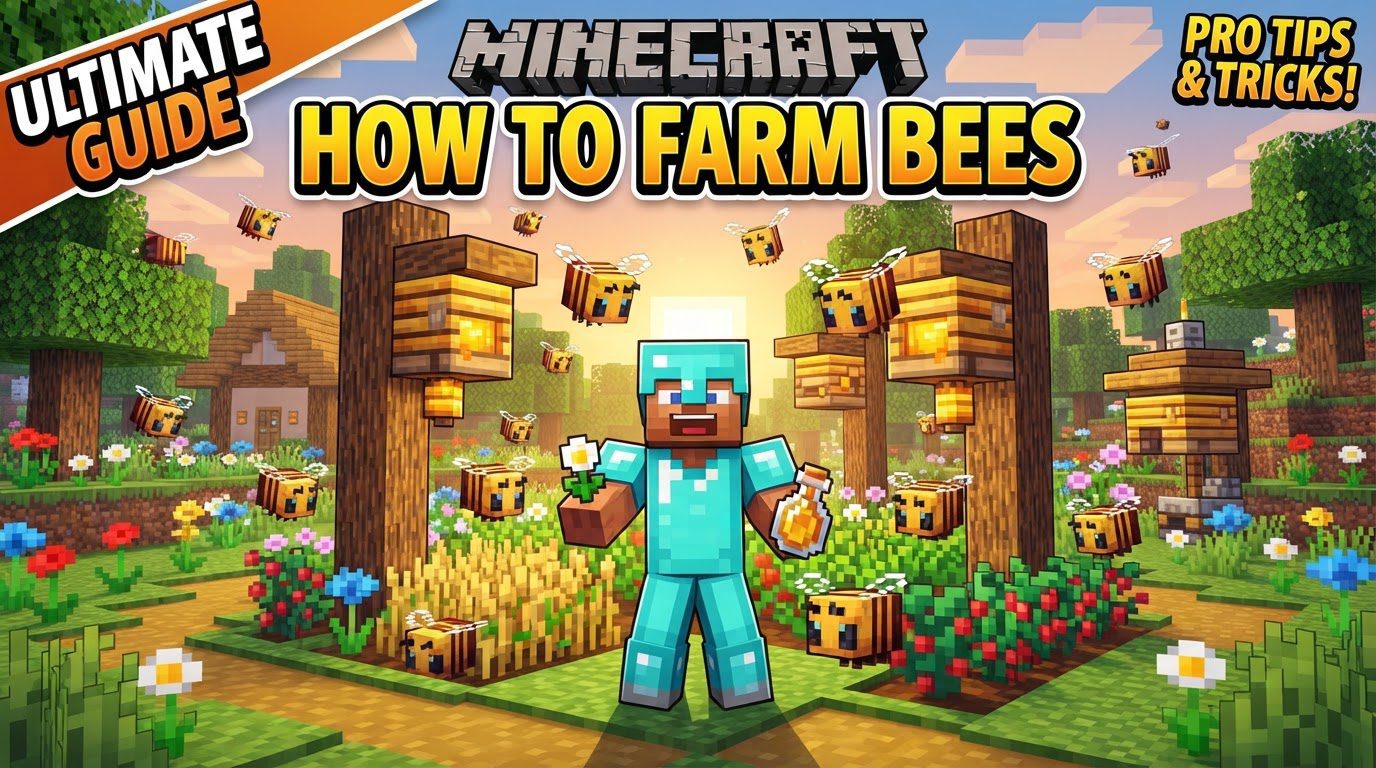
Locating Your Buzzing Friends
Your first step is to find wild bee nests. These natural structures typically generate attached to oak or birch trees. While found in many biomes, your best chances for higher concentrations are in Flower Forests, Plains, and Sunflower Plains due to their abundant flora. A keen eye will spot the distinct brown block hanging from a tree, often with bees buzzing nearby. Each natural nest typically spawns with three bees.
- Biomes: Flower Forests, Plains, Sunflower Plains offer the highest density.
- Trees: Nests exclusively attach to Oak and Birch trees.
Safe Extraction: Bringing Bees Home
Moving bees and their nests without provoking their aggression requires careful preparation. Bees are neutral mobs, attacking only if provoked. Harvesting from their nest/hive without smoke, or attacking a bee, will cause the entire swarm to become aggressive. Their stings inflict poison, though Java Edition bees die after stinging (Bedrock bees do not).
Collecting Nests
To safely collect a bee nest with its resident bees, you need a tool enchanted with Silk Touch. Before breaking, place a lit campfire or several torches directly underneath it. The smoke or light pacifies the bees, preventing them from attacking. The collected nest retains its bees and honey/honeycomb level. Breaking a nest without Silk Touch destroys it, releasing aggressive bees.
Moving Individual Bees
If you only need to move individual bees, a lead is effective. Alternatively, bees are attracted to flowers; hold one to lead them, or plant a path of flowers to encourage them to follow. They naturally seek out any bee nest or hive within a 22-block radius, especially if flowers are nearby.
Crafting Your Apiary: Hives and Flowers
Expand your farm by crafting additional bee hives. Each hive requires three honeycomb and six planks of any wood type. Like natural nests, each crafted hive can house up to three bees.
The Essential Role of Flowers
Bees require flowers to produce honey and honeycomb. They collect pollen from flowers, then return to their home. Closer flowers mean greater efficiency. Any flower type works, including two-block tall varieties. Plant dense patches directly in front of or around your apiary. Bone meal can accelerate flower growth.
Designing Your Bee Farm: Manual vs. Automated
Choose between simple manual collection or a highly efficient automated system.
Manual Bee Farm Setup
A manual farm is easy for early-game players. Arrange nests and hives with ample flight space and dense flowers nearby. Place a campfire under each hive for safe harvesting. When full (dripping honey particles), use shears for honeycomb or glass bottles for honey. Use flowers on two adult bees to breed them.
Automated Bee Farm Setup
For large-scale production, automation is key. This Redstone design detects a full hive and harvests automatically.
- Observer: Place an observer block facing the back of a hive. It triggers when the hive fills (honey level 5).
- Dispenser: Connect the observer’s output to a dispenser directly in front of the hive’s opening. Fill it with glass bottles or shears.
- Collection: Place a hopper beneath the hive, leading into a chest. Harvested items drop into the hopper.
- Campfire: Recommended under the hive to prevent aggression and guide bees.
- Enclosure: Containing the farm with transparent blocks keeps bees focused and improves efficiency.
This scalable system provides a hands-off honey and honeycomb factory.
Sweet Rewards: Harvesting and Uses
When a bee nest or hive is full (honey level 5), it visibly drips honey, signaling readiness for harvest.
- Honey Bottles: Use an empty glass bottle on a full hive. Restores 6 hunger. Craft into sugar (3 per bottle) or a honey block.
- Honeycomb: Use shears on a full hive to collect three pieces. Crafts new bee hives (3 honeycomb + 6 planks) and decorative honeycomb blocks (4 honeycomb).
- Honey Blocks: Crafted from four honey bottles, they slow entities, reduce fall damage, and are sticky for piston contraptions. Players also slide down their sides.
Always use a campfire or light source to pacify bees during manual harvesting.
Bee-havior and Breeding Mechanics
Understanding bee behavior optimizes your farm.
- Pollination: Bees collect pollen from flowers, then return to their home to increase honey level.
- Breeding: Use any flower on two adult bees to breed them, creating a baby bee.
- Aggression: Bees become aggressive if their nest/hive is broken without Silk Touch, a bee is attacked, or honey/honeycomb is harvested without smoke.
- Night/Rain: Bees return to homes during night or rain, a good time for safe maintenance.
Optimizing Your Apiary
Maximize your bee farm’s output:
- Flower Density: More flowers mean faster pollen collection and honey production.
- Enclosure: Containing bees, especially in automated setups, prevents wandering and maintains focus.
- Storage: Plan for extensive storage; productive farms generate resources quickly.
By mastering these mechanics and techniques, you can establish a thriving bee farm, continuously supplying valuable resources. The gentle hum of happy bees and the sight of abundant honey will be a testament to your agricultural prowess.
Tags:
YOU MAY ALSO LIKE...


