

Minecraft How to Get 3 Enchantments
Achieving three or more enchantments on a single Minecraft item is not just possible, but a cornerstone of late-game progression and crafting truly powerful gear. This advanced customization allows players to create tools, weapons, and armor that significantly enhance their capabilities, turning ordinary items into legendary artifacts. The journey to accumulating a multitude of magical properties on one item involves mastering two fundamental blocks: the enchanting table and the anvil, alongside a strategic understanding of their mechanics and limitations.
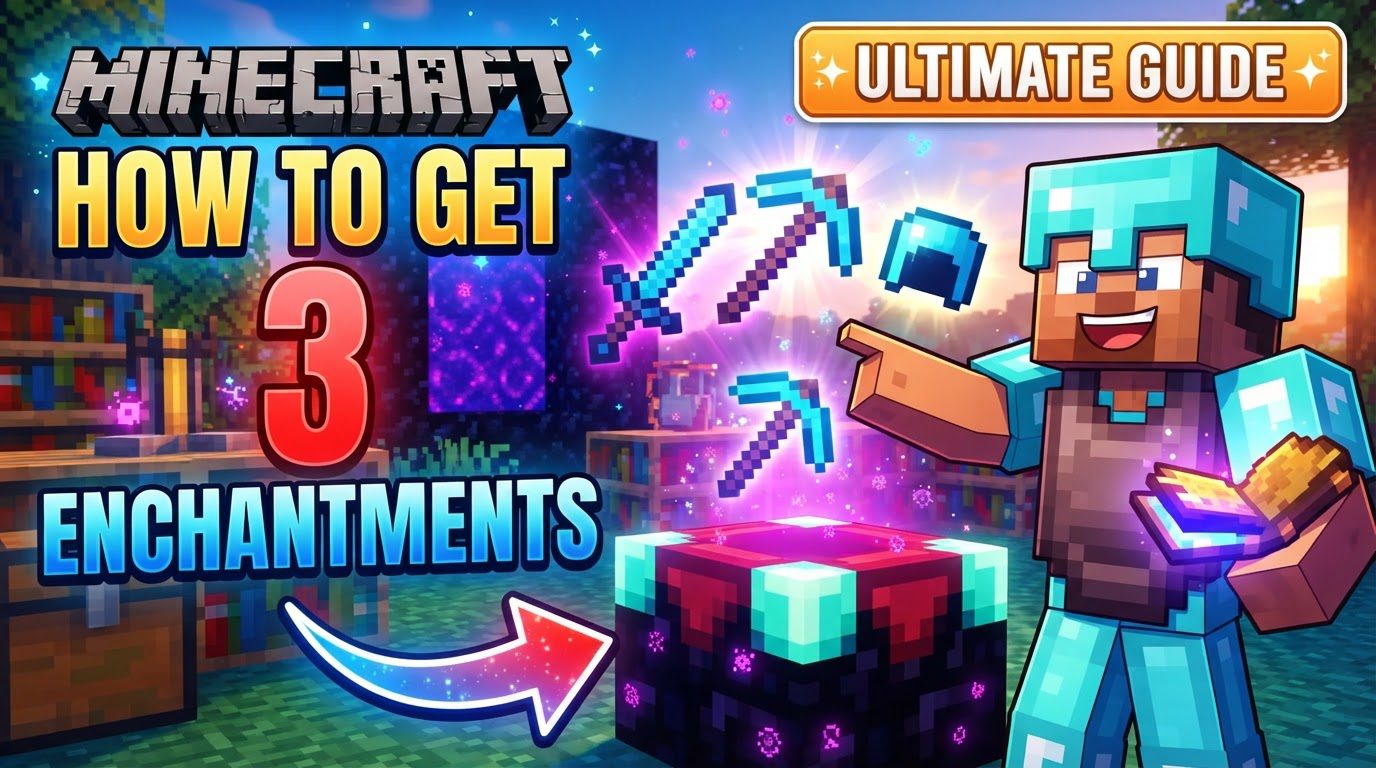
The Foundation: Enchanting Tables and Bookshelves
The enchanting table is your initial gateway to imbuing items with magical properties. It allows you to apply enchantments to unenchanted items directly, using experience points and Lapis Lazuli. However, to truly unlock its potential and increase your chances of obtaining multiple enchantments from a single use, proper setup is paramount.
- Crafting and Placement: Your first step is to craft an enchanting table, requiring 4 Obsidian, 2 Diamonds, and 1 Book. Once crafted, its placement is crucial for maximizing its power.
- The Power of Bookshelves: Surrounding an enchanting table with 15 bookshelves is not merely decorative; it’s essential. These bookshelves must be placed one block away from the enchanting table, with an air gap in between, to function correctly. This configuration unlocks the highest possible enchantment level, level 30, which significantly increases the likelihood of an item receiving multiple enchantments simultaneously. For example, a single enchant at level 30 might grant a pickaxe both Efficiency IV and Unbreaking III.
- Enchanting Books: Beyond directly enchanting tools, weapons, or armor, the enchanting table can also be used to enchant books. These enchanted books act as portable enchantment storage. Instead of applying enchantments directly to your primary item and hoping for the best, you can enchant books, effectively “saving” the enchantment for later application via an anvil. This method offers greater control over the final enchantment loadout of your gear.
The Art of Combination: Understanding the Anvil
While the enchanting table initiates the process, the anvil is where the true magic of combining and accumulating enchantments happens. This block is indispensable for merging enchantments from various sources onto a single item, allowing for customization far beyond what a solo enchanting table can offer.
- Crafting an Anvil: To begin, you’ll need to craft an anvil using 3 Iron Blocks and 4 Iron Ingots. Anvils are not just for enchanting; they also repair items and rename them, but their role in enchantment accumulation is arguably their most critical function.
- Combining Enchanted Items: One primary use of the anvil is to combine two of the same item, each possessing existing enchantments. When combined, their enchantments are merged onto one item. For example, two swords, one with Sharpness III and another with Knockback II, can be combined to create a single sword with both enchantments.
- Applying Enchanted Books: The most versatile application of the anvil is combining enchanted books with compatible items. This allows you to meticulously build up your item’s enchantment list. Simply place your primary item (tool, weapon, or armor) in the first slot of the anvil and an enchanted book in the second. If compatible, the enchantment from the book will be added to your item.
- Merging Enchanted Books: Anvil mechanics also extend to combining enchanted books with each other. This is a powerful technique for consolidating multiple enchantments into a single book, which can then be applied to an item, often at a reduced total experience cost compared to applying individual books.
- Enchantment Levels and Merging: When combining enchantments, understanding how levels merge is key. If you combine two enchantments of the same level (e.g., Protection III and Protection III), they will typically merge into the next higher level (Protection IV). If combining enchantments of different levels, the higher of the two levels usually prevails.
- The “Too Expensive!” Barrier: A critical mechanic to be aware of is the “work penalty” associated with anvil usage. Each time an item is processed in an anvil (repaired, renamed, or enchanted), its “prior work cost” increases. If this cumulative cost exceeds 39 experience levels, the item will display the message “Too Expensive!” and can no longer be modified or repaired in an anvil in Survival mode. This makes strategic planning essential.
A Step-by-Step Path to Power
With the core mechanics understood, let’s outline the practical steps to achieve multiple enchantments on your desired gear.
- Establish Your Enchanting Station:
- Craft an enchanting table (4 Obsidian, 2 Diamonds, 1 Book).
- Place 15 bookshelves around it, ensuring a one-block air gap, to guarantee access to level 30 enchantments. This maximizes your chances of getting multiple enchantments from the table itself.
- Acquire Initial Enchantments:
- Direct Enchanting: Place an unenchanted item and Lapis Lazuli into the enchanting table. Select one of the available level 30 options. You might get lucky and receive several enchantments at once.
- Enchanted Books: Alternatively, use the enchanting table to enchant books. This provides more flexibility. You can also find enchanted books in treasure chests, trade with Librarian villagers, or obtain them through fishing. These alternative sources are crucial for obtaining specific, high-level, or rare enchantments.
- The Anvil Combination Process:
- Craft an Anvil: Create an anvil (3 Iron Blocks, 4 Iron Ingots).
- Initiate Combining: Open the anvil interface. Place your primary item (the one you want to enhance) in the first slot.
- Add Enchantments: Place an enchanted book or another enchanted item of the same type in the second slot. The anvil will display the resulting item in the output slot, along with the experience cost.
- Pay the Cost: If the combination is compatible and the cost is within your means, retrieve the combined item from the output slot by paying the experience levels.
- Iterate and Enhance: Continue this process, adding more enchanted books or combining other enchanted items, until your primary item possesses all the desired enchantments. Always monitor the experience cost to avoid the “Too Expensive!” limit.
Mastering the Process: Advanced Tips and Strategies
To efficiently and effectively gather multiple enchantments, strategic planning is key.
- Prioritize Enchanting Books: It’s generally more efficient and cost-effective to enchant books first and then apply them to your desired item using an anvil. This approach gives you greater control over which enchantments go onto your gear, allowing you to curate the perfect set.
- Optimal Anvil Combining Order: To minimize experience costs and prevent hitting the “Too Expensive!” limit prematurely, develop a combining strategy. A good rule of thumb is to consolidate enchanted books first (e.g., combine two enchanted books into one more powerful book) and then apply these consolidated books to the item. Additionally, applying the least expensive enchantments first can sometimes help manage the cumulative cost.
- Leverage High-Level Enchantments: Always aim for level 30 enchantments at the enchanting table. This not only maximizes the chance of getting multiple enchantments but also increases the likelihood of obtaining higher-tier enchantments.
- Resource Management: Enchanting is resource-intensive. You’ll need a steady supply of Lapis Lazuli for the enchanting table and vast amounts of experience levels. Engage in activities like mining, farming, and fighting mobs, or consider setting up dedicated experience farms to sustain your enchanting endeavors.
- Villager Trading: Librarian villagers are an invaluable resource. They can offer specific enchanted books for emeralds, providing a reliable way to acquire rare or hard-to-get enchantments without relying solely on luck at the enchanting table. This method can significantly speed up the process of acquiring your desired enchantment set.
Navigating the Pitfalls: Common Mistakes to Avoid
Even experienced players can fall victim to common errors that hinder their enchanting progress.
- Ignoring Bookshelves: Failing to place the full 15 bookshelves around your enchanting table, or placing them incorrectly (e.g., directly adjacent without an air gap), will limit you to lower-level enchantments. This dramatically reduces your chances of getting multiple enchantments from a single table use.
- Hitting “Too Expensive!”: Repeatedly enchanting the same item directly or applying enchantments in a haphazard order can quickly accumulate the prior work penalty. Once an item is “Too Expensive!”, it becomes permanently locked out of further anvil modifications in Survival mode, potentially ruining valuable gear.
- Inefficient Anvil Usage: Adding many individual enchanted books to an item one by one is often the most expensive method. Consolidating books first is almost always more cost-effective in terms of experience levels.
- Non-Compatible Enchantments: Attempting to combine enchantments that are mutually exclusive will simply not work. Examples include Mending and Infinity on a bow (you can only have one), or different types of Protection (e.g., Blast Protection and Fire Protection) on the same armor piece (only one Protection type per piece).
- Lack of Prioritization: Not all enchantments are equally critical for every item. Prioritizing which enchantments to apply first, especially on new or early-game gear, can make a significant difference in your character’s effectiveness and resource expenditure.
- Applying Thorns indiscriminately: While tempting, the Thorns enchantment on armor can be a double-edged sword. It reflects damage to attackers but also causes your armor to take additional durability damage, leading to faster wear and increased repair costs. Consider if the trade-off is worth it for your playstyle.
By understanding these mechanics, following a structured approach, and avoiding common missteps, you can consistently achieve three or more powerful enchantments on your Minecraft items, transforming your gameplay experience and making you a force to be reckoned with in any biome.
Tags:
YOU MAY ALSO LIKE...


