

Minecraft Light Levels Guide: How to Spawn-Proof Your Base
Introduction: Understanding Light Levels and Mob Spawning
In Minecraft, hostile mobs (zombies, skeletons, creepers, spiders, etc.) spawn only in areas where the light level is 7 or lower. This is the fundamental rule for spawn-proofing your base, farms, and any area you want to keep safe. Every block has a combined light value from two sources: sky light (from the sun, moon, or sky) and block light (from placed light sources like torches, glowstone, or lava). The game compares the final light level at a given block to the spawning threshold. If it’s 0-7, and the block is a solid, opaque surface with at least one block of air above it, and there is no player within 24 blocks (and within 128 blocks for despawning), hostile mobs can appear.
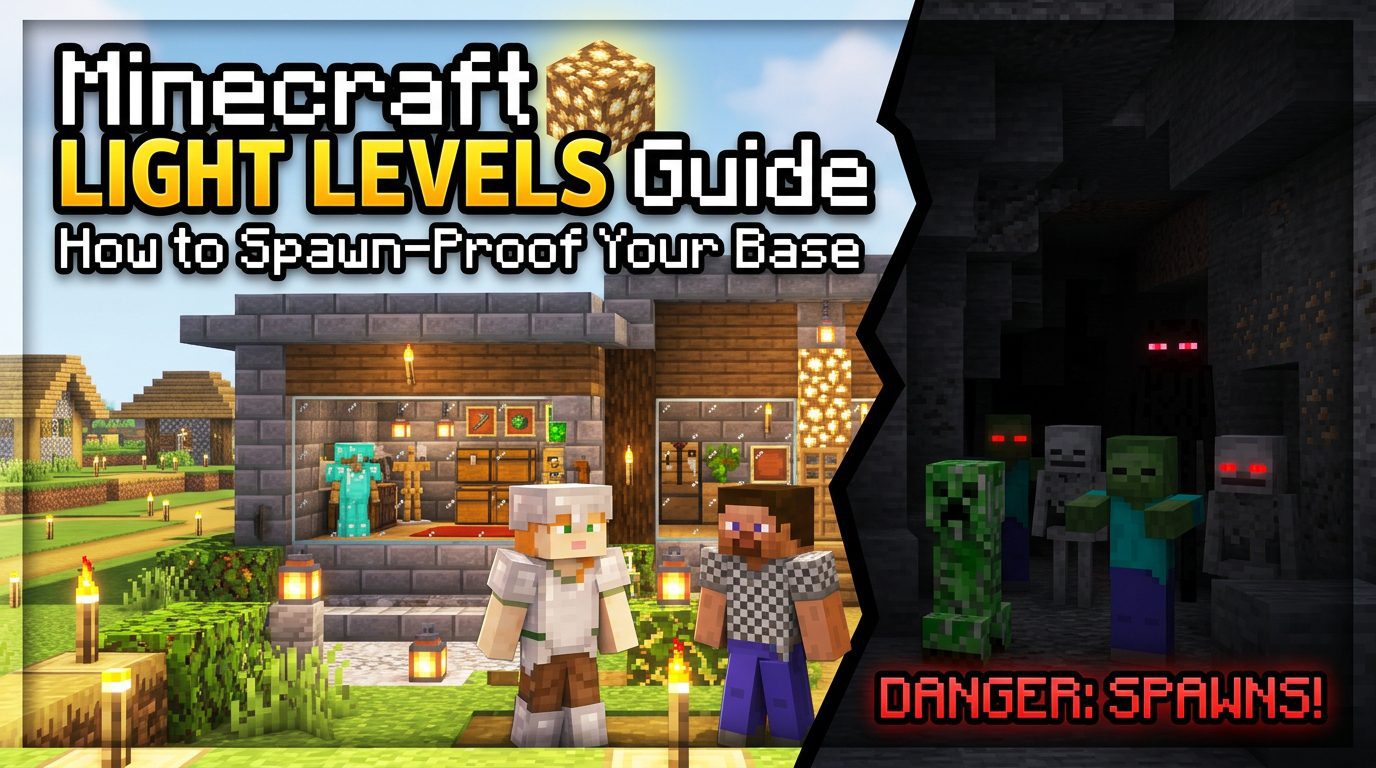
To “spawn-proof” an area, you must ensure that every block where a mob could stand has a combined light level of 8 or higher. This guide covers every aspect of light level mechanics, how to check light levels, which blocks and light sources work best, and how to apply this knowledge to keep your base, farms, and builds safe from unwanted visitors.
How Light Levels Work
Block Light vs Sky Light
- Sky Light – Illumination from the sun, moon, or open sky. Sky light during daytime is 15 at the highest point and decreases by 1 for each block of solid material it passes through (but not through glass, leaves, or other transparent blocks). At night, sky light drops to 4, which is still above the hostile mob spawning threshold (7), so mobs do not spawn outdoors at night due to sky light alone – wait, that’s incorrect. Actually, at night the sky light level can be as low as 4 (if there are no clouds and no obstructions). But hostile mobs still spawn at night because the sky light level is 4? No, they spawn because the combined light level (sky + block) can be below 8 even with sky light at 4? Let me clarify: Hostile mob spawning checks the internal light level at a block. At night, sky light is 4, which is below 8, so mobs can spawn in open fields at night. During the day, sky light is 15, preventing spawns. Sky light can also be reduced by shadows from trees, terrain, or solid blocks. So you cannot rely on sky light at night – you must provide block light.
- Block Light – Light emitted from items like torches, glowstone, lanterns, sea lanterns, jack o’lanterns, redstone lamps (when powered), shroomlights, and even fire, lava, or nether portals. Each source has a specific light level (torches = 14, glowstone = 15, etc.) and decreases by 1 for every block in air (or through transparent blocks) until it reaches 0.
The final light level at a block is the maximum of the sky light and block light values at that block. So if you place a torch (block light 14) two blocks away, the block light at that position is 12, even if sky light is 0 (night) or 4 (night). As long as the maximum exceeds 7, no hostile mob will spawn.
Spawning Conditions
Hostile mobs require:
- Light level ≤ 7
- A solid, opaque block (e.g., stone, dirt, wood planks – not glass, slabs (bottom half), or transparent blocks)
- At least one block of air above that block (so the mob has space to stand)
- No player or other cause within a 24-block spherical radius (though this is distance‑based, not light‑based)
If you raise the light to 8 or higher on every such block within and around your base, you effectively eliminate hostile mob spawns.
Checking Light Levels – The F3 Debug Screen
In Java Edition, press F3 to open the debug screen. Look for the line that says “Light: ” followed by numbers like “0, 0”. The first number is block light; the second is sky light. For example, “Light: 12, 4” means block light 12, sky light 4. The combined light level (the one used for spawning) is the maximum of the two, which in this case is 12. If both numbers are 7 or lower, and you are standing on a solid block, hostile mobs can spawn in that spot.
In Bedrock Edition, you can enable the “Show coordinates” option and also use a light level texture pack or command. Bedrock also uses the same spawning rules.
Pro tip: Use F3 while holding a torch or other light source to see how far its light reaches. Walk to a dark area, place a torch, and then check the block light values at the edge of the lit area. You’ll see they drop to 8, 7, etc.
Common Light Sources and Their Efficiencies
| Light Source | Light Level | Max Distance to Reach Light 8 | Notes |
|---|---|---|---|
| Torch | 14 | 6 blocks away (14–6=8) | Cheap, easy, but needs support block. Full block or wall. |
| Lantern (regular or soul) | 15 (regular) / 10 (soul) | 7 blocks (regular) / 2 blocks (soul) | Soul lantern is dimmer (light 10) – only reaches 2 blocks for spawn‑proofing. Use only if you want a blue tint. |
| Glowstone | 15 | 7 blocks | Emits full light, but ugly. Can be hidden under carpets or used in walls. |
| Sea Lantern | 15 | 7 blocks | Like glowstone but more decorative. |
| Jack o’Lantern | 15 | 7 blocks | Carved pumpkin on top of torch – great for Halloween builds. |
| Redstone Lamp (powered) | 15 | 7 blocks | Requires redstone power – good for toggling lights. |
| Shroomlight | 15 | 7 blocks | From nether – burns forever, nice warm orange. |
| Fire (on netherrack) | 15 | 7 blocks | Infinite light, but dangerous near wood. |
| Lava (source block) | 15 | 7 blocks | Bright but can burn you. Good for nether safety. |
| Redstone Torch | 7 | 0 blocks (light level 7 is not enough to prevent spawns) | Never rely on redstone torches for spawn‑proofing – they are too dim. |
| End Rod | 14 | 6 blocks | Decorative, throws light in a line – good for modern builds. |
Key takeaway: A torch (light 14) will create a sphere of light where any block within 6 blocks of the torch (in Manhattan or Euclidean distance? Actually light decreases by 1 per block in any straight line, including diagonals? In Minecraft, light decreases by 1 per block in each of the three axes (taxicab distance). So a torch at (0,0,0) will give light level 14 at that block, 13 at (1,0,0), 12 at (2,0,0), etc. The distance is the greatest of the X, Y, Z differences – actually it’s the Manhattan distance (sum of absolute differences) for block light? Let’s clarify: Block light from a source travels in all directions, and the light level at a given block is the source level minus the Manhattan distance (i.e., the number of blocks you have to travel to get there, counting each axis). So a block at coordinates (3,2,1) from a torch has a Manhattan distance of 3+2+1=6, so light = 14-6 = 8. Therefore, a torch can reach a block that is up to 6 steps away along any path. In practice, placing torches every 5-6 blocks in a grid (like 5×5 spacing) ensures all floor blocks are at least light 8.
Spacing Strategies for Torches and Other Lights
Basic Torch Grid
To spawn‑proof a large flat area (like a floor), place torches in a 5×5 grid (i.e., every 5 blocks in both x and z, with torches on walls or on the floor). This guarantees that every block in the grid is within 2.5 blocks of a torch? Actually with a 5-block spacing, the farthest block from any torch is at the center
Tags:
YOU MAY ALSO LIKE...


