

Minecraft Saturation Explained: The Secret to Stopping Food Hunger
Understanding the Hidden Hunger Bar
Every Minecraft player knows the hunger bar – those ten drumsticks that deplete as you sprint, jump, mine, and heal. But there’s a second hidden mechanic called saturation that actually determines how long you stay full and how fast you regenerate. Most players only learn about saturation after being frustrated by food that fills the bar but leaves them hungry again in moments. This guide will explain saturation in detail, reveal which foods give the best saturation-to-hunger ratio, and show you how to use this knowledge to stop hunger effectively – whether you’re caving, exploring, or fighting the Wither.
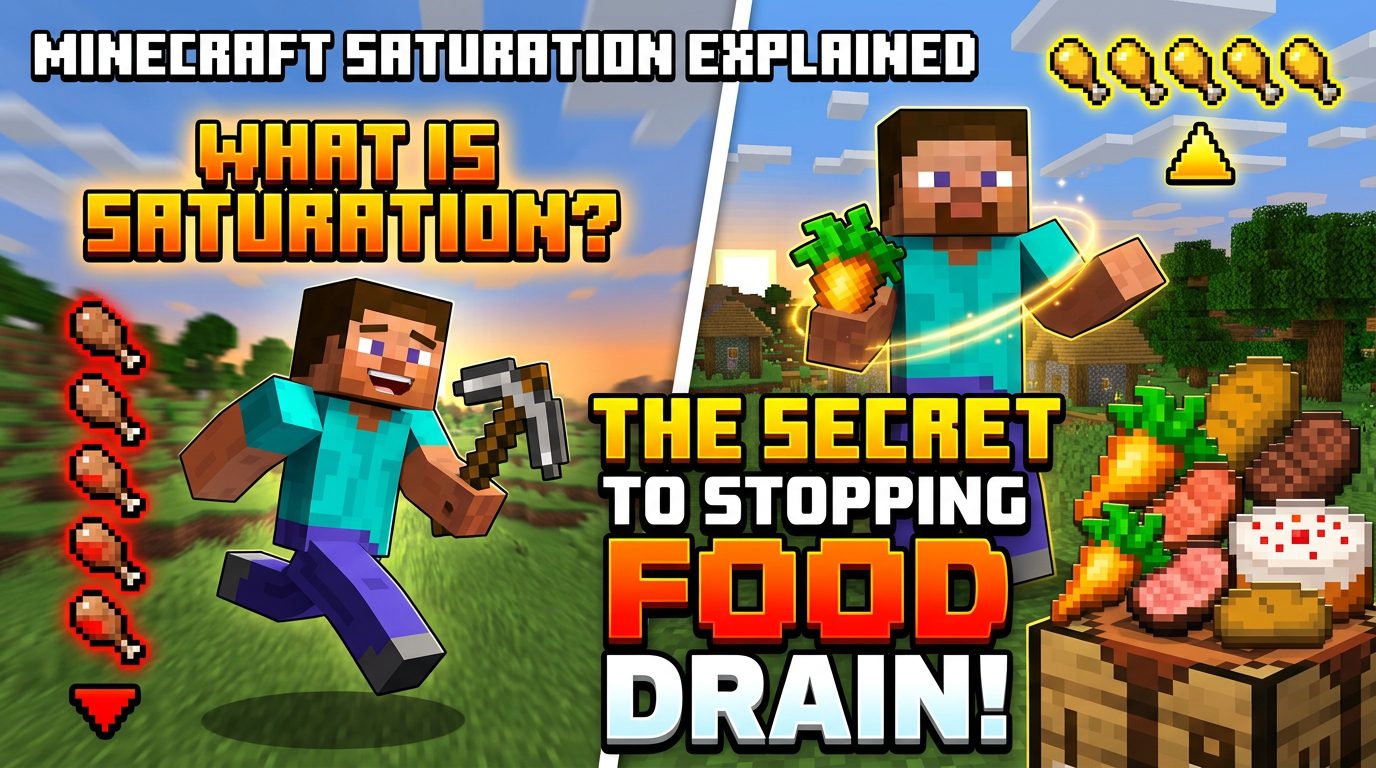
What Is Saturation?
Saturation is a hidden numerical value that sits above your hunger bar. In the game code, each food item provides two numbers: hunger points (the visible drumsticks) and saturation points (the hidden “super hunger”). When you eat, your saturation fills first. Then, as you perform actions that consume energy, the game deducts from saturation before it touches your hunger bar. Only after saturation reaches zero does your hunger bar start to drop.
The maximum saturation a player can have is equal to their current hunger value. For example, if you have 10 hunger points (5 drumsticks), your saturation cannot exceed 10. If you eat a food that provides 12 saturation but you only have 8 hunger, the excess saturation is wasted. This is why timing and food choice matter.
- Hunger points: The visible shank icons. Each drumstick is 2 hunger points (total 20).
- Saturation points: Hidden value that acts as a buffer. It ranges from 0 up to your current hunger level.
- Exhaustion: The third hidden mechanic. Every time you sprint, jump, swim, mine a block, or take damage, you accumulate exhaustion. When exhaustion reaches 4, the game reduces either saturation (if above 0) or hunger (if saturation = 0).
How Saturation Affects Regeneration
Natural health regeneration only kicks in when two conditions are met: your hunger bar is at 18 or higher (9 drumsticks), and your saturation is above 0. When you heal, the game consumes both saturation and hunger: every half-heart regenerated requires 6 exhaustion points, which translates to 1.5 hunger points and 1.5 saturation points (or 3 hunger if saturation is zero, but you can’t heal without saturation). This is why you can eat a steak, see full hunger, but still not regenerate health if your saturation was low when you ate.
Many players think eating any food when the hunger bar is full will heal them. That’s only partially true. If you eat low-saturation food like a melon slice (2 hunger, 1.2 saturation), you’ll fill your hunger bar but your saturation will be low. Healing will stop quickly. On the other hand, a golden carrot (6 hunger, 14.4 saturation) gives enough saturation to regenerate several hearts even after the hunger bar is nearly full.
The Saturation Values of Every Major Food
I’ve compiled the saturation values from the Minecraft wiki and community testing. Saturation is listed as a “saturation modifier” in the game files. The actual saturation you get is hunger points × modifier. For example, cooked beef (steak) gives 8 hunger and a modifier of 12.8, so total saturation is 8×12.8 = 102.4? Wait, that math is wrong. Let’s check: The game uses a formula: saturation = hunger × modifier. But the modifier is applied after the hunger value. Actually, the food component data in the code uses a “saturation modifier” which is a decimal. So for steak: hunger=8, modifier=12.8 => saturation = 8 * 12.8? That would be 102.4, which is far too high. The correct representation is that the total saturation value is the modifier. The wiki says: “saturation = food value × saturation modifier”. However, for steak, the total saturation is 12.8 (a single value). So the modifier is not multiplied; the given saturation is the exact number. Let’s clarify.
In the game, each food has a fixed saturation number (not a multiplier). For example:
- Steak: 8 hunger, 12.8 saturation
- Cooked porkchop: 8 hunger, 12.8 saturation
- Golden carrot: 6 hunger, 14.4 saturation
- Baked potato: 5 hunger, 6 saturation
- Bread: 5 hunger, 6 saturation
- Cooked salmon: 6 hunger, 9.6 saturation
- Cooked cod: 5 hunger, 6 saturation
- Pumpkin pie: 8 hunger, 4.8 saturation
- Beetroot: 1 hunger, 1.2 saturation
- Melon slice: 2 hunger, 1.2 saturation
- Sweet berries: 2 hunger, 0.4 saturation
- Apple: 4 hunger, 2.4 saturation
- Chorus fruit: 4 hunger, 2.4 saturation (but teleports)
- Enchanted golden apple: 4 hunger, 9.6 saturation, plus absorption and regen
The key takeaway: golden carrot gives the highest saturation per hunger (14.4 for 6 hunger) and is the best sustainable food. Steak/porkchop give 12.8 for 8 hunger. However, golden carrots are better for regeneration because you need less hunger to reach high saturation.
Why Saturation Is the Secret to Stopping Hunger
You might ask: “If I eat a stack of steak, my hunger bar is full – why do I still get hungry so fast?” The answer is that each food fills your hunger bar to the same visual level, but the hidden saturation determines how long that fullness lasts. When your saturation is zero, every action you take reduces your hunger bar directly. When you have high saturation, your hunger bar stays full while saturation drains first. So eating high-saturation foods means you can sprint, jump, and fight for a longer time before your hunger bar shows any loss. This is critical for long mining trips or boss fights where you can’t afford to stop and eat repeatedly.
Real-World Examples from Reddit and Testing
Popular Minecraft survival YouTubers like Etho and Docm77 often emphasize using golden carrots because they give the best saturation-to-hunger ratio. On the r/Minecraft subreddit, many players recommend carrying a stack of golden carrots for the End or for deep mining. One user tested walking 1000 blocks while sprint-jumping: with steak, his hunger bar started dropping after 200 blocks; with golden carrots, it stayed full for 600 blocks. That’s the saturation difference.
Another Reddit thread titled “Stop eating steak, use golden carrots” explains that golden carrots are cheaper than steak if you have a gold farm and a carrot farm. Even without a gold farm, trading with piglins is a steady source. The post argues that the extra saturation from golden carrots saves you inventory space because you eat less often.
How to Maximize Saturation Efficiency
Here are evidence-based strategies gathered from Minecraft communities:
1. Know Your Activity
- Mining (no sprinting): Steak is fine, but golden carrots still last longer.
- Exploring/Sprinting: Use golden carrots exclusively. The saturation buffer prevents hunger loss during long sprints.
- Building (frequent jumping): High saturation foods reduce down time.
- PvP / Combat: Golden apples (normal) give 4 hunger and 9.6 saturation plus absorption. Enchanted golden apples give 4 hunger, 9.6 saturation, plus regeneration II and absorption IV. For extended fights, the extra saturation from gapples is a lifesaver.
2. Stews and Suspicious Stew
Suspicious stew can have effects that affect saturation indirectly. For example, a stew with Regeneration effect heals you without consuming hunger, but saturation is still used for natural regen when effect ends. Also, Saturation effect (from stew) instantly fills both hunger and saturation – it’s the only way to regain saturation without eating food. However, it’s not a food item itself. In Bedrock Edition, suspicious stew with the Nausea effect is useless. For Java, you can farm specific flowers for desired effects.
3. The “Hunger Gap” Trap
Many players eat melons or sweet berries to save space – bad idea. A melon slice fills only 2 hunger and gives 1.2 saturation. You’ll need to eat multiple to fill the bar, and the saturation will be low. You’ll be eating again in seconds. Instead, carry high-density foods like golden carrots, steak, or even baked potatoes if you have a large farm. Potatoes (baked) give 5 hunger and 6 saturation, which is mediocre but still better than berries.
Advanced Mechanics: Exhaustion Sources
To fully control hunger, you must understand exhaustion. Every action adds a certain amount of exhaustion points (EP). When total EP reaches 4, saturation (or hunger) decreases by 1 point. Here are common exhaustion values (per action):
- Sprinting (per meter): 0.01 EP
- Jumping (per jump): 0.2 EP
- Sprint-jumping (per meter): 0.2 EP (roughly)
- Mining a block: 0.005 EP (negligible)
- Taking damage (per hit): varies, but roughly 0.2 EP per half-heart
- Swimming (per meter): 0.01 EP
Using this, you can calculate how long saturation lasts. For example, golden carrots provide 14.4 saturation. Each saturation point can absorb up to 4 EP (since 4 EP = 1 point). So 14.4 saturation gives you 14.4 × 4 = 57.6 EP before it runs out. If you’re sprint-jumping (0.2 EP per meter), you can travel 57.6 / 0.2 = 288 meters before saturation depletes. After that, hunger depletes at the same rate. So with golden carrots, you can sprint-jump about 288 meters before your hunger bar starts to empty. With steak (12.8 saturation), that’s 12.8×4/0.2 = 256 meters. The difference is small but additive over time.
Tags:
YOU MAY ALSO LIKE...


