

Minecraft Sulfur Cube vs Slime: What’s the Difference?
Minecraft is an expansive world filled with diverse creatures and unique blocks, each serving a distinct purpose or presenting a particular challenge. Among the game’s many bouncy entities, two stand out for their gelatinous nature and peculiar behaviors: the newly introduced Sulfur Cube and the long-standing Slime. While they might appear similar at first glance, these two entities possess fundamental differences in their origins, behaviors, acquisition methods, and overall utility. Understanding these distinctions is crucial for any player looking to master the mechanics of Minecraft’s ever-evolving landscape.
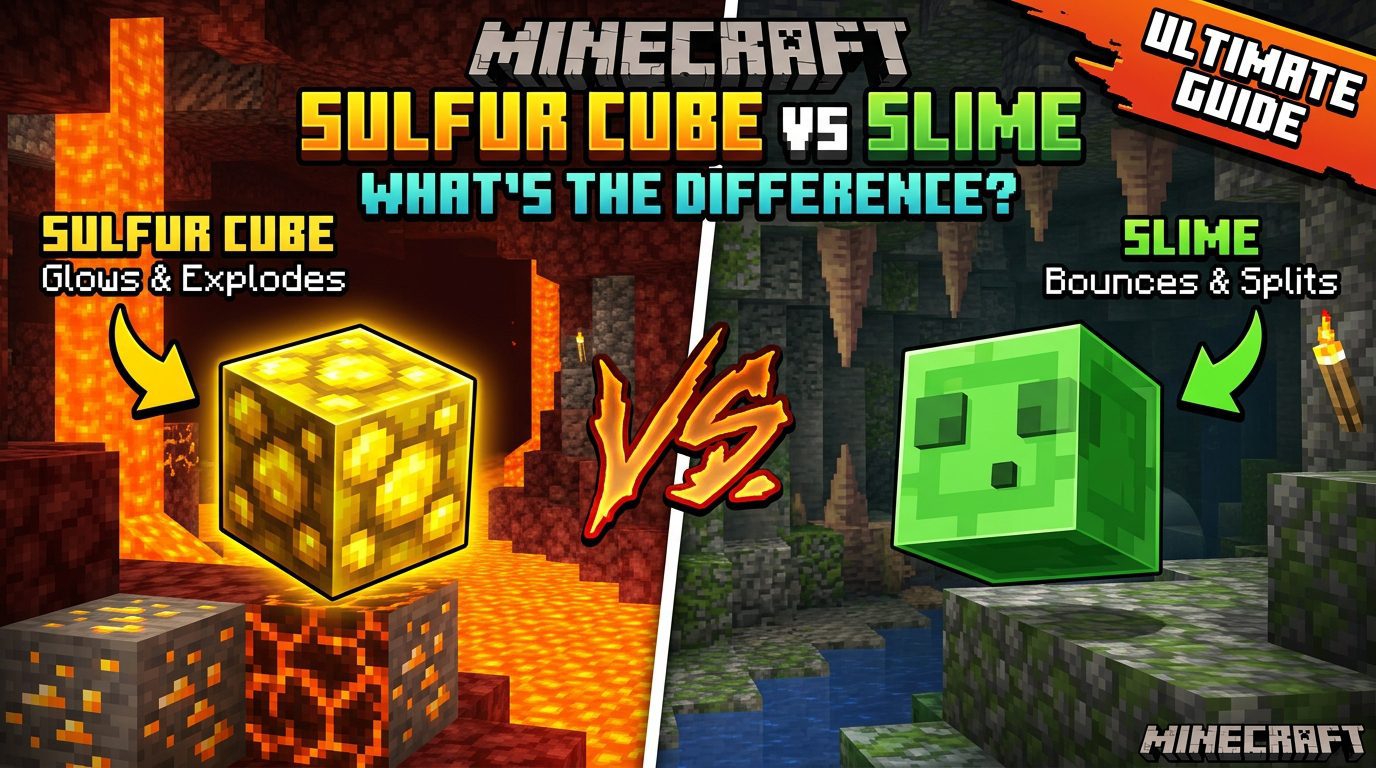
Understanding the Sulfur Cube
The Sulfur Cube is a fascinating new mob making its way into Minecraft as part of the “Chaos Cubed” content drop. Unlike many traditional blocks or items, the Sulfur Cube itself is not a craftable item but a living, interactive entity with unique properties.
Acquisition and Spawning
- Natural Habitat: Sulfur Cubes spawn naturally within a specific new biome known as the “Sulfur Caves.” These caves are found underground.
- Locating Sulfur Caves: Players can often locate Sulfur Caves by searching for “sulfur springs” on the surface. These springs commonly appear in plains, swamps, or desert biomes, acting as indicators to dig downwards to find the caves.
- Capturing Sulfur Cubes: Adult Sulfur Cubes can be picked up and contained using an empty bucket, which creates a “Bucket of Sulfur Cube” item. This allows for easy transport and deployment of the mob.
- Leading Sulfur Cubes: Interestingly, Sulfur Cubes can also be led using leads, but only if they have already absorbed a block.
Unique Behaviors and Duplication
Sulfur Cubes exhibit several behaviors that set them apart from other mobs:
- Duplication: Adult Sulfur Cubes can be “bred” or duplicated by attacking them. When an adult Sulfur Cube that has not absorbed a block is attacked, it will split into two smaller Sulfur Cubes, mimicking the splitting mechanic of regular Slimes.
- Growth: These smaller, baby Sulfur Cubes are not permanent. They can be tempted and fed Slime Balls to grow them into adult Sulfur Cubes. Alternatively, they will grow into adults naturally over a period of 20 minutes without player intervention.
- Block Absorption: One of the most distinctive features of the Sulfur Cube is its ability to absorb a single block. This can be done by interacting with the cube while holding a block (right-clicking) or by allowing the cube to pick up a nearby dropped block item.
- Property Changes: Absorbing a block significantly alters the Sulfur Cube’s physical properties. These changes include modifications to its speed, bounciness, ground friction, air drag, and buoyancy, making it a highly dynamic and customizable mob.
- Removing Absorbed Blocks: If a player wishes to change or remove an absorbed block, they can use shears on the Sulfur Cube.
Platform Differences
As the Sulfur Cube is a new addition, its implementation includes some platform-specific nuances:
- Introduction: Sulfur Cubes are being introduced to both Java Edition (via snapshots, starting with 26.2) and Bedrock Edition (via betas/previews, starting with 26.20) as part of the “Chaos Cubed” content drop.
- Growth Requirements: The number of Slime Balls required to instantly grow a baby Sulfur Cube into an adult differs significantly between platforms. In Bedrock Edition, approximately 10 Slime Balls are needed, whereas in Java Edition, players might need up to four stacks of Slime Balls.
Version Notes
The Sulfur Cubes were officially added to the game during the “Chaos Cubed” content drop, with their initial appearance in Java Edition 26.2 snapshots and Bedrock Edition 26.20 betas, rolling out between March and June 2026.
Understanding the Slime (Mob and Block)
The Slime is a classic Minecraft mob, a bouncy, green cube that has been a part of the game for a long time. Beyond the mob itself, the Slime also contributes to a crucial crafting ingredient, the Slimeball, which in turn forms the versatile Slime Block.
Slimeballs: Acquisition and Uses
- Killing Slimes: The primary method of obtaining Slimeballs is by defeating Slime mobs. Small Slimes drop 0-2 Slimeballs (up to 5 with the Looting III enchantment). When a Slime is killed by a frog, it is guaranteed to drop 1 Slimeball.
- Baby Pandas: Rarely, baby pandas can sneeze out Slimeballs, offering an unconventional source (a 1 in 700 chance).
- Wandering Trader: Occasionally, the Wandering Trader may sell Slimeballs for four emeralds each.
- Crafting: Slimeballs are essential for crafting various items, including Magma Cream, Sticky Pistons, Leads, and Slime Blocks. They are also used to breed frogs.
Slime Blocks: Crafting and Properties
- Crafting Recipe: A Slime Block is crafted using 9 Slimeballs, filling all nine slots of a crafting table.
- Properties: Slime Blocks are known for their unique properties. They cause entities to bounce when they land on them and can push or pull adjacent blocks when moved by pistons, making them invaluable in complex Redstone contraptions.
Slime Mob Spawning
Slimes have specific spawning conditions:
- Slime Chunks: They frequently spawn in designated “slime chunks” below Y-level 40, regardless of the light level.
- Swamp Biomes: Slimes also spawn in swamp biomes between Y-levels 51 and 69, provided the light level is 7 or less. Spawning is more frequent during a full moon.
Platform Differences
Slimes, being an older mob, have developed some distinct behaviors across Java and Bedrock Editions:
- Slime Chunk Algorithm: The algorithm that determines “slime chunks” differs between Java and Bedrock Editions. In Bedrock, the algorithm is not dependent on the world seed, meaning slime chunks are located at the same coordinates across all Bedrock worlds.
- Despawn Radius: In Java Edition, Slimes despawn instantly if no player is within 128 blocks. In Bedrock Edition, this despawn range varies from 44 to 128 blocks, depending on the player’s simulation distance setting.
- Named Slimes: If a large Slime is named using a name tag in Java Edition, its smaller counterparts will retain that name upon splitting. However, in Bedrock Edition, the smaller Slimes lose their name after splitting.
Version Notes
Slime blocks were added to Java Edition in version 1.8, with snapshots first appearing in 2013-2014. Slimeballs themselves were introduced earlier but were initially unobtainable and purposeless until later updates gave them crucial crafting recipes and uses, such as for breeding frogs.
Key Differences: Sulfur Cube vs. Slime
While both entities are bouncy and green, their core functionalities and interactions within the game are quite different:
- Nature and Origin:
- Sulfur Cube: Primarily a mob that cannot be crafted. It is found exclusively in the new Sulfur Caves biome.
- Slime: A mob found in slime chunks or swamps, but also a source of Slimeballs, which are craftable into a highly functional Slime Block.
- Acquisition and Spawning:
- Sulfur Cube: Located by finding sulfur springs and digging to Sulfur Caves. Can be scooped up with a bucket.
- Slime: Found in specific chunks below Y-40 or in swamps during certain conditions. Slimeballs are obtained by killing them.
- Duplication and Growth:
- Sulfur Cube: Attacking an adult (without an absorbed block) splits it into two smaller cubes. Baby cubes can be fed Slime Balls to grow them or will grow naturally.
- Slime: Large Slimes split into smaller ones upon being defeated, eventually yielding small Slimes that drop Slimeballs. Slimes do not grow from smaller to larger forms.
- Unique Mechanics and Utility:
- Sulfur Cube: Its defining feature is the ability to absorb a single block, dynamically changing its physical properties (speed, bounce, friction, drag, buoyancy). It can be led with a lead if it has absorbed a block.
- Slime: Its primary utility comes from the Slimeball drops, which are crucial for crafting sticky pistons, leads, magma cream, and Slime Blocks. Slime Blocks themselves are vital for Redstone contraptions, offering bounce and block-pushing/pulling capabilities.
- Interaction with Players:
- Sulfur Cube: Can be picked up with a bucket, making it a portable mob. Can be customized by giving it blocks.
- Slime: Primarily an enemy mob that yields resources upon defeat. Slime Blocks offer player interaction through bouncing.
- Platform Differences:
- Sulfur Cube: Has significant differences in the quantity of Slime Balls required for growth between Java and Bedrock Editions.
- Slime: Exhibits differences in slime chunk algorithms, despawn radii, and the retention of names for smaller slimes upon splitting between Java and Bedrock Editions.
In conclusion, while both the Sulfur Cube and the Slime contribute to the bouncy, dynamic nature of Minecraft, they serve fundamentally different roles. The Slime is a classic mob providing valuable crafting resources and a versatile Redstone component, while the Sulfur Cube introduces a new level of interactive mob customization and environmental manipulation, marking a significant evolution in Minecraft’s creature mechanics. Understanding these distinctions will allow players to effectively utilize each entity in their adventures and builds.
Tags:
YOU MAY ALSO LIKE...


