

Minecraft Updates Ranked
Minecraft has undergone over 20 major updates since its official launch in late 2011, each introducing changes that profoundly reshaped its blocky landscape. From minor tweaks to complete overhauls of core dimensions, these transformations have consistently evolved the gameplay experience, sometimes to universal acclaim, other times sparking heated debate among the player base. Understanding the impact and reception of these updates is key to appreciating Minecraft’s dynamic history and adapting to its ever-changing world.
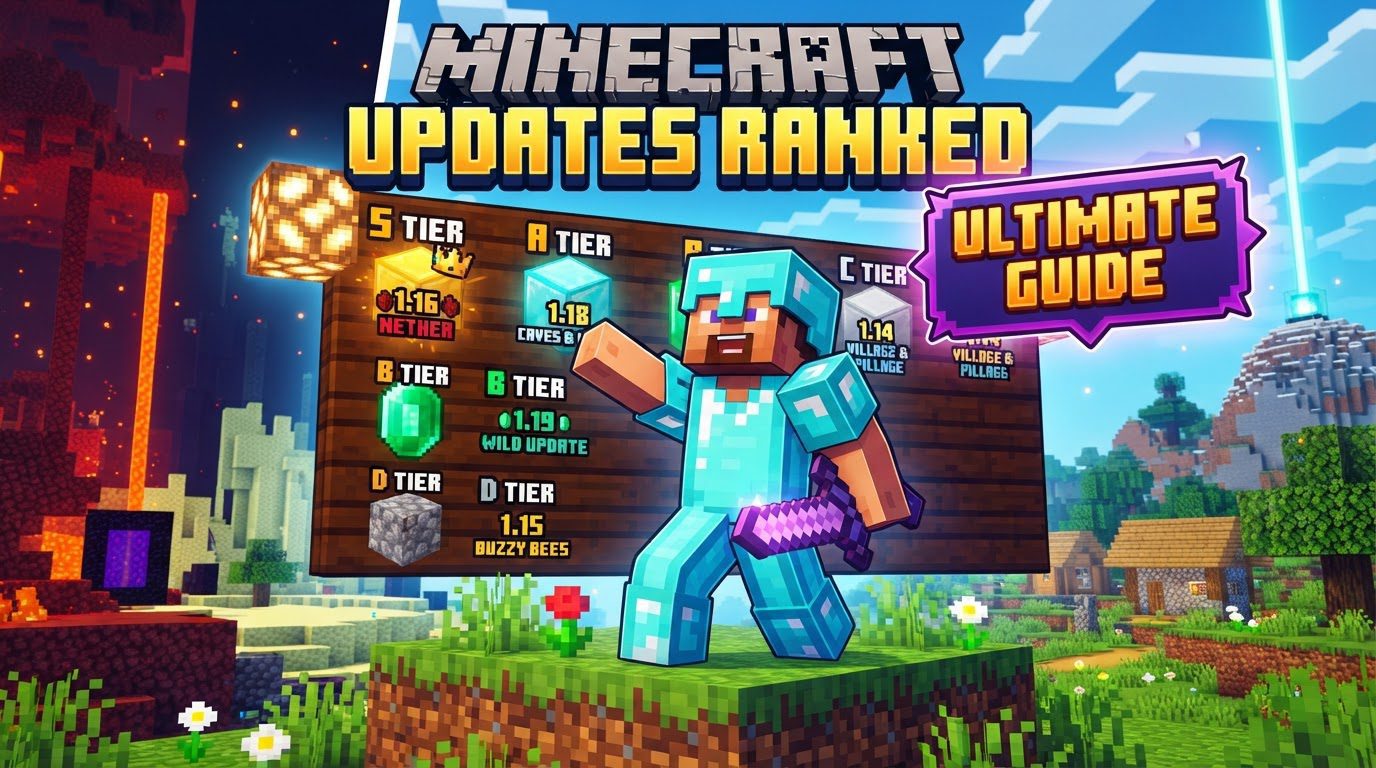
The Game Changers: Updates That Defined Eras
Certain updates stand out for their monumental impact, fundamentally altering how players interact with the game world and providing entirely new avenues for creativity and survival. These are often cited as the pinnacle of Minecraft’s developmental journey.
World-Shaping Marvels: 1.18 Caves and Cliffs Part 2
Often hailed as one of the best updates, 1.18 Caves and Cliffs Part 2 dramatically transformed world generation. It expanded the world’s vertical limits, increasing both height and depth from y0 to y320 and down to y-64 respectively. This change allowed for truly monumental builds and breathtaking natural vistas, introducing proper mountain peaks and dizzying cliff drops. Biomes were re-engineered to layer on top of terrain rather than determining it, leading to more diverse and realistic landscapes. Crucially, new caves and biomes now generate deep below the original y0 bedrock layer, creating vast subterranean networks waiting to be explored.
A Fiery Overhaul: 1.16 The Nether Update
Frequently cited as a top-tier update, 1.16 completely revitalized the Nether dimension. Previously a desolate and somewhat monotonous area, it was transformed with the addition of four distinct new biomes, such as the eerie Basalt Deltas and the vibrant Crimson Forest. New hostile and passive mobs, including the territorial Piglins, formidable Hoglins, and lava-traversing Striders, made the Nether a far more engaging and dangerous place. The introduction of Netherite, a material surpassing Diamond in strength and durability, provided a compelling reason for extended Nether exploration. Furthermore, new structures like Ruined Portals and Bastion Remnants offered both lore and valuable loot.
Community & Commerce: 1.14 Village & Pillage Update
This update brought significant depth to the game’s social and economic aspects. 1.14 completely revamped villages and villagers, introducing new trading mechanics that made interactions more dynamic and rewarding. Over 50 new blocks expanded building possibilities, while 7 new mobs, including the hostile Illagers and their raids, added new challenges and defense mechanics to village life. This update made villages feel like living, breathing communities, integral to a player’s survival and progression.
Unleashing Ingenuity: 1.5 The Redstone Update
For engineers and automation enthusiasts, 1.5 was a game-changer. The Redstone Update massively expanded the capabilities of Redstone, Minecraft’s in-game circuitry system. It introduced crucial components such as the comparator, daylight sensor, dropper, hopper, Redstone block, trapped chest, and weighted pressure plates. These additions enabled players to construct far more elaborate and functional contraptions, ranging from complex farms and automatic sorting systems to intricate mini-games and computing devices.
Beneath the Waves: 1.13 Update Aquatic
Before 1.13, Minecraft’s oceans were largely barren. The Update Aquatic revitalized these vast underwater biomes, introducing a wealth of new marine life, including dolphins, turtles, and various fish. New structures like shipwrecks and underwater ruins provided points of interest, while new mechanics for underwater exploration, such as conduits and improved swimming, made ocean adventures genuinely exciting and rewarding.
Navigating Controversy: When Change Isn’t Universally Loved
Not every update is met with unanimous praise. Some, despite their ambition, introduce changes that divide the player base, fundamentally altering established gameplay styles.
The Divisive Duel: 1.9 The Combat Update
1.9 remains one of the most controversial updates in Minecraft’s history. It drastically changed Player vs. Player (PvP) combat by introducing attack cooldowns, moving away from the rapid clicking-based combat that many players had mastered. This shift aimed to make combat more strategic, but it was met with significant backlash from a large portion of the player base, particularly those who enjoyed the older, faster-paced PvP style. While some adapted, others still lament the changes, often preferring to play on older versions for their combat mechanics.
Minor Adjustments: Updates That Fell Flat
While most updates contribute meaningfully, some are perceived as less impactful or even disappointing, offering little to truly enhance the core experience.
A Modest Offering: 1.10 The Frostburn Update
Often ranked among the less significant updates, 1.10 was criticized for its small scale and limited additions. It primarily introduced Polar Bears, Magma Blocks, Strays (skeletons with Slowness arrows), and Husks (zombies that cause hunger). While not inherently bad, many players found these additions to be minor, with some even considering the new mobs to be simply annoying rather than engaging. It lacked the transformative power seen in other major releases.
Mastering the Update Cycle: Essential Player Strategies
With each major update, players must adapt to new mechanics and prepare their worlds accordingly. Proactive steps can ensure a smooth transition and maximize enjoyment of new content.
Preparing for New Worlds
Always create a backup of your Minecraft worlds before updating the game, especially for major releases that change world generation. This is an essential safeguard against potential corruption or unwanted changes for both Java and Bedrock Editions. When upgrading an existing world to a version like 1.18 Caves & Cliffs Part 2, the process involves opening the world in the new version. New world generation will seamlessly blend with existing chunks, and the bedrock layer below previously generated chunks will be replaced by deepslate, allowing new caves and biomes to generate underneath. If an experimental Caves and Cliffs prototype datapack was used in 1.17, it should be disabled after opening the world in 1.18 in “Safe Mode” to prevent issues like missing vegetation in new chunks or sharp edges between old and new world generation.
Acquiring Advanced Resources
The 1.16 Nether Update introduced Netherite, the game’s strongest material. To acquire it, players must venture into the dangerous Nether and search for Ancient Debris, a rare block found deep within the dimension. This Ancient Debris is then smelted in a furnace into Netherite scraps. Four Netherite scraps combined with four gold ingots create a single Netherite ingot. These ingots are then used at a smithing table, alongside a Diamond tool or armor piece, to upgrade it into its superior Netherite equivalent.
Fundamental Player Practices
- Explore Unloaded Chunks for New Content: For updates that modify world generation (like Caves & Cliffs), new features and biomes will primarily generate in chunks that have not yet been explored in an existing world. To experience the new content, players should venture into new, unexplored areas of their map.
- Adapt to New Mechanics: Be open to learning and adapting to new gameplay mechanics introduced in updates. For instance, the 1.16 Nether Update completely changed the Nether, requiring new strategies for survival and resource gathering, such as using gold to appease Piglins.
- Stay Informed: Keep up-to-date with patch notes and community discussions to understand what changes each update brings. This allows players to anticipate new challenges and opportunities.
Avoiding Pitfalls: Common Mistakes to Sidestep
Even seasoned players can fall victim to common errors when navigating Minecraft’s update landscape. Awareness of these mistakes can save time and frustration.
- Not Backing Up Worlds: This is perhaps the most critical mistake. Failing to back up worlds before an update can lead to irreversible loss or corruption of saves if something goes wrong during the transition.
- Ignoring Update Details: Some players dive into new updates without thoroughly understanding the changes. This can lead to confusion or missed opportunities, such as overlooking the valuable properties of Netherite or new villager trading mechanics.
- Mismanaging Villagers After 1.14: The significant changes to villager mechanics in 1.14, including new trading systems and job site blocks, required players to rethink villager-based farms and trading halls. Misunderstanding these mechanics could lead to inefficient setups or non-functional designs.
- Expecting Immediate Perfection: Updates, especially large ones, can sometimes introduce bugs, glitches, or balancing issues. Expecting a completely flawless experience immediately upon release can lead to frustration. Patience is often required as Mojang addresses initial issues.
- Outdated Game Version for Multiplayer: Attempting to join multiplayer servers or friends’ worlds with an outdated game version is a common reason for connection errors. Always ensure your client matches the server’s version.
- Assuming Old Strategies Still Work: Significant updates often render old strategies or farm designs obsolete. Players who stick rigidly to outdated methods may find themselves at a disadvantage or their contraptions no longer functioning as intended.
- Carrying Valuables into Unfamiliar, Dangerous Areas: After an update introduces new hostile mobs or hazardous biomes, such as the deeper caves of 1.18 or the new Nether biomes in 1.16, going in unprepared with valuable gear can easily lead to loss. Always scout new areas cautiously.
Minecraft’s updates are a testament to its enduring appeal and continuous evolution. By understanding their impact, embracing new mechanics, and exercising caution, players can fully enjoy the ever-expanding universe that Mojang Studios continues to build.
Tags:
YOU MAY ALSO LIKE...


