

Stop Wasting Time On Manual Tree Farming
Many Minecraft players commit a significant blunder when it comes to resource gathering: they spend countless hours manually chopping down trees, overlooking the incredible efficiencies offered by automated and optimized farming methods. The endless swing of an axe, the constant replanting, and the tedious collection of logs can quickly drain the fun from your game. Fortunately, the world of Minecraft offers a spectrum of solutions, from ingeniously complex Redstone contraptions to simple, clever planting patterns, all designed to free you from the lumberjack grind. It’s time to reclaim your time and let your world do the heavy lifting.
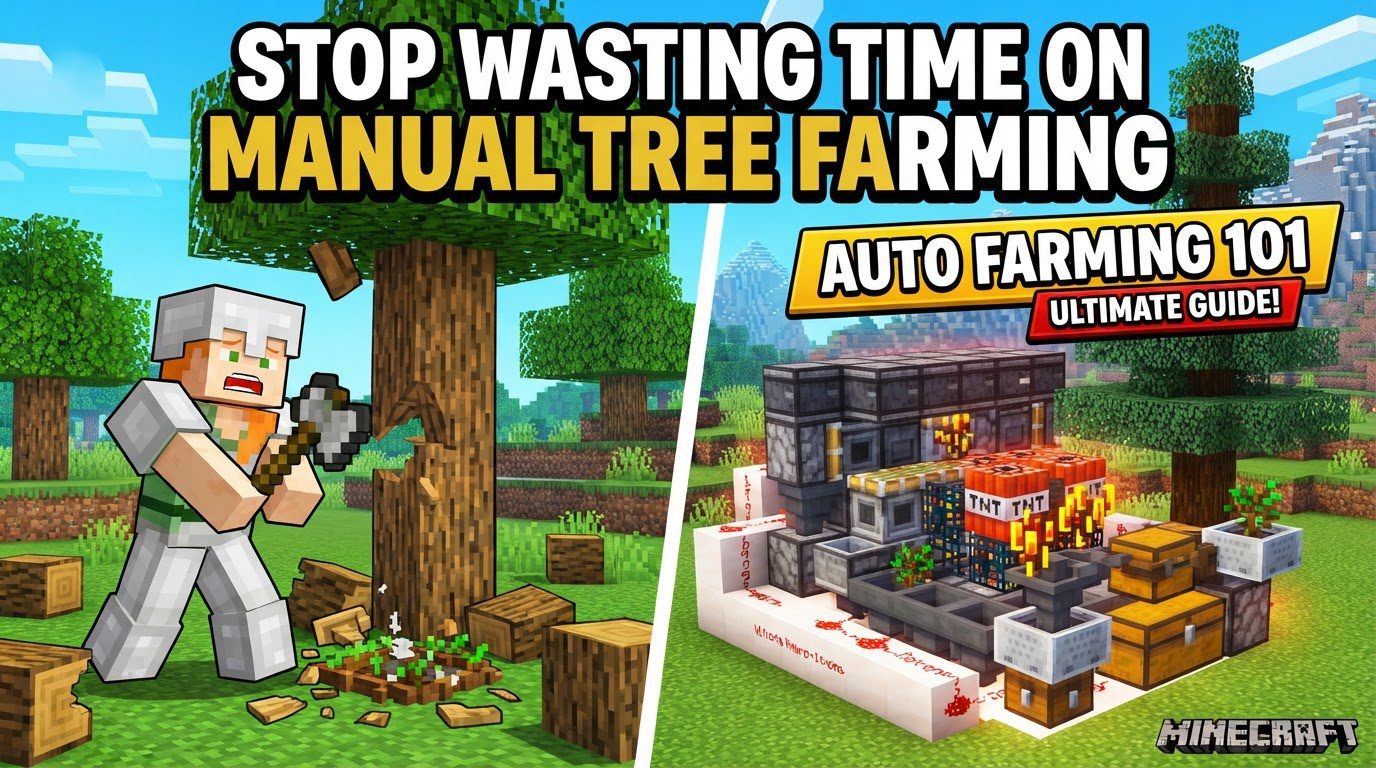
The Pinnacle of Automation: Universal Tree Farms
For those seeking the ultimate in wood production, universal automatic tree farms represent the apex of Minecraft engineering. These sophisticated machines, often inspired by designs from Redstone masters like RaysWorks, are capable of growing and harvesting almost every type of tree and even fungi within a single, integrated system. They leverage advanced Redstone logic, often incorporating TNT for efficient log destruction, and complex mechanisms for planting, growing, and collecting resources.
- Pros:
- High Output: These farms boast staggering production rates, easily exceeding 20,000 logs per hour, making them ideal for large-scale projects or server-wide resource provision.
- Versatility: A single universal farm can handle an impressive array of 15 different tree and fungi types, including oak, birch, spruce, jungle, acacia, azalea, cherry, poplar, dark oak, mangrove, and various Nether fungi (crimson, warped, red, brown mushrooms). This eliminates the need for multiple specialized farms.
- AFK-able: Once constructed, these farms can run autonomously, allowing players to go AFK (Away From Keyboard) and return to vast quantities of wood and other materials without direct interaction.
- Resource Conservation: By providing a consistent, renewable source of wood, these farms minimize the environmental impact on natural forests, preserving the aesthetic of your world.
- Cons:
- Complex Build: Constructing a universal tree farm demands significant Redstone knowledge, precision, and a substantial investment of resources, often requiring materials like observers, pistons, dispensers, and a vast amount of Redstone dust.
- Lag Inducing: The sheer number of operations, entities, and often the use of TNT dupers within these farms can cause considerable game or server lag, especially on less powerful machines or crowded servers.
- Resource Consumption: While highly efficient, they often rely on a steady supply of bone meal for accelerated growth and TNT for harvesting, which themselves require dedicated farms or resource gathering efforts.
- Stats:
- Output: 20,000+ items per hour.
- Supported Types: 15 different trees and fungi (oak, birch, spruce, jungle, acacia, azalea, cherry, poplar, bamboo, dark oak, pale oak, crimson fungus, warped fungus, red mushroom, brown mushroom, and mangrove).
- Version Compatibility: Specific designs may require Java Edition 1.21.9+ for optimal functionality.
Explosive Efficiency: TNT-Powered Wood Production
A slightly more focused but equally powerful approach to automated tree farming involves the strategic use of TNT. These farms are designed around the principle of using explosions to instantly break down grown trees, with the dropped logs then collected by sophisticated water streams or hopper networks. They often integrate bone meal dispensers to ensure rapid tree growth, creating a continuous cycle of planting, growing, exploding, and collecting.
- Pros:
- High Efficiency: TNT-based farms can achieve very high log production rates, often exceeding 10,000 logs per hour for specific tree types, significantly outperforming manual labor.
- Automation: They drastically reduce manual effort, allowing players to focus on other aspects of the game while wood accumulates in storage.
- Compact Designs: While powerful, many TNT tree farms can be built in relatively compact footprints, making them suitable for survival bases where space is a premium.
- Cons:
- Resource Intensive: A major drawback is the constant demand for TNT, which requires a consistent supply of sand (often from desert biomes) and gunpowder (from mob farms, particularly creepers). This can be a significant resource sink.
- Bone Meal Consumption: To achieve high growth rates, these farms typically consume large quantities of bone meal, necessitating an efficient bone meal source, such as a mob farm or composting system.
- Noise and Visual Impact: The frequent explosions can be noisy and visually disruptive, potentially affecting the ambiance of your base or causing annoyance.
- Lag: Similar to universal farms, the rapid item drops, entity processing, and explosion mechanics can contribute to server or game lag.
- Stats:
- Output: 10,000+ logs per hour for specific designs and tree types.
- Supported Types: Commonly used for 1×1 trees like oak, birch, spruce, and jungle saplings, which grow into single-block trunks.
Starting Small: Early-Game and Simple Tree Farms
Not every player needs or can immediately build a mega-farm. For those in the early to mid-game, or players who prefer less complexity, simple automatic tree farms offer a significant upgrade over purely manual methods without the massive resource and Redstone investment. These designs often focus on one or a few tree types and use more basic Redstone or optimized planting patterns to streamline wood production.
- Pros:
- Easier to Build: Requiring fewer rare resources and less intricate Redstone, these farms are accessible to players with foundational knowledge of Redstone and basic survival resources.
- Good for Starters: They provide a substantial increase in wood production efficiency compared to manual chopping, serving as an excellent stepping stone before tackling more advanced automation.
- Self-sufficient Sapling Production: Many simple designs can be configured to ensure a continuous supply of saplings, preventing the need to gather them manually.
- Cons:
- Lower Output: Production rates are generally lower than the advanced TNT-based or universal farms, making them less suitable for extremely large-scale projects.
- Limited Versatility: These farms are often optimized for one or a few specific tree types, meaning you might need multiple simple farms for different wood varieties.
- May Require Some Manual Intervention: While automated, some simpler designs might not be fully AFK-able and could require occasional player interaction for optimal performance.
- Stats:
- Supported Types: Works well with 1×1 trees like oak, birch, spruce, acacia, cherry, and pale wood, as well as 2×2 trees like large spruce and jungle trees when planting patterns are optimized.
Mastering Manual: Optimized Harvesting Techniques
Even if full automation isn’t your goal, you can still drastically reduce wasted time on tree farming through optimized manual techniques. These methods focus on intelligent planting layouts and harvesting strategies to maximize yield and minimize effort without requiring any Redstone. It’s about working smarter, not harder, with your axe.
- Pros:
- No Redstone Required: The biggest advantage is the complete absence of complex mechanics or Redstone circuits, making these farms incredibly simple and quick to set up.
- Resource-Efficient Setup: The “farm” area itself requires minimal material cost; primarily just dirt or grass blocks for planting.
- Player Control: You retain full control over harvesting timing and sapling management, which some players prefer over fully automated systems.
- Cons:
- Time-Consuming: Despite optimizations, these farms still demand direct player involvement for planting saplings and chopping down trees, making them less efficient for large-scale wood needs.
- Less Output than Automated: They cannot match the sheer volume of logs produced by fully automatic farms, especially for extended periods.
- Can Be Tedious: The repetitive nature of planting and chopping, even in an optimized setup, can still feel like a chore over time.
- Stats:
- Best for: 2×2 spruce trees are highly recommended due to their tall, dense wood production and high sapling yield. Dark oak trees also provide a good amount of wood, though their sapling production can be inconsistent without Fortune enchanted tools.
Nether’s Bounty: Specialized Fungi Farms
Venturing into the Nether opens up unique opportunities for wood-like resources with huge fungi. Crimson and Warped fungi, distinct from Overworld trees, offer their own set of advantages and challenges, and can be farmed with specialized automated setups, often utilizing pistons for harvesting.
- Pros:
- Space-Efficient Growth: Unlike Overworld trees, huge fungi do not have strict empty space requirements for growth checks, allowing them to be planted much closer together, maximizing farm density.
- Fast Cycle Speeds: Automated fungi farms can achieve rapid harvesting cycles by placing pistons directly adjacent to the fungi’s trunk, quickly breaking the stems.
- Shroomlight Production: These farms naturally produce Shroomlight, a unique, opaque light source that can be used for decoration or general lighting.
- Non-Flammable Wood: Crimson and warped stems, planks, and wart blocks are immune to fire and lava, making them invaluable for builds in the Nether or fire-prone environments.
- Bone Meal Positive: The wart blocks harvested from fungi often yield enough bone meal through composting to sustain the farm’s bone meal needs, making them self-sufficient in this regard.
- Cons:
- Half Fuel Value: Fungi stems have only half the fuel value of Overworld logs, meaning you’ll need more of them for smelting or burning.
- Limited Fuel Use: Fungi logs (stems) cannot be burned in a furnace to produce charcoal, limiting their versatility as a fuel source.
- Wart Block Clearing: The wart blocks that make up most of the fungi’s “canopy” do not decay naturally and must be cleared by pistons or other means, adding a layer of complexity to automation.
- Specific Biome: Fungi can only be found and grown in the Crimson Forest and Warped Forest biomes within the Nether, requiring travel to these specific locations.
- Stats:
- Shortest tree variant is the smallest of all tree types, which can be useful for compact designs.
- Wart blocks are excellent for composting into bone meal, decoration, or as non-flammable solid building blocks.
The journey to efficient wood production in Minecraft is a rewarding one, transforming a tedious chore into an automated resource stream. Whether you opt for a simple setup to get by or a colossal Redstone marvel, embracing these farming techniques will significantly enhance your gameplay experience and free you up for more exciting adventures. The specific method you choose will depend on your play style, resource availability, and technical ambition, but all offer a path to stop wasting time on manual tree farming.
Installation/Background: The various tree and fungi farms discussed here are community-developed designs that leverage Minecraft’s core mechanics, including Redstone, pistons, observers, and growth patterns. While specific build tutorials are outside the scope of this guide, searching for the farm types mentioned (e.g., “RaysWorks Universal Tree Farm” or “Minecraft TNT Tree Farm”) on platforms like YouTube will yield numerous step-by-step guides for construction in your world.
Tags:
YOU MAY ALSO LIKE...


