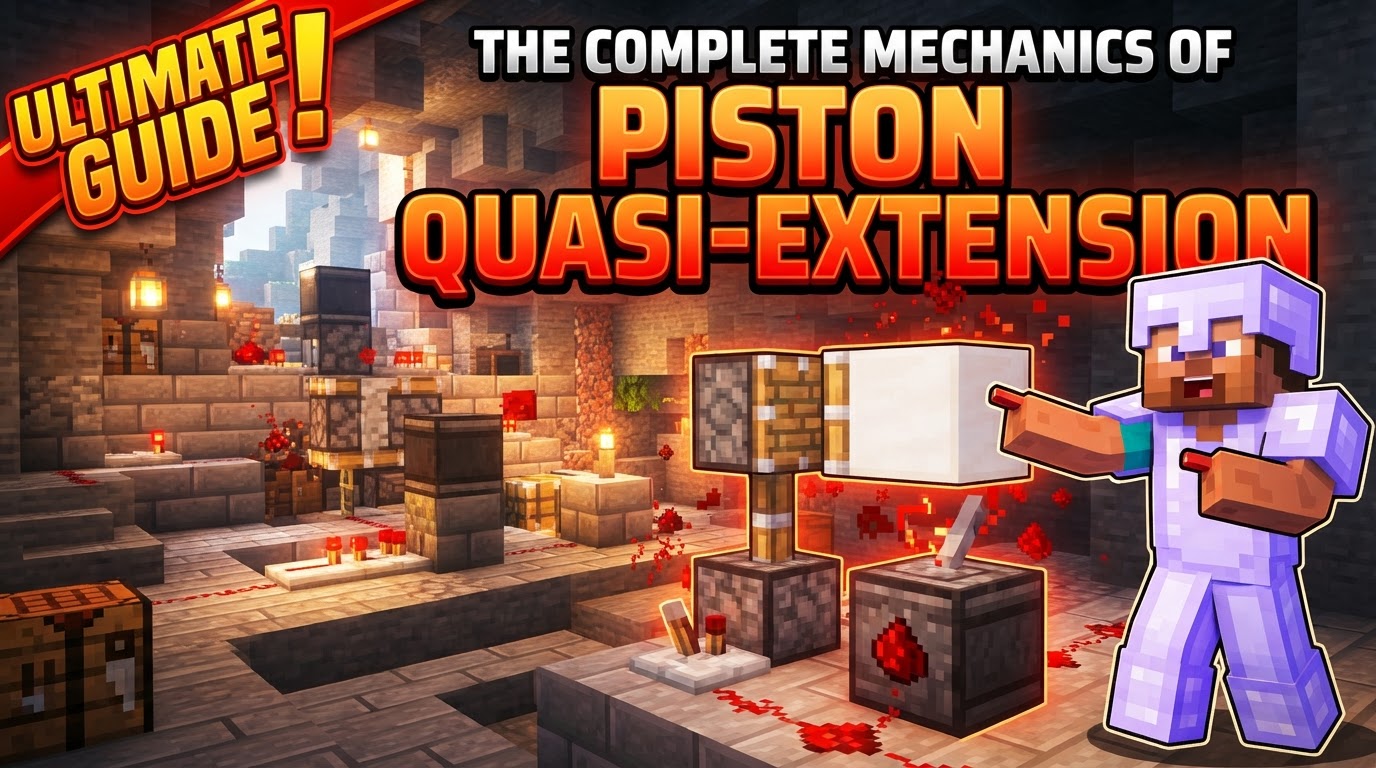
The Complete Mechanics of Piston Quasi-Extension
Minecraft’s most complex redstone bug, quasi-connectivity, has become an indispensable feature for expert builders in Java Edition. Officially known as Piston Quasi-Extension, this unique mechanic allows pistons, dispensers, and droppers to react to power sources that are not directly touching them. What began as an accidental quirk in the game’s code is now an intended, platform-specific cornerstone of advanced redstone engineering, enabling compact and sophisticated contraptions.
The Fundamental Mechanics of Quasi-Connectivity
Quasi-connectivity (QC) redefines how certain redstone components perceive power, introducing an indirectness crucial for understanding its behavior.
- Indirect Powering: Unlike components requiring direct adjacency, QC allows a piston to register power from a source one block above it. This also applies if the power source itself is diagonally positioned relative to the piston, but still powers the block above it. This “quasi” nature means power is almost, but not quite, directly connected.
- “Powered” vs. “Extended” State: This distinction is paramount. When quasi-powered, a piston internally registers as “powered” but will not immediately extend or retract. It enters an anticipatory state, awaiting a specific trigger to act upon its internal power status.
- Java Edition Exclusive: Piston Quasi-Extension is unique to Minecraft’s Java Edition. Builds relying on QC will not function in Bedrock Edition, a critical distinction that often causes confusion.
- Origin from Doors: The mechanic stems from pistons sharing code with doors, which check for power in the block space directly above them. Pistons inherited this behavior, leading to the unintended, yet embraced, quasi-connectivity.
The Two-Step Quasi-Extension Process
For a piston to quasi-extend, a precise two-step sequence must occur: providing power, then initiating a block update.
- Provide Quasi-Power: Place a redstone power source (e.g., redstone block, lever, torch, or dust) in the block space directly above the piston. Alternatively, the source can power the block directly above the piston from an adjacent position. The piston becomes internally “powered” but remains physically retracted.
- Initiate a Block Update: This is the crucial trigger. A “block update” must occur in any block adjacent to the piston. This update prompts the piston to re-evaluate its power state and, finding itself internally powered, to extend. Common block update methods include:
- Placing or breaking any block next to the piston.
- Activating or deactivating an adjacent lever or button.
- A redstone signal changing (on or off) in an adjacent block.
- Using a note block or bell near the piston.
Once this update occurs, the piston extends. Similarly, a quasi-de-powered piston will retract upon receiving a block update.
Practical Applications and Tips for Quasi-Connectivity
Understanding and utilizing quasi-connectivity unlocks possibilities for compact and efficient redstone designs.
- Compact Piston Walls: QC excels in building compact piston walls for hidden doors or elevators. A single power source can quasi-power multiple pistons, and a single block update can trigger their simultaneous extension, significantly reducing component requirements.
- Observers for Dynamic Updates: Observer blocks have revolutionized QC use. They are ideal for providing continuous or timed block updates. An observer facing a changing block state (e.g., a redstone signal) can generate the necessary update to trigger an adjacent quasi-powered piston, enabling responsive, automated QC systems.
- Advanced Compact Designs: For experienced redstone engineers, QC is indispensable for highly compact and efficient contraptions. Leveraging indirect powering and the block update trigger is key to pushing the boundaries of Minecraft’s redstone system, from intricate hidden entrances to complex item sorters.
Common Mistakes and Key Considerations
While powerful, quasi-connectivity can be frustrating if its nuances are not understood. Awareness of common pitfalls saves troubleshooting time.
- Unintended Extensions: A frequent issue is pistons extending or retracting unexpectedly. This happens when a quasi-powered piston receives an unmanaged block update. Careful planning and circuit isolation prevent these accidental activations.
- Transparent Block Interference: Transparent blocks (glass, leaves) or certain non-solid blocks (slabs in lower half) in the power path or directly above the piston can prevent QC from working. These blocks may not properly conduct or transmit the power for the piston to register its “powered” state. Use solid, opaque blocks for reliable quasi-power.
- Bedrock Edition Incompatibility: As noted, QC is a Java Edition exclusive. Attempting QC builds in Bedrock Edition will fail. This fundamental difference is a frequent source of confusion.
- From “BUD Switches” to Observers: Historically, complex “Block Update Detector” (BUD) switches used QC to detect block updates. While QC was the underlying principle, the introduction of observer blocks has largely replaced the need for such complex circuits. Observers offer a simpler, dedicated, and more compact way to detect block updates, making them the modern preferred tool for QC designs.
Mastering Piston Quasi-Extension transforms basic redstone builders into architects of complex, efficient contraptions. It embodies the spirit of Minecraft’s redstone – where bugs become features, and ingenuity thrives on understanding deep game mechanics.
Tags:
YOU MAY ALSO LIKE...