

The Real Reason Your Fish Attracting Farm Fails
The biggest culprit behind a failing Minecraft AFK fish farm for many Java Edition players isn’t a complex redstone error or a bug in the game; it’s a fundamental change introduced in the 1.16 update that often goes unnoticed or misunderstood. This one alteration alone has rendered countless older farm designs obsolete for treasure hunting, leading to frustration and wasted time.
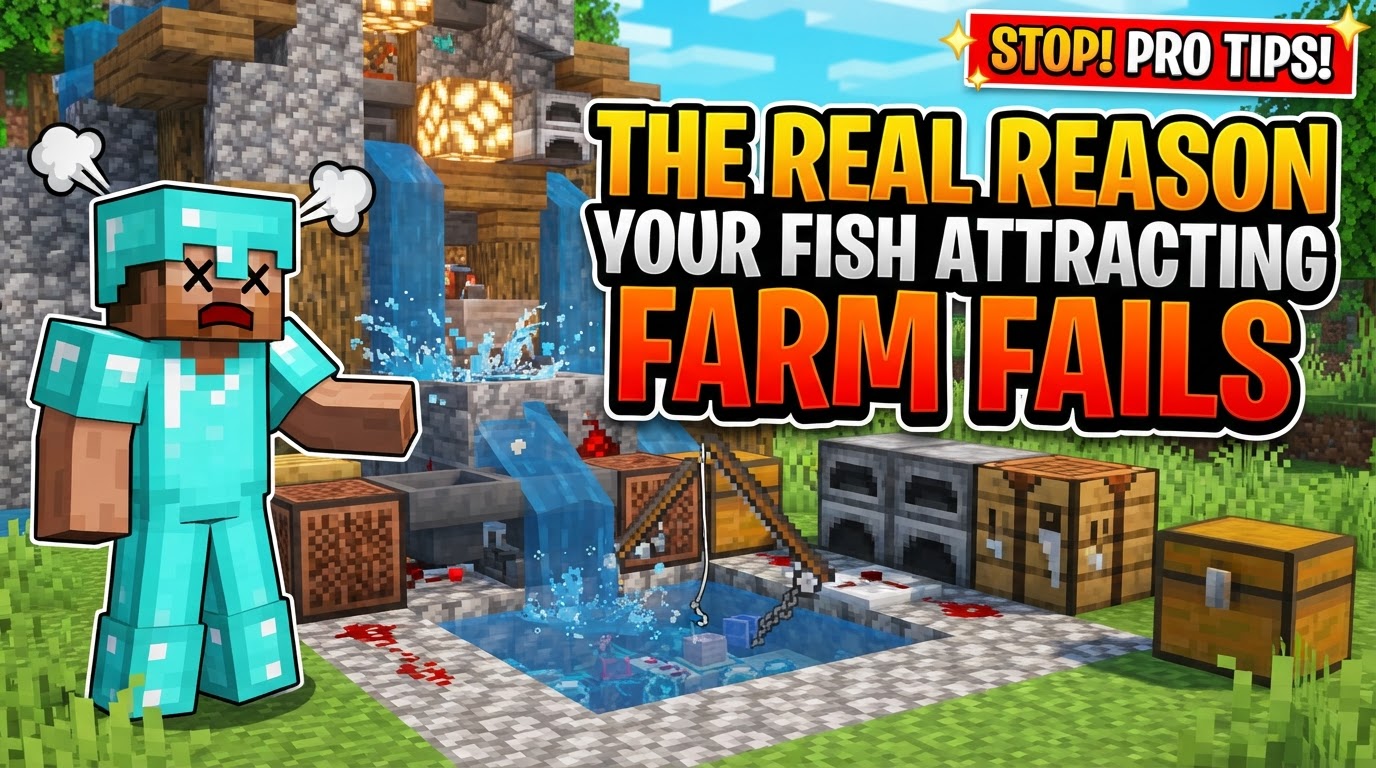
The Foundational Flaw: The 1.16 Update’s Silent Killer
For players operating in Java Edition, the primary reason your AFK fish farm might be failing to yield valuable treasure is likely tied to the water source size requirement introduced in the 1.16 update. Prior to this, many compact designs allowed players to catch enchanted books, bows, and other rare items from a small, often single-block water source. However, this is no longer the case for treasure. To successfully catch treasure items in Java Edition, the water source where your bobber lands must be a minimum of 5x5x4 blocks in size. If your water source is smaller than this specific dimension, your farm will still catch fish and provide experience, but it will never yield treasure. This is a critical distinction that many players overlook when troubleshooting their non-performing farms, often assuming their redstone or aiming is off when the core environment itself is the issue.
This requirement emphasizes the need for a sufficiently large, unobstructed body of water around the point where the fishing bobber interacts. Without meeting this specific spatial criterion, your farm is simply not set up to attract anything beyond basic aquatic life and the associated experience points. Many older designs, while still functional for fish, inherently fail at treasure acquisition due to this single, significant change.
Beyond Water Size: Common Pitfalls and How to Avoid Them
While the 1.16 water source change is paramount for treasure, numerous other factors can contribute to an AFK fish farm’s failure. Addressing these common mistakes is crucial for consistent, automated success.
Farm Activation & Automation Glitches
- Farm Not Activated: A surprisingly common oversight is simply forgetting to properly activate the farm’s redstone mechanism. Many AFK designs rely on a delicate interplay of components to automatically reel in and cast the fishing rod. If a pressure plate isn’t depressed, a note block isn’t triggered, or a trapdoor isn’t set to open and close correctly, the automatic loop will break. Ensure all redstone components are receiving power and functioning as intended.
- Missing Components: Even a single missing block, piece of redstone dust, or incorrect placement of a hopper can render an entire complex farm non-functional. Double-check your build against a verified design, ensuring all necessary materials are present and correctly positioned.
Storage Overload & Collection Woes
- Full Storage: An often-underestimated problem is allowing your collection chests to fill up. Once chests are full, items cannot be collected by hoppers, leading to a backup. This can cause items to despawn, or worse, halt the entire farm’s operation if the item collection is integral to the redstone loop (e.g., if items falling onto a pressure plate trigger an action). Regular chest emptying or expanding your storage system is vital for long AFK sessions.
Precision in Placement: Aiming and Bobber Mechanics
- Improper Aiming/Positioning: AFK fish farms demand precise player positioning and crosshair placement. The fishing rod must be aimed at a specific target block (like a note block or trapdoor) to ensure the automatic casting and reeling loop works. Even a slight misalignment can prevent the bobber from interacting correctly with the water, the pressure plate, or the redstone trigger, breaking the automation.
- Bobber Stuck: The fishing bobber itself can be temperamental. If the water levels are incorrect, or blocks are placed in such a way that the bobber can get physically stuck, it won’t interact with the pressure plate or trapdoor that signals a catch. The bobber’s water level is critical; it must be low enough to dip when an item is caught but high enough not to bob constantly. A drop of 3 to 5 blocks is often ideal for its movement.
Edition Differences & Outdated Blueprints
- Bedrock vs. Java Differences: Minecraft exists in different editions, primarily Java and Bedrock. Farm designs and underlying mechanics can vary significantly between these versions. A design that works flawlessly in Java Edition might be completely non-functional or require substantial modification in Bedrock Edition, and vice-versa. Always ensure the design you are following is specifically for your game version.
- Outdated Designs: Relying on AFK fish farm designs that predate the 1.16 update (for Java Edition) will inherently fail to yield treasure due to the aforementioned water source changes. Always seek out designs confirmed to be functional in your current game version.
Mastering the Mechanics: How a Successful Farm Works
Understanding the core mechanics of a functional AFK fish farm can help you diagnose issues and even build your own robust designs.
Redstone’s Role in Automation
The magic of an AFK farm lies in its redstone automation. The core principle involves automating the casting and reeling process. This typically utilizes components like:
- Weighted Pressure Plates: Often placed on a fence post or other block, these detect when a player is standing on them, or when an item falls on them, triggering redstone.
- Note Blocks: These are frequently used as target blocks for aiming the fishing rod and can also be part of the redstone trigger mechanism.
- Trapdoors: These are often positioned to open and close in response to a redstone signal, interacting with the bobber or creating a space for water flow.
- Hoppers: Essential for item collection, feeding caught items into storage chests.
The bobber’s interaction with a caught item causes it to retract, and the redstone mechanism then automatically recasts it, creating a continuous loop. Standing in a specific spot, often on storage chests, and holding down right-click (either manually, with an auto-clicker, or physical means) completes the AFK setup.
The Art of the Bobber and Water Level
The fishing bobber is the heart of the operation. Its interaction with the water and the game’s mechanics is key. A successful farm ensures the bobber has space to move, dip, and interact with the water correctly. The water level is crucial: if it’s too high, the bobber might not register a catch properly; if too low, it might not even cast. A drop of 3 to 5 blocks from the casting point to the water surface is often ideal, allowing the bobber to dip when a fish bites but remain stable otherwise.
Enhancing Your Haul: Enchantments and Long Sessions
Once your farm is technically sound, you can optimize its output.
- Enchantments: A fishing rod enchanted with Luck of the Sea significantly increases the rate of treasure catches. Lure speeds up the fishing process, reducing the wait time between bites. Mending is invaluable, repairing your rod with the experience points gained from fishing, ensuring it never breaks during long AFK sessions. Some advanced designs can even prevent durability loss entirely, often by using lava in conjunction with waterlogged chests or other specific block placements.
- Long AFK Sessions: To obtain the best and most diverse loot, plan for extended AFK sessions. Many valuable items have a lower drop chance, meaning you’ll need to fish for at least 5-10 hours to see a significant return on treasure.
- Location: While not strictly necessary for fishing itself, placing an AFK farm near other active farms can be beneficial for overall resource gathering. Additionally, finding a body of open water in a frequently raining biome, such as a river in a jungle or forest, is ideal for maximizing output due to increased fishing speed during rain.
By meticulously addressing these potential failure points and understanding the underlying mechanics, you can transform your struggling fish-attracting farm into a reliable source of invaluable resources and experience.
Tags:
YOU MAY ALSO LIKE...


