

The Real Reason Your Furnace Farm Smelts Slowly
Your Minecraft furnace farm isn’t smelting slowly because of a bug, but likely due to a fundamental misunderstanding of its core mechanics or an oversight in its design. Many players invest significant time into building elaborate smelting arrays, only to be frustrated by a trickle of processed items. The good news is that the solution rarely involves complex redstone wizardry or obscure game glitches; more often, it boils down to a few critical factors that, once understood and addressed, can transform a sluggish setup into a blazing fast production line.
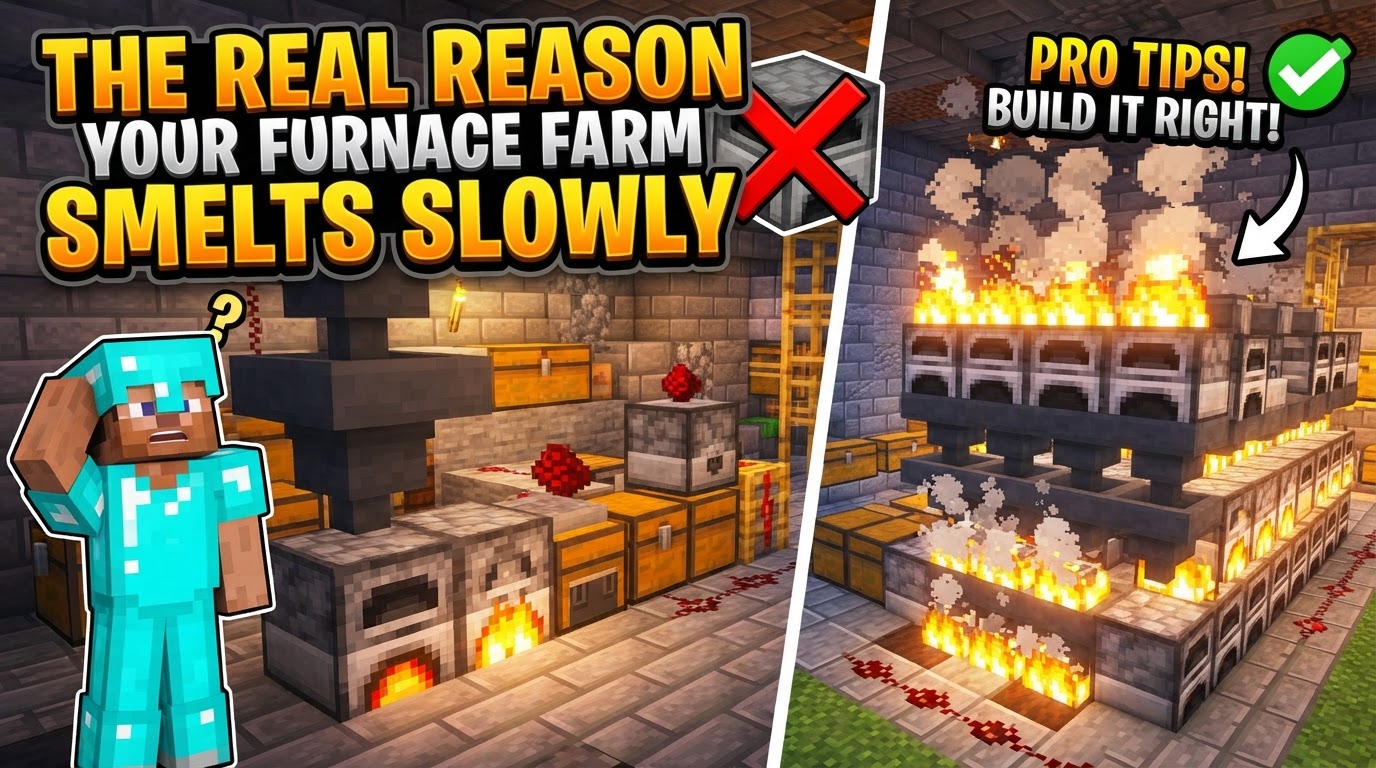
This guide will delve into the true reasons behind slow furnace farms, dissecting the game’s mechanics, highlighting common pitfalls, and offering expert strategies to optimize your smelting operations. From basic furnace principles to advanced automation techniques, we’ll cover everything you need to know to ensure your furnaces are always running at peak efficiency.
The Foundational Mechanics of Smelting
At its heart, a Minecraft furnace is a simple block with a straightforward function. It requires an item to be placed in its top slot (the input), a fuel source in its bottom slot, and, once smelting begins, the processed product appears in the right slot (the output). Understanding these basic interactions is the first step towards diagnosing any performance issues.
However, not all furnaces, or indeed all items, are created equal when it comes to speed. A standard furnace processes items at a base rate. This rate can feel slow when dealing with large quantities, which is why specialized furnaces exist:
- Blast Furnaces: These are a game-changer for processing metal items. They smelt ores, raw metals, tools, and armor at twice the speed of a regular furnace. The trade-off is that they consume fuel at double the rate.
- Smokers: Dedicated to culinary tasks, Smokers cook all food items twice as fast as standard furnaces. Like Blast Furnaces, they also consume fuel at an accelerated rate, but their efficiency for food processing is unmatched.
Crucially, furnaces only operate when they are within a loaded chunk. If you venture too far away from your farm (typically beyond 8-10 chunks), the game “unloads” that area, and your furnaces will pause operation until you return. This is a common and often misunderstood reason for perceived slowness.
Optimizing with Specialized Furnaces and Automation
One of the most significant leaps in smelting efficiency comes from matching the right furnace to the right task. Ignoring this simple principle is a primary reason for slow processing.
- Targeted Smelting: Always use Blast Furnaces for ores (like iron, gold, copper, ancient debris), metal tools, and armor. For all food items, from raw chicken to potatoes, the Smoker is your best friend. Only use standard furnaces for everything else, such as sand into glass, cobblestone into stone, or wood logs into charcoal. Using the wrong furnace type (e.g., trying to cook food in a Blast Furnace) will yield no results and waste fuel.
- Harnessing Hoppers for Automation: Manual loading and unloading of furnaces is incredibly inefficient. Hoppers are essential for any high-volume furnace farm.
- Input Hoppers: Place hoppers on top of your furnaces to automatically feed raw materials into the input slot.
- Fuel Hoppers: Place hoppers on the side of your furnaces to automatically feed fuel into the fuel slot.
- Output Hoppers: Place hoppers underneath your furnaces to collect smelted products as soon as they are ready.
Correct hopper placement is paramount; incorrect placement (e.g., feeding fuel from the top or items from the side) will prevent automation and halt your farm.
Scaling Up: The Power of Super Smelters
When you need to process truly massive quantities of items, a single furnace, even a specialized one, won’t cut it. This is where “super smelters” come into play. A super smelter is an array of multiple furnaces, often dozens or even hundreds, designed to process items simultaneously.
These large-scale farms typically employ minecarts with hoppers to distribute raw materials and fuel efficiently across the entire array. A minecart with a hopper can travel along a rail system, pausing over each furnace’s input or fuel hopper to offload items. This ensures that every furnace is constantly supplied and operational, maximizing throughput.
However, super smelters introduce their own set of potential issues. Minecarts moving too fast or not pausing long enough over individual furnaces can lead to uneven distribution. Some furnaces might receive too much fuel or too many items, while others sit idle, creating bottlenecks and reducing overall efficiency.
Fueling Your Farm: The Efficiency Equation
The choice of fuel significantly impacts both the speed and sustainability of your furnace farm. Different fuels have varying burn times and can smelt a different number of items. Choosing inefficient fuels for large-scale operations is a common mistake that can make the entire process feel agonizingly slow and resource-intensive.
- High-Capacity Fuels: For bulk smelting, fuels that can process many items per unit are ideal.
- Lava Buckets: A single lava bucket can smelt an impressive 100 items. While not renewable in all contexts, it’s an excellent choice for large, one-off smelting tasks if you have an abundant lava source.
- Dried Kelp Blocks: One of the most efficient renewable fuels, a dried kelp block smelts 20 items. Kelp farms are relatively easy to automate, making this a highly sustainable option for continuous operation.
- Coal/Charcoal: Each piece smelts 8 items. Charcoal is particularly useful as it’s renewable (from wood) and easily automated.
- Bamboo: While less efficient per item (smelts 0.5 items per bamboo, meaning two bamboo for one item), bamboo farms are incredibly fast and easy to automate, making it a viable option for continuous, albeit slower, fuel supply in large quantities.
- Batch Smelting: To minimize waste and maximize output, try to smelt in batches that align with your fuel capacity. For example, if using coal, process multiples of 8 items to fully utilize each piece of fuel.
The Silent Stopper: Unloaded Chunks
Perhaps the most insidious reason for a slow or seemingly non-functional furnace farm is the issue of chunk loading. Minecraft only actively processes game mechanics within a certain radius around the player. This means that if your furnace farm is outside of your currently loaded chunks, it will simply cease to function. It’s not running slowly; it’s not running at all.
To ensure continuous operation, your furnace farm must reside in an area that remains chunk-loaded. This typically means building it close to your main base or an area where you spend a lot of time. In some versions of Minecraft (especially on servers or with specific mods), dedicated chunk loaders can be used to force chunks to remain active, but for vanilla single-player, player presence is the primary mechanism.
Common Pitfalls and Their Solutions
Beyond the fundamental mechanics, several common mistakes can severely hamper your furnace farm’s performance:
- Incorrect Hopper Placement: As mentioned, hoppers must be precisely placed: top for items, side for fuel, and bottom for output. Double-check every hopper in your setup.
- Locked Hoppers: Hoppers can become “locked” if they are powered by Redstone. A locked hopper will not move items. Ensure any Redstone components near your hoppers are not accidentally powering them. This often happens with redstone lines running too close or observers/comparators placed improperly.
- Using the Wrong Furnace Type: Attempting to smelt food in a Blast Furnace or ore in a Smoker will yield zero output and waste fuel. Always use the correct specialized furnace for the item type.
- Inefficient Fuel Choices: Relying on low-efficiency fuels like sticks or wooden planks for large-scale operations will quickly deplete your resources and make the smelting process feel painfully slow. Invest in renewable, high-capacity fuels.
- Minecart Distribution Issues: In super smelters, minecarts with hoppers need to distribute items and fuel evenly. If a minecart moves too fast or doesn’t pause long enough over each furnace’s input hopper, some furnaces will starve while others overflow. Adjust track lengths, power rail timing, or add detector rails to ensure proper distribution.
- Not Being in a Loaded Chunk: This is a critical point to reiterate. If you’re wondering why your farm isn’t producing while you’re off exploring, this is almost certainly the reason. Keep your farm within your loaded chunks or consider chunk-loading solutions if your game version/server allows.
By understanding these mechanics, leveraging specialized tools, and meticulously avoiding common construction and operational errors, you can transform any sluggish furnace farm into a highly efficient, automated production powerhouse. The key lies not in sheer complexity, but in smart design and adherence to the game’s underlying principles.
Tags:
YOU MAY ALSO LIKE...


