

The Real Reason Your Nether Portal Links Incorrectly
Many players mistakenly believe their Nether portals possess a memory, somehow “remembering” where they’re supposed to link. The truth is far more dynamic and less forgiving: Minecraft’s Nether portal system doesn’t rely on memory at all. Instead, it constantly calculates the most suitable destination based on strict mathematical rules and a search algorithm every single time you step through. This fundamental misunderstanding of coordinate conversion and portal search mechanics is the real reason your Nether portals often link incorrectly, leading to frustrating one-way trips, unexpected destinations, or portals spawning in perilous locations.
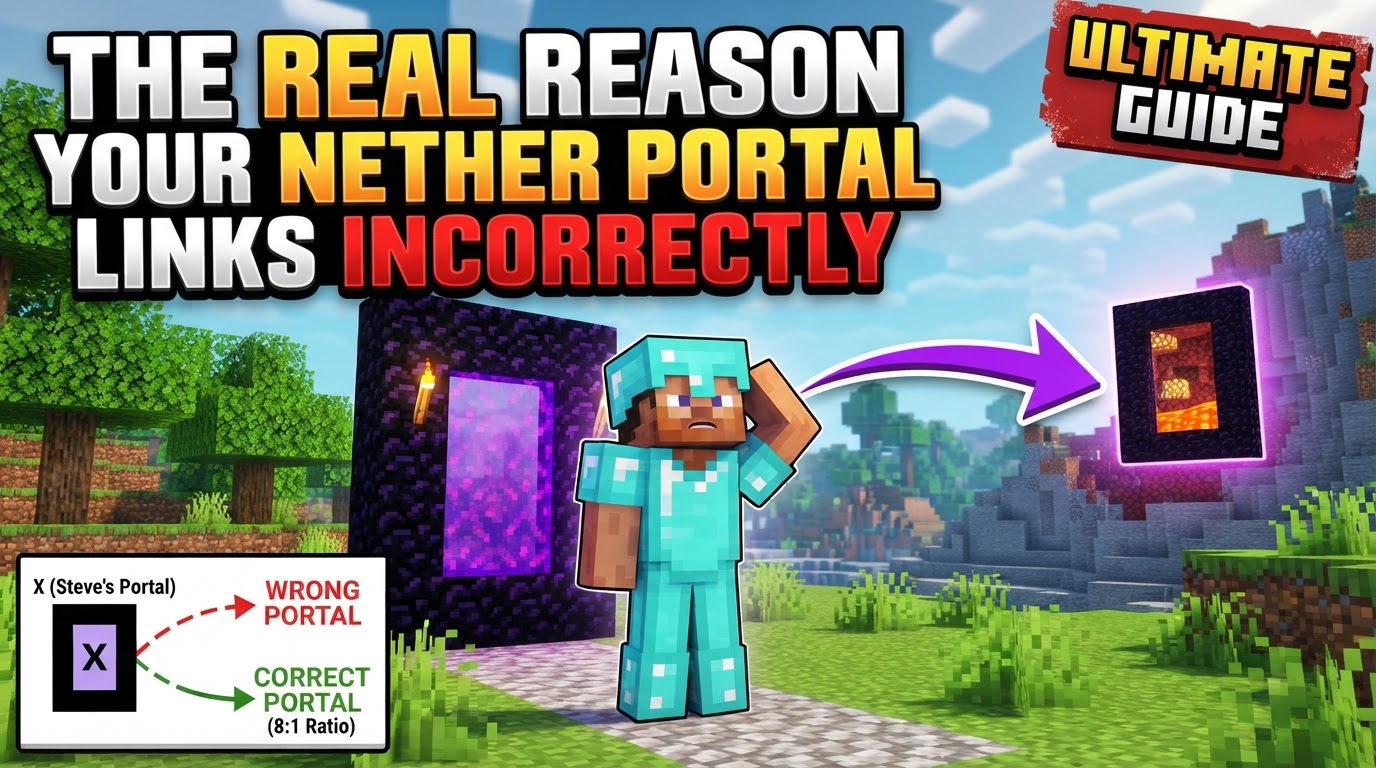
To truly master interdimensional travel in Minecraft, one must first grasp the underlying principles that govern portal behavior. It’s not about luck or random chance; it’s about precise calculation and strategic placement.
The Algorithmic Heart of Portal Linking
At the core of every Nether portal interaction lies a set of algorithms that determine your destination. The game doesn’t store a direct link between two specific portals. Instead, when you enter a portal, it performs a series of calculations to find or create its counterpart in the other dimension.
- The 8:1 Coordinate Conversion Rule: This is arguably the most crucial piece of information. One block in the Nether is equivalent to eight blocks in the Overworld for the X and Z coordinates. This means if you want to travel 800 blocks in the Overworld, you only need to travel 100 blocks in the Nether. The Y-coordinate (height) does not follow this 8:1 ratio; it remains the same for calculation purposes, though its specific value can significantly influence which portal is deemed “closest.”
- The “Closest Portal” Directive: Once you step through a portal, the game first calculates an “ideal” destination coordinate in the other dimension. This is done by either dividing your Overworld X and Z coordinates by eight (when going to the Nether) or multiplying your Nether X and Z coordinates by eight (when returning to the Overworld). With these ideal coordinates, the game then searches for an existing portal within a specific radius around that point. If multiple portals are found, it links you to the one that is closest in 3D distance to the ideal spot.
- Varying Search Radii: The search radius isn’t uniform. When you travel from the Overworld to the Nether, the game looks for an existing portal within a relatively small 3×3 chunk area (approximately 48×48 blocks) around the calculated ideal Nether coordinates. However, when traveling from the Nether back to the Overworld, the search is much broader, spanning a 17×17 chunk area (up to 8 chunks away from the ideal coordinates, or about 272×272 blocks). This larger search area in the Overworld is a common culprit for mislinks, as it can easily connect to an unintended Overworld portal if not managed carefully.
- Automatic Portal Generation: If, after calculating the ideal destination and searching within the specified radius, no existing portal is found, the game will automatically generate a new portal. This auto-generated portal will appear at the most suitable location near the ideal coordinates. While convenient in a pinch, these portals can spawn in highly inconvenient or dangerous places, such as suspended over lava lakes, inside solid rock, or in the middle of a Ghast-infested cavern. This is rarely the desired outcome for precise travel.
The Path to Perfect Portal Pairing
Achieving reliable, two-way portal links is a systematic process that bypasses the game’s sometimes unpredictable auto-generation. Follow these steps for flawless interdimensional travel:
- Establish Your Overworld Anchor: Begin by constructing your primary portal in the Overworld. Before you activate it, record its exact X and Z coordinates. Pressing F3 in Java Edition will display this information. For example, if your portal is at X=1600, Z=800.
- Perform the Nether Coordinate Calculation: Take your recorded Overworld X and Z coordinates and divide each by eight. This gives you the target X and Z coordinates for your corresponding Nether portal. Using our example: 1600 / 8 = 200 (X), and 800 / 8 = 100 (Z). Your target Nether coordinates are X=200, Z=100.
- Initial Journey to the Nether: Step through your newly built Overworld portal. The game, following its rules, will likely generate a new portal for you in the Nether. This portal might not be at your calculated ideal spot.
- Dismantle the Auto-Generated Portal: Crucially, destroy the Nether portal that the game automatically created. You do not want to use this for your permanent link.
- Construct Your Manual Nether Portal: Travel to your precisely calculated Nether X and Z coordinates (X=200, Z=100 in our example). Build a new portal frame at this exact location. While the Y-coordinate isn’t converted, try to build it at a height (Y-level) that is practical and safe, or one that is as close as possible to your Overworld portal’s Y-level to maximize its “closest” status for the algorithm.
- Verify the Link: Once your manually placed Nether portal is complete, step through it. If all steps were followed correctly, you should arrive back at your original Overworld portal, completing a perfectly synced, two-way connection.
Mastering Your Portals: Essential Tips for Reliability
Beyond the basic setup, several strategies can enhance your portal network’s reliability and utility:
- Manual Construction is Paramount: Never rely on the game’s auto-generated portals for precise, two-way linking. Always calculate and manually build your Nether-side portal.
- Maintain Sufficient Distance: To prevent multiple Overworld portals from inadvertently linking to a single Nether portal, ensure they are spaced at least 128 blocks apart in the Overworld. This equates to 16 blocks in the Nether, giving each Overworld portal its own unique 16×16 block area in the Nether.
- The Y-Coordinate’s Subtle Influence: While X and Z are paramount, the Y-coordinate still matters for the “closest portal” calculation. If possible, try to align the Y-levels of your linked portals. If not, ensure your chosen Y-level in the Nether is the most logical and closest option to avoid misdirection.
- Leverage Online Calculators: For complex setups, negative coordinates, or simply to double-check your math, online Nether portal calculators are invaluable tools. They eliminate human error in coordinate conversion.
- Fortify Your Gateways: Always build a blast-resistant enclosure around your Nether portals, especially in the Nether. This protects them from Ghast fireballs and prevents hostile mobs from spawning directly inside or near your portal. Light the area thoroughly.
- Embrace Nether Hubs: For extensive travel across your Overworld, consider building a central “Nether hub.” From this hub, construct tunnels leading to your various linked portals. This allows for incredibly fast travel between distant Overworld locations.
Pitfalls and How to Avoid Them
Even with the right knowledge, certain common mistakes can still lead to portal linking woes:
- Ignoring the 8:1 Ratio: This is the most frequent blunder. Players often try to build their Nether portal at the exact same X and Z coordinates as their Overworld portal, or at arbitrary locations, completely disregarding the fundamental 8:1 conversion. This will almost always result in an incorrect or unexpected link.
- Trusting Auto-Generated Portals: As discussed, letting the game create your Nether portal is a recipe for chaos. It will place the portal at the first suitable location it finds, which may be far from your ideal coordinates or in a dangerous spot. Always destroy these and build your own.
- Placing Portals Too Close Together: If you build multiple Overworld portals less than 128 blocks apart, they can all fall within the search radius of a single Nether portal. This leads to frustrating one-way trips where multiple Overworld portals lead to the same Nether portal, but only one Nether portal leads back to a specific Overworld portal.
- Overlooking Significant Y-Level Differences: While not a direct conversion, a massive height disparity between your Overworld and Nether portals can confuse the “closest portal” algorithm. If there’s another portal (even an unintended one) closer to the calculated Y-level, the game might link you there instead.
- Inconsistent Entry Points: The exact block a player stands on when entering a 2-block wide portal can slightly influence the calculated destination coordinates. While usually minor, precision matters for perfectly aligned portals. Try to enter from the same relative position.
By understanding these mechanics, meticulously calculating your coordinates, and manually constructing your portals, you can transform your Nether travel from a chaotic gamble into a reliable, efficient system, connecting your Minecraft world with unparalleled precision.
Tags:
YOU MAY ALSO LIKE...


