

The Science of Block Update Propagation Order
One of the most persistent misconceptions in Minecraft is the belief that all actions within the game world occur simultaneously. In reality, nothing could be further from the truth. The game engine, constrained by computing limitations, meticulously processes changes through a complex system known as block update propagation. Understanding this system is not merely an academic exercise; it is the bedrock upon which reliable redstone contraptions are built and optimized.
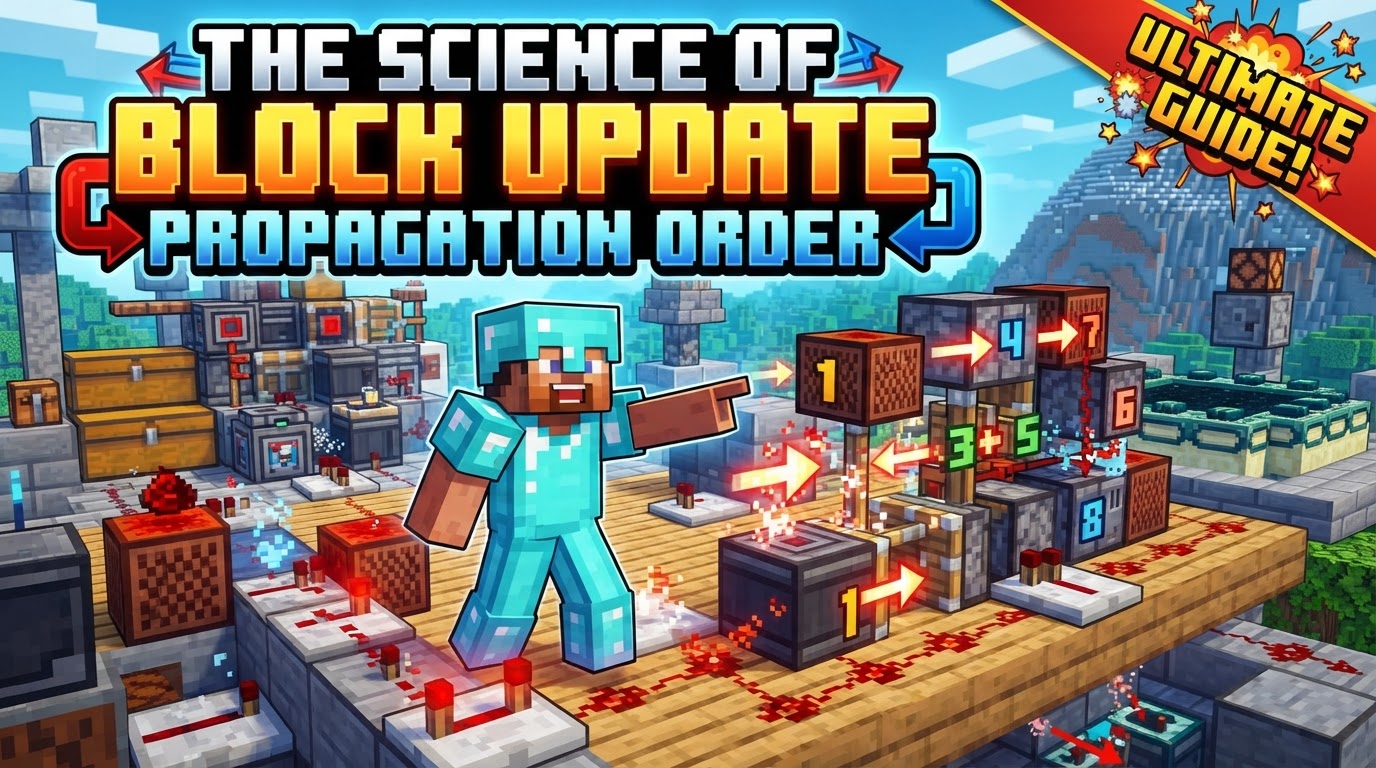
The Fundamental Nature of Block Updates
At its core, a block update is an in-game mechanism triggered whenever a block in the world undergoes a modification. This can be as simple as placing a new block, destroying an existing one, replacing a block with another, or even just altering its internal “blockstate” (e.g., a lever flipping, water flowing). The necessity for this system arises from the sheer impossibility of processing every single block in a loaded chunk at every game tick. Instead, Minecraft employs a reactive system where blocks notify their neighbors of changes, prompting them to re-evaluate their own states.
In Java Edition, block updates are typically categorized into three primary types, each with its own priority and behavior:
- Post Placement (PP) Updates: These occur immediately after a block is placed, often to ensure it interacts correctly with its new surroundings.
- Neighbor Changed (NC) Updates: The most common type, sent by a block to its immediate neighbors when its state changes. Most blocks send these general updates.
- Comparator Updates: Specialized updates sent by comparators, often with unique timing and propagation rules relevant to their specific redstone logic.
Beyond these general categories, certain redstone components send more specialized updates, reflecting their unique functionalities. For instance, redstone dust is considered “block update instant,” meaning it processes whenever it receives an update without a pre-defined order within a single game tick, a critical distinction for timing circuits.
Deconstructing the Propagation Sequence
The sequence of a block update, from initiation to its potential ripple effect, follows a structured process:
- Initial Block Change: The journey begins when a block’s state changes. This could be anything from a player placing a cobblestone block to a piston extending.
- Update Initiation: The changed block doesn’t just sit there; it actively sends update notifications to all its immediate neighbors. This is the signal that something in their vicinity has altered.
- Directional Propagation: This is where the intricacies truly begin. For many general Neighbor Changed (NC) updates, the order in which these notifications reach adjacent blocks is consistent: west, east, down, up, north, then south. However, for Post Placement (PP) updates, the order differs: west, east, north, south, down, then up. Other patterns, such as -x, +x, -y, +y, -z, +z (representing coordinate directions), are also observed depending on the specific block and context. This directional bias is paramount for redstone engineers.
- Neighboring Block Reaction: Upon receiving an update notification, a neighboring block evaluates its own state in light of the change. If necessary, it will react by changing its own blockstate (e.g., a redstone torch turning off) or by sending further updates to its own neighbors.
- Recursive Chain: This evaluation and reaction process doesn’t stop with the immediate neighbors. It can create a cascading “rolling wave” of updates that propagates through the world, continuing until no further changes are needed within the loaded chunks. This chain reaction is what allows complex redstone contraptions to function across distances.
Mastering Update Order for Advanced Redstone
For redstone enthusiasts, understanding the specific update order of various components is not optional; it is absolutely vital for constructing reliable and precise contraptions. Subtle differences in update timing can determine whether a circuit functions perfectly or fails spectacularly.
- Component Priorities: Repeaters generally update before comparators and redstone torches if powered within the same game tick. This distinction is incredibly useful for fine-tuning timing and ensuring components activate in the desired sequence.
- Piston Mechanics: When pistons move structures, especially those involving slime blocks, the affected blocks are updated in a defined order. Blocks in columns closest to the piston are typically updated first, which can have implications for complex moving contraptions.
- Leveraging “Instant” Updates: To trigger rapid circuit activation, skilled builders often leverage mechanics that cause “instant” block updates, bypassing the more typical propagation delays.
- `FallingSand` vs. `/setblock`: When a block requires an update to properly interact with nearby redstone or command blocks, using a `FallingSand` entity to place it can be more effective than the `/setblock` command. `FallingSand` ensures the necessary redstone metadata updates are triggered, leading to correct behavior, whereas `/setblock` might merely place the block without initiating the full update sequence.
Debugging and Optimizing Update Behavior
Even with a solid understanding, issues can arise. Knowing how to debug and optimize block update sequences is a crucial skill:
- Manual Triggers: To manually trigger a block update for a specific block, simply place and then immediately break a block adjacent to it. Water can be an excellent tool for this, as it leaves no dropped items to collect.
- Advanced Debugging Tools: For advanced debugging in Java Edition, mods like QueueLogMod can visualize block updates in real-time. This allows players to identify performance bottlenecks, unexpected update paths, or subtle bugs that might otherwise be impossible to diagnose.
- Performance Optimization: To optimize game performance, especially in large-scale redstone builds or complex farms, it’s wise to stagger resource-intensive updates. Additionally, avoid simulating actions or triggering updates in chunks that are not currently visible to the player, as this can lead to unnecessary processing load.
Common Pitfalls and Misconceptions
Despite its fundamental importance, block update propagation is rife with potential misunderstandings:
- The Simultaneous Update Myth: The most common mistake is assuming all block updates occur at the same exact moment. As established, there is a distinct order of propagation and a priority system.
- Ignoring Directional Order: Failing to account for the directional update order (e.g., west-east-down-up-north-south) is a frequent cause of unpredictable or non-functional redstone circuits.
- Bedrock BUDs: Attempting to use Block Update Detectors (BUDs) with pistons in Bedrock Edition will lead to disappointment, as this specific functionality has been largely removed from that version of the game.
- `/setblock` for Redstone: Using the `/setblock` command for redstone-sensitive blocks can be problematic, as it may not trigger the necessary updates for redstone components to react correctly, leading to unresponsive circuits.
- Redstone Dust Misinterpretation: Many misunderstand redstone dust’s update behavior. While it processes whenever it receives an update, it’s “block update instant” rather than following a fixed sequential order within a single game tick like some other components.
- Visual Glitches: Encountering visual anomalies like “ghost lighting” or “chunk glitches” often relates to incorrect chunk loading or update issues. These can sometimes be resolved by placing a block in the affected area and reloading the world, forcing a re-evaluation of block states.
- Beyond Immediate Neighbors: It’s incorrect to assume that block updates only affect immediate neighbors. Certain blocks, notably redstone dust, can trigger updates in blocks two spaces away, adding another layer of complexity to circuit design.
The science of block update propagation is a cornerstone of Minecraft’s technical gameplay. By understanding its rules, priorities, and directional biases, players can transcend basic builds and engineer truly robust, efficient, and ingenious contraptions that harness the very fabric of the game world.
Tags:
YOU MAY ALSO LIKE...


