

Top 10 Reasons to Build a Nether Hub Before Anything Else
Did you know that traversing just one block in the Nether can transport you across eight blocks in your Overworld map? This incredible 8:1 ratio is the single most compelling reason why establishing a Nether Hub should be at the very top of your early-game priorities in Minecraft. Far from being an endgame luxury, a well-planned Nether Hub acts as the circulatory system of your entire world, unlocking unparalleled efficiency and opening up new possibilities from the moment you step foot in the fiery dimension.
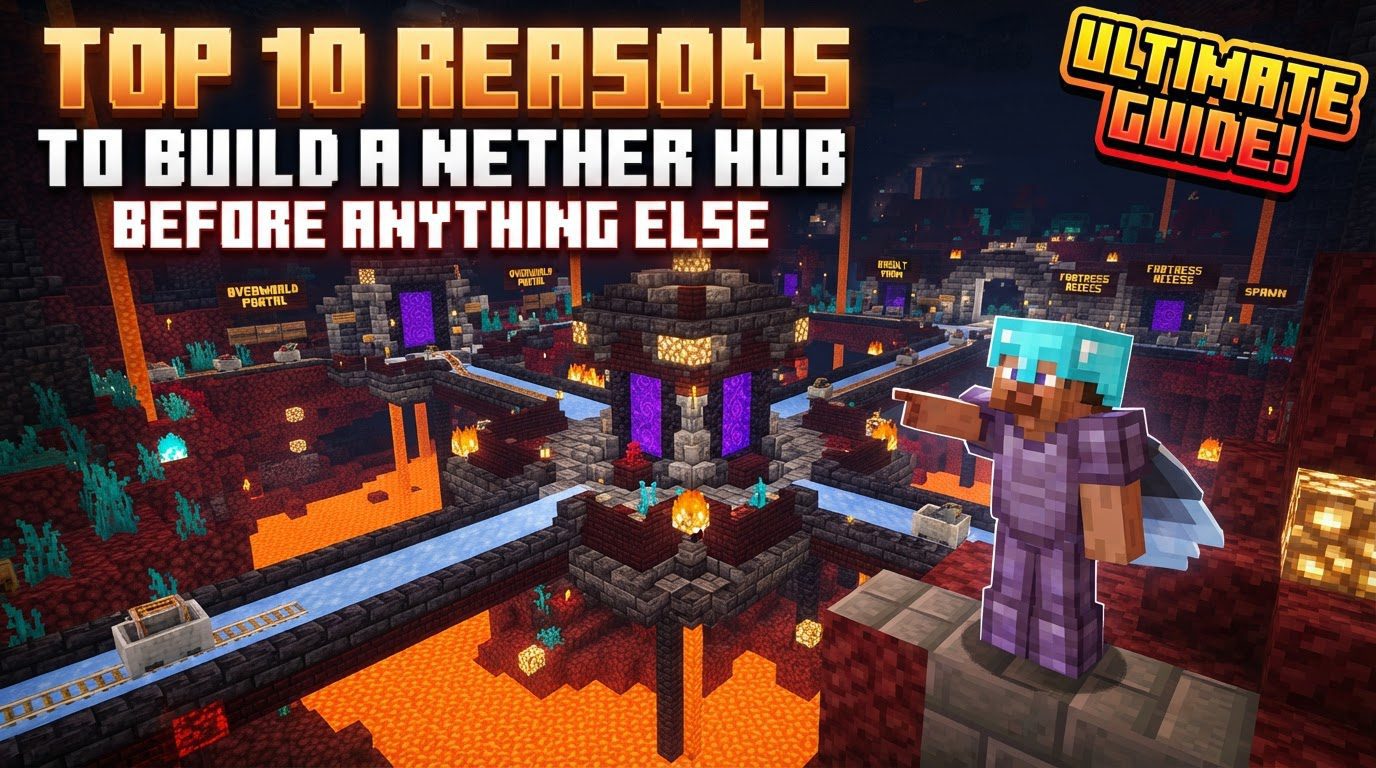
Many players delay building a proper Nether transport system, often focusing on surface exploration or basic resource gathering. However, by understanding the profound advantages a Nether Hub offers right from the start, you can dramatically accelerate your progress, enhance your gameplay experience, and lay a robust foundation for all future endeavors. Here are the top 10 reasons why your first major project should undoubtedly be a Nether Hub.
1. Unlocking Hyper-Speed Overworld Travel
The most iconic benefit of the Nether Hub is its ability to provide ultra-fast travel across the Overworld. Thanks to the unique spatial relationship where one block in the Nether corresponds to eight blocks in the Overworld (for X and Z coordinates), a short journey through the fiery dimension can cover immense distances on the surface. By establishing a central hub and extending tunnels in the Nether, you can reach far-flung Overworld locations in a fraction of the time it would take to travel conventionally. This dramatically reduces travel time over long distances, making exploration, resource gathering, and returning to base incredibly efficient. While it requires an initial investment in obsidian and careful coordinate calculation to align portals precisely, the time saved in the long run is immeasurable.
2. Seamlessly Connecting Your World’s Hotspots
Beyond just fast travel, a Nether Hub transforms into a central interchange for all your important Overworld destinations. Imagine effortlessly linking your primary base, a remote mining outpost, a crucial village, a stronghold you’ve discovered, or even the homes of fellow players on a server. This creates an interconnected travel network where every significant point is just a short Nether tunnel away. This streamlining of logistics between multiple bases or resource outposts is invaluable. However, careful planning and precise portal alignment are absolutely critical to ensure new portals spawn correctly at your intended Overworld destinations, preventing the creation of unwanted or misaligned portals.
3. Accelerating Overworld Exploration and Discovery
With the ability to cover vast distances quickly, a Nether Hub significantly enhances your exploration efforts. You can accelerate the process of discovering new biomes, locating rare structures like Mansions or Woodland Fortresses, and scouting out ideal locations for future builds. This speeds up the discovery of new chunks and valuable resources, drastically reducing the grind associated with overland travel. Instead of spending hours trekking across the surface, you can use your Nether tunnels to rapidly jump to new areas, then pop out to explore a concentrated region. The only caveat is ensuring safe passage through the Nether itself to reach the new portal exit locations.
4. Centralizing Crucial Nether Resources and Farms
A well-constructed Nether Hub doesn’t just serve the Overworld; it also provides a safe and organized base within the Nether itself. This facilitates easy and consistent access to valuable Nether-specific resources such as Nether Quartz, Ancient Debris (essential for Netherite), Basalt, and Wither Skulls. Furthermore, the hub can serve as a secure location for building and operating various Nether-based farms, including gold farms (for immense quantities of gold ingots, nuggets, and experience), Wither Skeleton farms, or even simple hoglin farms for food. This makes mining and farming in the inherently dangerous Nether more manageable and secure, allowing for efficient resource acquisition without constant exposure to threats.
5. Establishing a Secure and Controlled Travel Network
The Nether is a hostile environment, teeming with Ghasts, Blazes, Hoglins, and Piglins. Rather than exposing yourself to these dangers on open paths, a Nether Hub allows you to construct enclosed, well-lit, and protected tunnels. These tunnels can be made blast-proof using materials like cobblestone or obsidian, and mob-proof with sufficient lighting and walls, offering a secure path to different portal exits. This minimizes exposure to the Nether’s formidable threats, making travel less stressful and significantly safer. While the construction of extensive, blast-proof tunnels can be resource-intensive and time-consuming, the peace of mind and reduced risk are well worth the effort.
6. Empowering Multiplayer World Coordination
For players on multiplayer servers, a Nether Hub is an invaluable asset. It provides a shared, fast-travel network that allows all players to easily reach each other’s bases, communal farms, or shared exploration sites. This fosters a sense of community, promotes cooperation, and makes meeting up with friends or visiting their builds much simpler and quicker. A centralized hub can be a meeting point, a trading post, or simply a way to stay connected across vast distances. Its effectiveness, however, does rely on agreement and coordination among players for portal placement and tunnel design to maintain efficiency and avoid conflicts.
7. Founding an Early-Game Permanent Base in the Nether
While primarily a travel system, the Nether can surprisingly serve as a viable location for an early-game permanent base, especially for players who enjoy unique building challenges. The Nether lacks a day-night cycle, meaning there are no nighttime Overworld mob spawns like zombies or skeletons, and creepers do not exist there. This offers a different set of challenges and advantages. You won’t need to sleep to skip the night, you’re immune to creeper explosions, and lighting conditions are consistent. However, the absence of water mechanics, the constant presence of hostile Nether mobs, and the need for careful setup to ensure safety and resource access mean it’s not without its difficulties.
8. Ensuring Future-Proof Expansion and Scalability
A well-designed Nether Hub, particularly those built in a radial or circular fashion, is incredibly easy to expand. As your Overworld exploration continues and you discover new locations you wish to connect – be it a new biome, a potential mega-build site, or a friend’s new base – new pathways can be seamlessly added to the central hub without the need to rebuild the entire system. This future-proofs your travel network, allowing it to grow organically and efficiently with your world. Conversely, a poorly planned initial design can lead to difficult, messy, or inefficient expansions down the line, highlighting the importance of forethought.
9. Embracing Unique Aesthetic and Creative Building Opportunities
Beyond its immense utility, the Nether provides a distinct and often overlooked canvas for creative building. A Nether Hub can be far more than just a functional pathway; it can be an impressive architectural project in its own right. Incorporating Netherrack, Basalt, Blackstone, Quartz blocks, and other Nether-specific materials allows for unique and visually striking builds that differ significantly from Overworld structures. The eerie glow of lava, the deep reds and blacks of the terrain, and the unique block palettes offer a chance to express your creativity in a truly distinctive environment. This requires gathering specific Nether blocks, which can add to the challenge but also to the reward.
10. Gaining Access to the Nether Roof for Advanced Builds
For more experienced players, the Nether Hub can be the gateway to one of Minecraft’s most powerful building spaces: the Nether roof. Building above the bedrock ceiling provides a vast, flat, and completely mob-free zone, ideal for large-scale, efficient farms (like massive gold farms or even mob switch setups) or extensive transportation networks like ice boat highways. A Nether Hub can include a dedicated portal or access point to the Nether roof, providing this safe, open space without interference from native Nether mobs. Accessing the Nether roof typically requires specific techniques to break through the bedrock layer, which, while sometimes considered an exploit, is a widely adopted strategy in many communities and servers for advanced automation.
Installation/Background: To begin building a Nether Hub, you’ll first need a working Nether Portal. Once in the Nether, locate a relatively flat and safe area for your central hub. The key is to build your main portal at coordinates that, when divided by eight, correspond to a logical central point in your Overworld (e.g., if your Overworld base is at X=1000, Z=1000, your Nether portal should be near X=125, Z=125). From this central Nether point, you’ll then extend tunnels in cardinal directions, placing secondary portals at calculated distances to link up with your desired Overworld locations. Always remember to multiply your target Overworld X and Z coordinates by 1/8 to find their corresponding Nether coordinates for precise portal alignment.
Tags:
YOU MAY ALSO LIKE...


