

Ultimate Minecraft Villager Trading Guide: How to Get Mending Easily
Getting Mending in Minecraft can be a game-changer for your gear, but relying on fishing or loot chests is slow and unreliable. Villager trading offers the fastest and most consistent method to obtain Mending books once you understand the mechanics. This guide compiles proven strategies from the Minecraft community, including Reddit’s trading experts, Planet Minecraft tutorials, and YouTube veterans, to help you get Mending easily and efficiently.
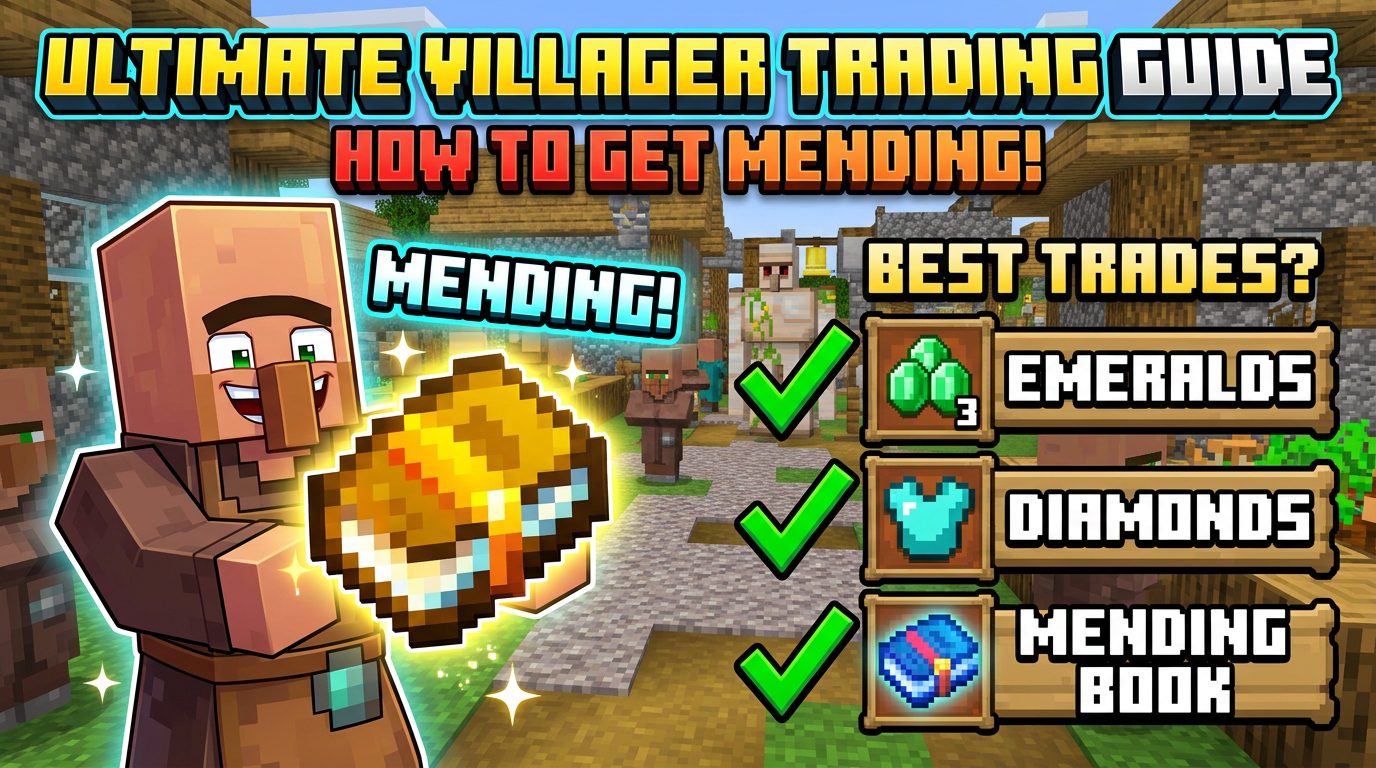
Why Mending Matters
Mending uses experience orbs to repair your tools, weapons, and armor. Instead of spending diamonds or anvil uses, you just keep playing. A Mending pickaxe means never crafting another; Mending elytra lets you fly indefinitely. Getting Mending as early as possible saves resources and frustration. Villagers are your ticket-specifically, librarian villagers who trade enchanted books.
Villager Trading Basics
Every villager has a profession (librarian, farmer, etc.) and a career level (Novice, Apprentice, etc.). Trading lowers their price and unlocks new trades. You can reset a villager’s trades by breaking and replacing their job block, but only if they haven’t been traded with yet. Librarians use a lectern. Their first trade is always a book enchanted with a random level I–II enchantment, and it’s usually available at the Novice level. The goal is to get a Mending book as that first trade.
What is Mending?
Mending is a treasure enchantment, meaning it cannot be obtained from an enchanting table. The only reliable source is from trading with a librarian, fishing (very rare), or from chests in end cities, bastions, etc. Librarian trading is the only method that gives you unlimited, predictable access once you set up a villager hall.
Step 1: Find or Create a Villager
You need at least one librarian candidate. The best source is a natural village. If you cannot find one, cure a zombie villager. Zombie villagers are common at night; trap them with a boat or drop them in a hole. Feed them a golden apple after splashing them with a Weakness potion (use a witch or craft the potion). The curing process takes a few minutes but gives you a normal villager with drastically discounted trades (permanently) if you cure them multiple times.
Alternatively, breed villagers: place two villagers in a room with beds and give them bread, carrots, etc. The baby grows into a random profession unless you set up a job site block. For librarians, just place a lectern.
Step 2: Setting Up a Lectern Trading Station
Place a lectern in a well-lit area with a bed for the villager. Stand close and let the villager claim the lectern (green particles appear). If the villager already has a different profession, break their current job block first. Once they become a librarian, open their trade interface. The first slot shows an enchanted book (usually a low level). If it’s not Mending, break the lectern, wait a few seconds, and place it again. This resets the villager’s trades, giving a new book. Repeat until Mending appears.
Tip: Check All Enchantments
Mending can appear as any level I–II, but it’s always named “Mending” in the tooltip. The price is usually 5–64 emeralds plus a book. A high price can be brought down by zombifying and curing the villager multiple times (each curing reduces prices permanently, minimum 1 emerald). This is a popular strategy on YouTube for a cheap Mending book.
Step 3: Lock the Trade
Once Mending appears, do not break the lectern until you have traded at least once. After you buy the book or trade for the first time, the trades are locked to that villager forever. Now you can break the lectern and replace it so the villager keeps the Mending for future restocks. You can then trade again after the villager restocks (twice per Minecraft day). Lock the trade by making the first purchase.
Optimizing for Cost and Efficiency
The price of a Mending book can be high (up to 64 emeralds + a book). To reduce cost, use the zombie curing method. Here’s the Reddit-approved method:
- Find a zombie villager or convert a normal villager by letting a zombie kill it (on Hard mode, zombies convert 100% of the time).
- Cure the zombie villager with Weakness + golden apple. This gives a discount of –20% to –40% on trades.
- Repeat the curing process up to five times for maximum discounts. Each cure reduces prices by about 20–30% (cumulative to a minimum of 1 emerald).
- After multiple cures, a previously 64-emerald book might cost only 1 emerald plus a book.
This method is extensively covered in Planet Minecraft tutorials and YouTube videos by streamers like Mumbo Jumbo, Ilmango, and Wattles. Ensure you have a safe area to cure multiple zombies without losing your villager.
Building a Trading Hall
Once you have one librarian with Mending, breed more villagers to create multiple librarians. The trading hall should have:
- Individual cells (2×2 or 1×3) with a bed, a job block (lectern), and a trapdoor or door to prevent escape.
- A water stream or rail system to move villagers from breeder to cells.
- Light level >8 to prevent zombie spawns.
- Proximity to your main base for quick trades.
Some Reddit users recommend a stacked design: multiple floors with villagers in rows, each facing a window where you can trade through a slab walkway. This makes restocking fast.
Earning Emeralds Fast
To buy many Mending books, you need emeralds. The fastest ways (from community forums):
- Fletcher and farmer villagers: Stick farms (from fletchers) sell sticks for emeralds; farmers buy pumpkins/melons for emeralds.
- Iron golem farm: Iron ingots sold to armorers/clerics.
- Automatic crop farms: Wheat, carrots, potatoes sold to farmers.
- Raid farms: High yield but requires late-game setup.
Combine these with cured villagers for low prices-you can quickly amass hundreds of emeralds.
Advanced Tips from the Community
Here are extra nuggets gleaned from Reddit threads and YouTube comments:
- Use a “village breeder” to produce unlimited villagers. Design from ImpulseSV works: two villagers with lots of beds and a door timer.
- Break and replace the lectern quickly. If you see a Mending book but accidentally break the lectern, the trade resets. To avoid losing it, trade once even if expensive, then cure later.
- Mending books can also come from master-level librarians (level 5), but that’s inefficient. Novice is best because you can reset instantly.
- If a villager dies, you lose the trade. Protect your hall with fences, carpet, or slabs to prevent zombie attacks.
- Use name tags to prevent despawning if you’re in a multiplayer server with low entity limits.
Troubleshooting Common Issues
Mending not appearing after many resets?
RNG can be cruel. There are 36 possible enchantments for books (with different levels). The odds of Mending on a Novice librarian are roughly 1 in 36, but some enchantments have multiple levels, so the probability is slightly lower. Keep breaking and placing the lectern. On average, you’ll see Mending within 30–40 tries. If you’re unlucky, move to another villager and try.
Villager won’t change profession?
Make sure the villager hasn’t been traded with before. Even one trade locks them. Also ensure the villager can access the lectern pathfinding-wise (no obstacles). Also confirm there’s no other job block nearby.
Mending book price too high?
As mentioned, curing works, but you can also trade other items to raise your reputation (like buying a book from a different librarian to gain Hero of the Village effect during a raid). That temporarily reduces prices.
How to Use Your Mending Book
Once you have the Mending book, combine it with an item using an anvil. Place the item you want to enchant (e.g., diamond pickaxe) in the first slot, the Mending book in the second. This costs experience levels (and possibly an anvil repair cost if the item already has other enchantments). Mending can coexist with other enchantments, but remember it conflicts with Infinity on bows (you cannot have both).
After applying, the item now repairs itself. For maximum benefit, always hold the Mending item while collecting XP (from mining, fighting mobs, smelting, trading, etc.). XP orbs will automatically go to the equipped or held item that has Mending. If you have multiple Mending items, XP repairs the one with the most missing durability (or the one in your main hand). Manage this by taking off fully repaired items.
Alternative: Fishing for Mending
While waiting for a librarian, you can try fishing with a Luck of the Sea III rod. The chance to get a Mending book from fishing is about 0.4% per cast. It’s not efficient but can serve as a backup. The community consensus: villager trading is far faster.
Common Reddit Myths Debunked
- Myth: You need a swamp biome for Mending. False. Librarian trades are biome-independent.
- Myth: Breaking the lectern after locking the trade loses Mending. False. The trade remains until the villager is killed or shifted to a different job block permanently (if you break the lectern and never replace it, they may forget after a long time, but typically they keep it if you replace the lectern within the same day).
- Myth: Curing a villager more than once doesn’t help. False. Each cure adds a discount multiplier, stacking up to 5 times multiplicatively. This can make Mending cost 1 emerald.
Final Step: Automate Your Mending Supply
With a trading hall of multiple Mending librarians, you can stock up on dozens of books. Combine with an automatic pumpkin/melon farm to generate emeralds with zero manual work. Then simply run through your hall and trade once per restock cycle. You’ll have unlimited Mending books for all your gear, including backups for future tools. This is the ultimate late-game convenience.
Mending changes how you play Minecraft. Instead of hoarding diamond gear, you can use it freely, knowing a few minutes of mining XP will repair it. Following this guide-finding or curing a villager, resetting their lectern until Mending appears, locking the trade, and then curing for cheap prices-will give you Mending in under an hour even in a new world. The community has perfected these steps, so trust the process. Now go get that Mending book!
Tags:
YOU MAY ALSO LIKE...


